



Call made to boost charging facilities









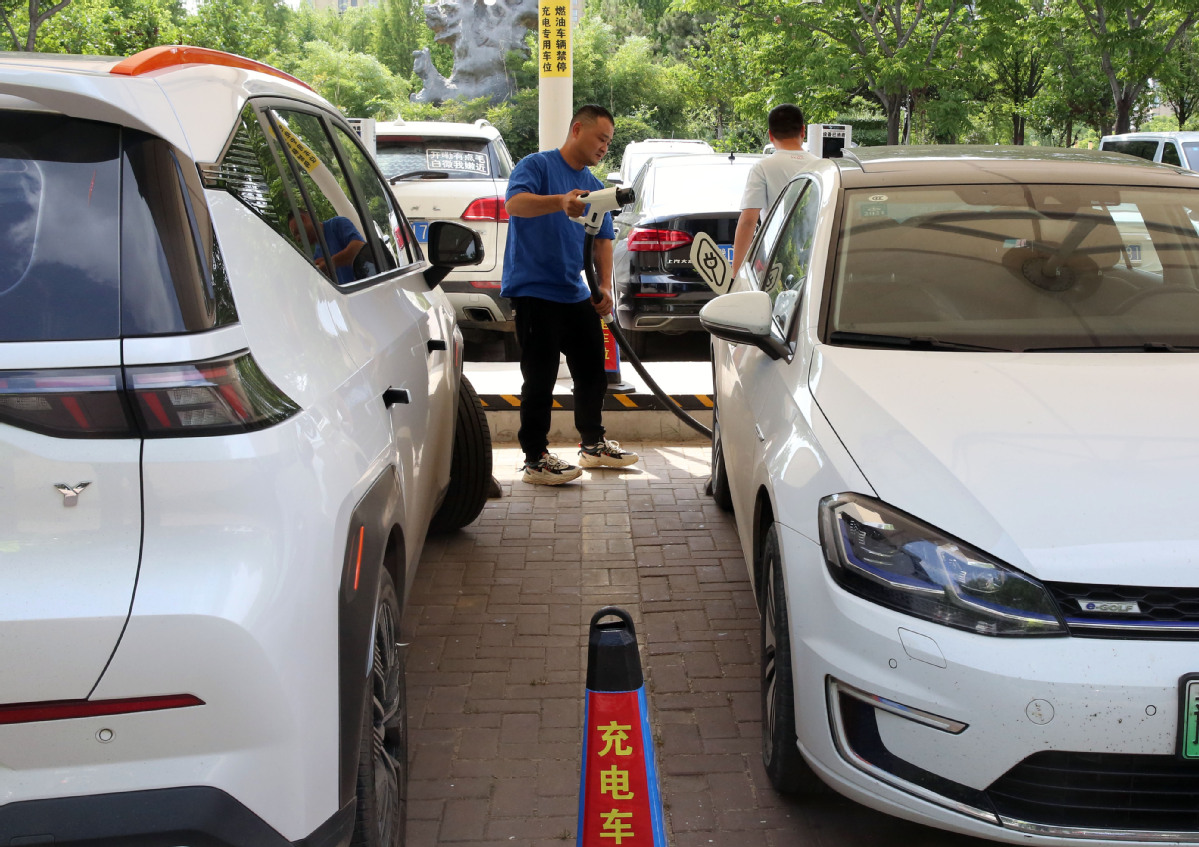
China unveiled a new plan on Thursday to expand basic charging infrastructure along its national roadway network to meet growing demand from surging numbers of new energy vehicles.
The move is likely to further boost NEV consumption and attract more investment in the sector as the country tackles problems of insufficient charging service coverage for long-distance NEV journeys, an expert said.
The action plan, released by the Ministry of Transport, the National Energy Administration, State Grid Corp of China and China Southern Power Grid, vowed to provide basic charging services at highway roadside service centers in areas other than ultra cold and high-altitude regions by the end of this year.
It also noted that basic charging services will be offered at service centers along national and provincial level trunk roads by the end of 2023.
By 2025, a charging infrastructure network along highways will be basically formed with fixed charging facilities and mobile alternatives as supplements. The network is expected to fully cover important transportation nodes and provide good operation and maintenance services to guarantee public demand for high-quality and diversified travel services.
The new action plan was released after China called for further efforts to improve charging infrastructure to further boost the already burgeoning NEV market.
Lin Boqiang, head of the China Institute for Studies in Energy Policy at Xiamen University, said the release of the action plan helps deal with a growing need for charging infrastructure services buoyed by the surging NEV sector, which is now on a fast track as the nation vows to peak carbon emissions by 2030 and reach carbon neutrality by 2060, replacing gasoline-powered cars with NEVs being an effective way to curb emissions.
"Increasing the number and coverage of charging facilities will no doubt offer great convenience for NEV users and help deal with concerns about NEVs traveling long distances, which is likely to further boost NEV consumption nationwide and attract investment in relevant areas," Lin said.
In the first half, more than 2.2 million NEVs were newly registered, 1.11 million more compared with the number of new registrations a year prior.
By the end of June, the total number of NEVs plying Chinese roadways surpassed 10 million, accounting for 3.23 percent of the total number of vehicles, said the Ministry of Public Security.
The Ministry of Transport said the total number of NEVs should surpass 25 million units as of 2025 and reach 80 million by 2030.
"Despite rapid development, the NEV industry still faces challenges that hinder its further growth including insufficient charging services, which cause problems for long-distance travel because electric vehicles can only travel up to 200 kilometers per charge," Lin said.
While China's charging infrastructure sector has also seen surging development, construction lags behind demand, which is creating a market valued at 30.5 billion yuan ($4.5 billion) per year, said China International Capital Corp Ltd.
Domestic charging infrastructure increased by 1.3 million units in the first half, with public charging piles surging 228.4 percent year-on-year, said the China Electric Vehicle Charging Infrastructure Promotion Alliance. As of June, the total number of charging facilities nationwide hit 3.9 million units, a year-on-year increase of 101.2 percent.
The Ministry of Transport said that currently, among the 6,618 highway service centers across the country, 3,102 are equipped with a total of 13,374 charging piles, which basically meets current charging needs of NEVs.
"However, compared with the rapid development of NEVs, the development of highway charging infrastructure still faces problems like insufficient coverage. In addition, construction of ordinary national and provincial level trunk roads and rural roads has not begun in an all-around way and cannot effectively meet the needs of long-distance NEV journeys," the ministry added.











