



Relic recovery verdict sets legal precedent









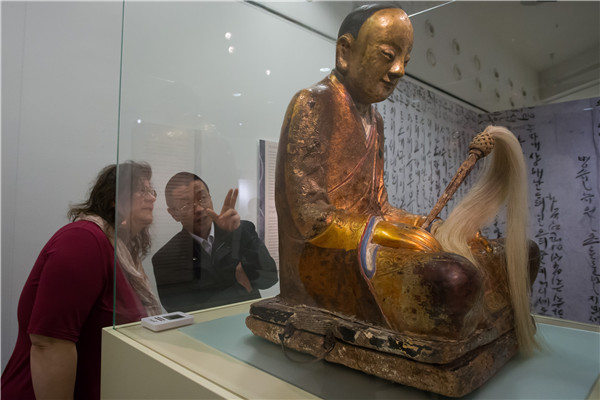
Editor's note: On Tuesday, Dutch architect Oscar van Overeem, who claims to have bought the Zhang Gong Patriarch — an ancient Buddha statue containing the mummified remains of a famous monk — was ordered by the Fujian Provincial High People's Court to return the stolen relic to its original owners. Will Van Overeem obey the court's order and return the statue from the Song Dynasty (960-1279) to the villagers of Yangchun and Dongpu in Fujian? Two experts share their views on the issue with China Daily's Yao Yuxin. Excerpts follow:
Move more than symbolic despite difficulties
Being the first verdict by a Chinese court on the recovery of stolen historical artifacts from another country, the judgment sets a legal precedent. But it is uncertain whether it will be recognized and enforced in the Netherlands.
Normally, a judgment passed by any court in a country is applicable only within the territory of that country, unless there is an international treaty or reciprocity provision between two countries to recognize and enforce each other's court verdicts.
Therefore there are two factors that hinder the verdicts. First, there is no such treaty between China and the Netherlands. Second, the Netherlands' laws don't admit village committees as legal entities, so village committees are ineligible to file a claim. That's why a Dutch court dismissed the suit in 2018.
However, even if a Dutch court rejects its validity, the Fujian court's ruling will remain legally significant. To begin with, since the Chinese court has ruled that the Buddha statue belongs to Yangchun and Dongpu villagers, it will be difficult for Van Overeem to sell it because collectors, aware of the dispute, may not buy it, prompting the Dutch collector to consider returning it to its owners.
The recovery of a historical artifact from another country is difficult in practice, partly because of the weak enforcement mechanism for international treaties among states and the limited number of signatory countries. The inconsistency in the laws of different countries, too, is a big obstacle. For instance, China and the Netherlands disagrees on whether the village committee has legal status. That means it is hard to recover relics using just legal means.
The law of the forum, known in Latin as the lex fori, applies to international civil litigation — or litigation for or against foreign parties, including individuals and businesses — and can help a court in one country to determine the legal entity of a party in another country. In fact, courts in some countries, such as the United Kingdom, do take the laws of the plaintiffs' countries into consideration when dealing with relic recovery cases.
Hopefully, more such legal precedents will be set so the existing obstacles to recovering cultural relics are removed.
Huo Zhengxin, a professor at the School of International Law, China University of Political Science and Law





