



Trump tariffs taxing American consumers









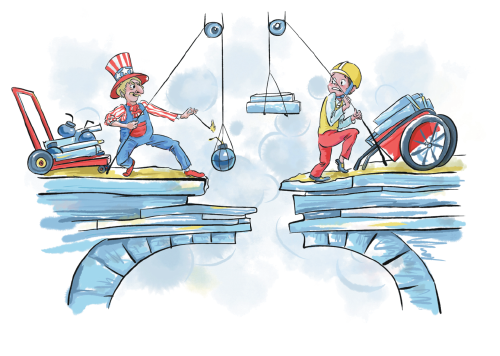
Editor's note: As the world's two largest economies, China and the United States have common economic and security interests. And faced with uncertainties and challenges, the two countries, keeping aside their differences for the common good, should work together to overcome them. Three experts share their views on the issue with China Daily.
Reading recent news about US President Joe Biden's reaction to reporters' questions on whether he will lift the excess tariffs his predecessor imposed on Chinese goods reminded me of the moniker Donald Trump coined for him: "Sleepy Joe".
Typical of his working style, Biden has been procrastinating over taking important decisions. A few days ago he, once again, told reporters that he is yet to make up his mind on which tariffs to lift. He is still holding meetings with relevant officials, "one at a time", on the issue, he said.
Asked again recently, Biden said the administration would be "having further discussions on that".
According to media reports, at least half a dozen meetings have been held in recent weeks on the issue, including one-on-ones with US Secretary of Commerce Gina Raimondo and Secretary of Treasury Janet Yellen who are proponents of tariff relief. Presumably, Biden has also consulted US Trade Representative Katherine Tai who, too, many say, wants the tariffs eased.
Biden will continue to have such meetings. But a delay of each day in taking a decision will cost every American household on average $1.5 to $3, because estimates of the impacts of Trump's tariffs range from $500 to $1,000 a year on a family. In trade economics, there is a term called "tax incidence", which describes how any increase in tax, which is tariff in this case, is going to be split between the demand and supply sides.
If the product in question is demand-inelastic, most of the tax burden would be borne by the demand side. For example, governments love to impose taxes on cigarettes and liquors to raise revenue, because they know the regular consumers are addicted to them so an additional tax won't lead to reduced consumption.
That does not mean Chinese products at Wal-Mart and Amazon are just cigarettes and liquors; they comprise a host of products. Studies after studies have shown that American demand for imports from China is quite robust, with trade data from the last two years since the tariffs were imposed illustrating this empirical phenomenon-last year China-US trade surged to more than $750 billion, a 28.7 percent year-on-year increase.
As a seasoned economist, Janet Yellen understands all too well that the tariffs are hurting American consumers more. In fact, she recently told lawmakers that some of the Trump-era tariffs were strategically questionable and were "paid by Americans, not by the Chinese".
National Security Advisor Jake Sullivan and Katherine Tai reportedly belong to the "against tariff removal" camp. While Sullivan's knowledge about trade economics may be suspect, Tai's argument is based on her belief that the tariffs could still help rectify China's so-called "non-market economic practices".
This argument probably worked two years ago, but today it has become stale, because Beijing doesn't care much about the tariffs anymore as their real impact over the last two years has been minimal, if any, and it is already addressing some of the trade-related issues, such as, intellectual property rights and market entry.
China has already passed a new IPR law, and Tesla has established a wholly-owned automobile company in Shanghai. Don't they say something?
That inflation in the US reached 8.6 percent in the last quarter-it jumped to 9.1 percent in June-suggests Biden is following in the footsteps of former president Jimmy Carter. It's time the Biden administration realized that tariff removal can help arrest the rising tide of inflation, which is fast snowballing into a major political headache for the Democrats ahead of the midterm elections. Some reports say tariff removal could reduce inflation by as much as 1 percent.
The world is inching toward a post-COVID-19 era, but the global economy seems to be heading into recession. It is high time China and the US resume the cooperative spirit they showed during the 2008 global financial crisis. Removing Trump's tariffs on Chinese goods would be the first step in that direction by the US.

The article reflects the author's views and not necessarily those of China Daily.
If you have a specific expertise, or would like to share your thought about our stories, then send us your writings at opinion@chinadaily.com.cn, and comment@chinadaily.com.cn.





