



Costume dramas a result of cultural innovation









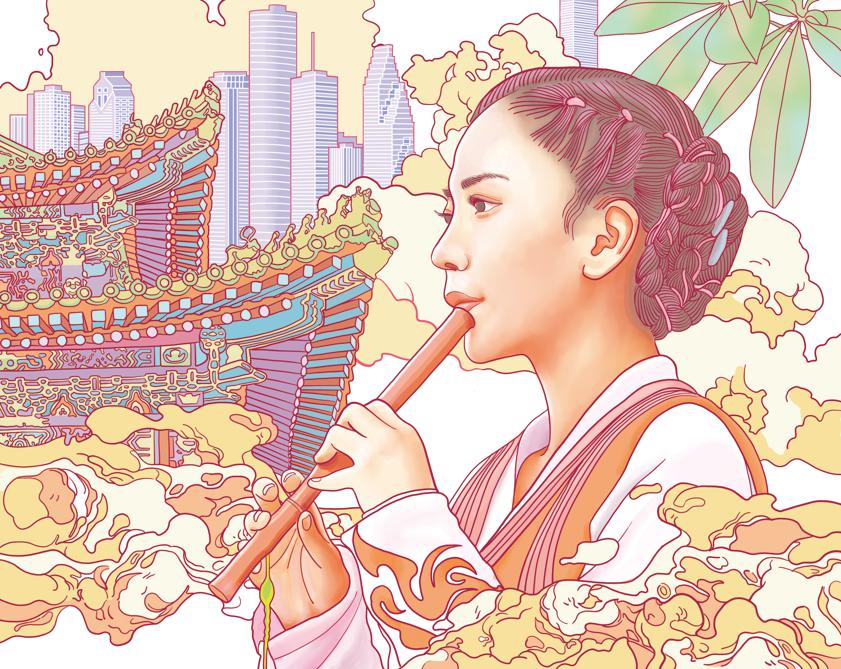
Costume dramas have become an important part of prime time in recent years and evolved into a prominent pop culture phenomenon, thanks to the rapid development of the digital cultural industry in China.
China's booming online cultural industry has given rise to tens of thousands of "web novelists" and tens of millions of readers. As a result, dramas based on top-notch novelists' works, mostly on wuxia (martial arts heroes), xianxia (immortal heroes) and xuanhuan (fantasy featuring adventures and wars), and starring A-list actors can attract huge investments and become overwhelmingly popular.
Plus, the large number of TV channels and online video apps provide a powerful platform for these dramas.
A costume drama can be a standout due to its stunning costume and prop design. But despite there being no need to recount history, the makers of such period or costume dramas should pay special attention to detail and accuracy, so the audience can be attracted by the charms of replicated architecture, furniture, dishes and gardens.
As for feedbacks, TV drama producers can get them through various platforms which can help them make improvements and deletions, if necessary, and/or make better dramas in the future.
Compared with historical dramas, costume dramas are usually visually pleasing since they focus more on romance and relationships in beautiful surroundings.
In a sense, costume dramas center on women characters. For example, hit dramas with strong women characters such as The Legend of Zhen Huan and The Legend of Mi Yue attracted an overwhelmingly high percentage of women viewers because they reflected women's struggle and growth in ancient China.
While most costume dramas are centered on or revolve around women, other TV series promote the charms of traditional Chinese culture by taking creative liberty with historic events. Such shows strive to recreate the past by ensuring the script, the clothing of the characters, foods and settings are true to the period depicted.
An apt example of this is one of the top trending TV shows, A Dream of Splendor. Its exquisite scenes showing life during the Song Dynasty (960-1279) have attracted audiences and received many reviews. The TV series opened a new chapter for costume dramas, thanks to its historical accuracy and aesthetic details.
Chinese costume dramas are more likely to convey the traditional Chinese philosophical concept of "heaven and man are one entity" through ancient art forms and lifestyle. Although ancient and modern China are totally different, ancient civilizational and philosophical aspects still impact today's society. Hence, the aesthetics and philosophy highlighted in Chinese costume dramas, which are different from Western TV series, can highlight China's unique beauty and national identity.
Chinese costume dramas are loved by not only domestic audiences but also overseas viewers, with many of them playing an important role in promoting Chinese cultural export. For example, Google's data show that The Story of Yanxi Palace-viewed more than 18 billion times at home-was the most followed and searched TV show in 2018. In fact, the drama has been exported to more than 90 countries.
The popularity of Chinese costume dramas in other countries reflects their high-quality production and the charms of traditional Chinese lifestyle. These costume dramas not only convey traditional aesthetic and spiritual values, but also reflect Chinese people's confidence in their traditional culture.
The proliferation of costume dramas sends a strong message that traditional culture is the foundation of China's creativity-and the dramas are the result of cultural transformation and innovation.
The author is a researcher at the China National Center for Cultural Studies, Chinese Academy of Social Sciences.
The views don't necessarily represent those of China Daily.
If you have a specific expertise, or would like to share your thought about our stories, then send us your writings at opinion@chinadaily.com.cn, and comment@chinadaily.com.cn.





