Policies launch NEV sector into nation's high sales fast lane









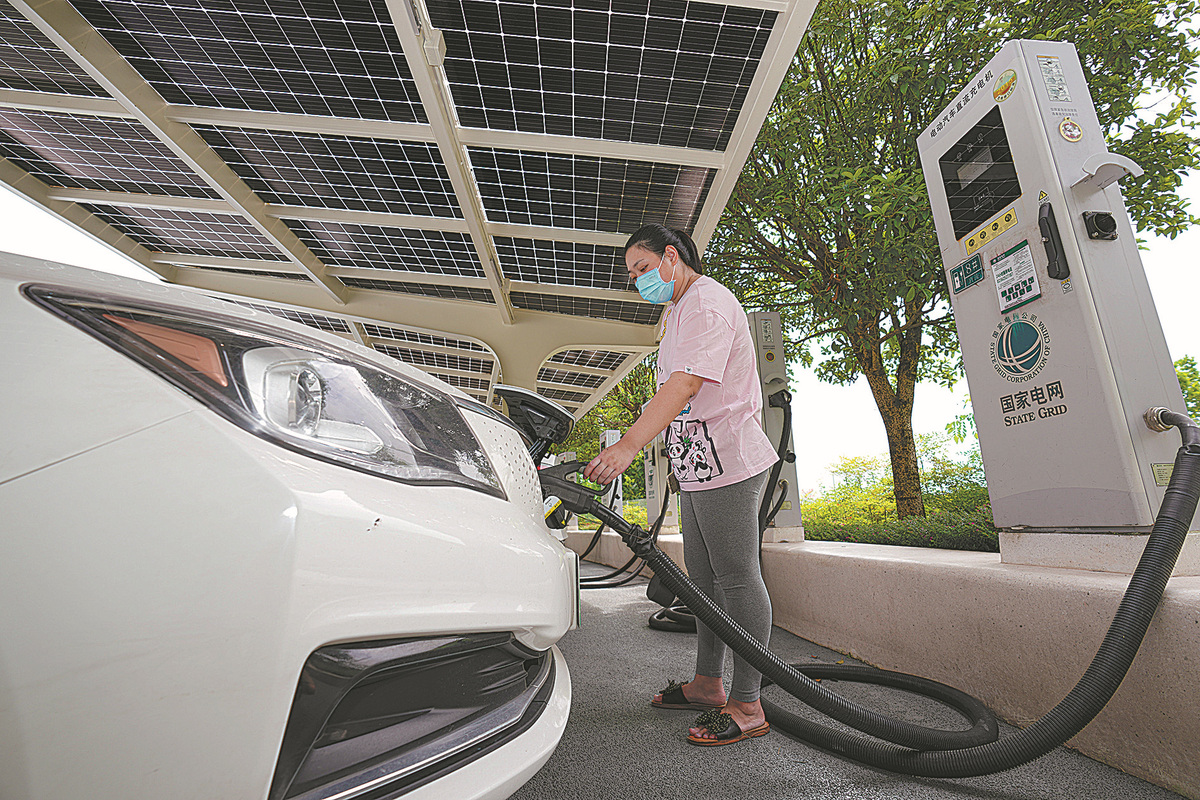
BEIJING-Riding the waves of green transition, China's new energy vehicle sector has seen turbocharged growth and is now in the fast lane. It is now geared up to play a bigger role in upgrading the global auto industry.
China's sales of NEVs topped 11.08 million units as of the end of May. Back at the end of 2012, the figure stood at only 20,000 units.
Globally, the country has ranked first in terms of production and sales for seven straight years since 2015, leading efforts in transforming the global auto industry, said Xin Guobin, vice-minister of industry and information technology.
Fu Bingfeng, secretary-general of the China Association of Automobile Manufacturers, attributed the rapid expansion of China's NEV market to sustained policy support, growing market acceptance and technological innovation over the past decade.
The boom in China's NEV market comes as it seeks to decarbonize the transport sector in order to meet the goal of peaking carbon dioxide emissions by 2030 and achieving carbon neutrality by 2060.
In its latest move to push green transportation, China has pledged to promote NEVs in public transportation and set a target of increasing the share of NEVs in aggregate car sales to around 20 percent by 2025, according to a five-year energy development plan unveiled in March.
Such policy support has been central to the takeoff of the NEV sector of the world's second-largest economy. Over the past decade, more than 600 supportive policies have been rolled out by central and local governments, covering technological innovation, promotion and application, security and other aspects, Xin said.
Policymakers have also leveraged incentives to attract car buyers to choose NEVs over fossil-fueled cars. At different localities, NEV buyers can enjoy various benefits ranging from lower taxes and purchasing subsidies to looser traffic restrictions and special plates.
Industry data showed that the NEV market penetration rate stood at 26.6 percent in May, indicative of wide market acceptance in the country.
Zhang Xiang, a researcher at the Jiangxi New Energy Technology Institute, said the robust growth of NEVs would not have been possible without the efforts of China's domestic brands.
Leading NEV manufacturer BYD, for instance, has displayed fairly strong supply chain resilience by effectively coping with chip shortages and COVID-19 disruptions, as it looks to further expand its global presence.
Boosted by strong sales data in May and bright market prospects, the NEV giant saw its market value cross the 1 trillion yuan ($149 billion) threshold on June 10 after its stock price rallied over 6 percent.
On the technological front, though the country has weak links in core technologies in producing fossil-fueled cars, the rise of NEVs has opened up a window of opportunity for it to overtake other major auto manufacturers.
After more than a decade of efforts, China's NEV-related technologies have made leaps and bounds, especially in components such as motors and power batteries. Moreover, China's recent focus on technology integration in intelligent networks and autonomous driving has also put its auto industry under the global spotlight.
With core technologies in hand, more made-in-China NEVs are able to "go global". Last year, China's NEV exports posted a strong performance, with 310,000 units exported. Orders from Europe grew the fastest, as its imports of China's NEVs surged by 204 percent in 2021 from a year ago.
In the global arena, China has been more engaged in exchanges and activities in international organizations and industrial standard-setting bodies, including the International Organization of Motor Vehicle Manufacturers and Asia-Pacific Economic Cooperation.
Moving forward, if China aims to thrive in the global auto market, and has an initiative and a say in competition, it should develop its own standards, local brands and products, said Zhang Jianping, a researcher at the Chinese Academy of International Trade and Economic Cooperation under the commerce ministry.
Xinhua