


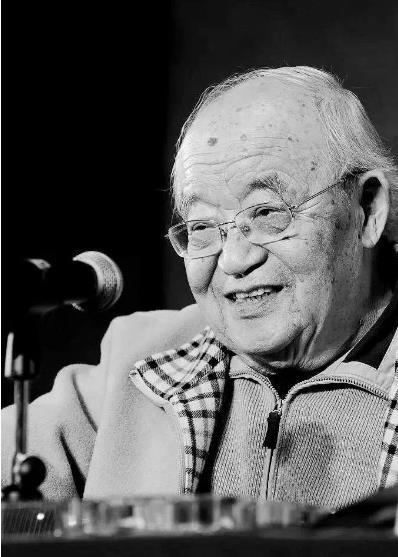
One of China's most renowned songwriters, Qiao Yu, died in Beijing on Monday. He was 95.
Born in Jining, Shandong province, Qiao Yu, a household name in China, whose real name was Qiao Qingbao, had a long career spanning seven decades. He wrote over 1,000 songs, some of which are still performed today and have gained popularity among audiences young and old.
He also published poems and wrote scripts for movies as well as writing songs for Chinese operas.
As a child, Qiao Yu, influenced by his father, read books about traditional Chinese culture and recited traditional Chinese poems. He only started school at the age of nine due to his family impoverishment.
In 1946, he changed his name from Qiao Qingbao to Qiao Yu, and left his hometown to study at Beifang University-which became part of present-day Renmin University of China-in Hebei province, where he began publishing poems, novels and wrote songs for yanggeju, a type of folk opera that combined local songs and dances.
In 1948, Qiao Yu started to work with Chinese poets, writers and playwrights, such as He Jingzhi and Guang Weiran. A year later, he joined the Communist Party of China.
"My songs are closely associated with the country's development since I grew up witnessing it. The emotions are real and natural," said Qiao Yu in an early interview.
One of the songs he wrote is My Motherland, which is one of his best-known songs. The song, first performed by Chinese singer Guo Lanying and the chorus of China National Opera and Dance Drama Theater, was featured in the movie, Shang Gan Ling, which premiered in 1956. Qiao Yu recalled that the song was written not long after the founding of the People's Republic of China on Oct 1, 1949. He considered the song as an ode to China, about the delivery of the people's wishes and their love for the new country.
Let Us Sway Twin Oars, also a song by Qiao Yu, was featured in the movie Flowers of Our Motherland, which was released in 1955 and was widely regarded as the first children's movie after 1949. The song captured the joyful scene of children boating on the lake in Beihai Park in Beijing, as well as reflecting the happy life of Chinese people after 1949. With its wide success, the song was included in the teaching materials for music classes in Chinese primary and middle schools.
Unforgettable Tonight, written by Qiao Yu, is a slow, smooth ballad first performed by Chinese singer Li Guyi during the 1984 CCTV Spring Festival Gala, the most-watched annual year-end gala in the country. It broke with the traditional type of song performed at the closing of the gala, which were usually magnificent singers performing in high-pitched voices with big orchestras. Expressing the emotions of families getting together and celebrating the coming New Year, the song became so popular among audiences that it has been used as the closing song for the annual CCTV Spring Festival Gala for over 30 years.
Qiao Yu also wrote scripts for movies, including Liu Sanjie in 1960, which follows a Zhuang ethnic folk singer.
He was the head of the China National Opera and Dance Drama Theater and president of the Chinese Music Literature Association.
"I'm very sad to hear about Qiao Yu's passing. He wrote so many good songs in his lifetime, which are enjoyed by lots of people," said singer Li Guyi, 78, adding that she grew up singing songs written by Qiao Yu. "His songs are timeless. He will be remembered forever."
"When I joined the China National Opera and Dance Drama Theater at the age of 18, I gained lots of opportunities to perform onstage thanks to Qiao Yu. He was keen on helping and supporting the younger generation of musicians," said Chinese soprano Wan Shanhong, who won the top national award for performing arts, the Plum Performance Award, with her role in the Chinese opera, The Wilderness, in 1988.
Video clip of My Motherland provided by China National Opera & Dance Drama Theater





