


Seasons ripe for change









Chinese also believe that eating something bitter is a way to call to mind one's past sufferings and think over the source of present happiness.
In the meantime, delicate whitlow-grasses that prefer shadowy places will start to wither and die in the direct heat of the sunshine.
Guo Wenbin, an award-winning author and a scholar of traditional culture, wrote in his novel The Lunar Calendar that in his hometown in Northwest China's Ningxia Hui autonomous region, locals went to the Dragon King's Temple to kiss the ears of wheat, and recite ragged verses to pray to the Dragon King that the wheat successfully ripens.
Guo believes it's one of the most scented solar terms, as the fragrance that spreads across the wheat field is intoxicating.
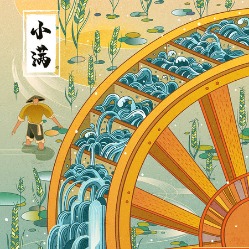
"The arrival of xiaoman means the wheat-reaping time is nigh, and we will soon be able to sample the delicious cooked wheat," he says.
"The ancient Chinese sang in praise of xiaoman."
According to him, as it's easy to lose one's temper in midsummer, the ancient Chinese believe it's essential to nurture calmness. It's helpful to listen to cheerful music, including those ancient classics passed on from generation to generation.
Dampness is a physiological and pathologic concept in traditional Chinese medicine, referring to an imbalance arising from having too much moisture in one's body.
The ancient Chinese believed it was important to manage the excess dampness in one's body around the period of xiaoman, for example, eating the seed of job's tears (millet), polished round-grained rice and Poria cocos, a type of mushroom.
As it's also the time when people perspire heavily, so it's a tradition to eat "the three freshness"-cucumber, garlic sprout and cherry, as a way to rehydrate, besides, of course, drinking water.
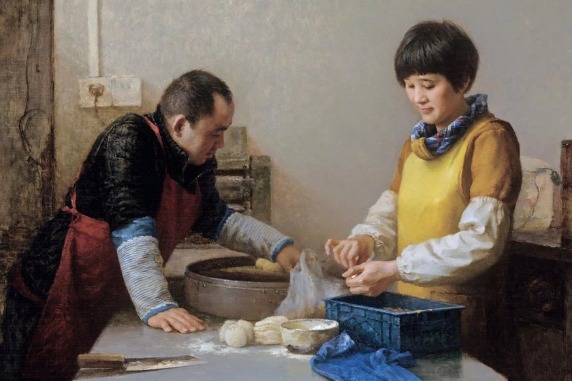
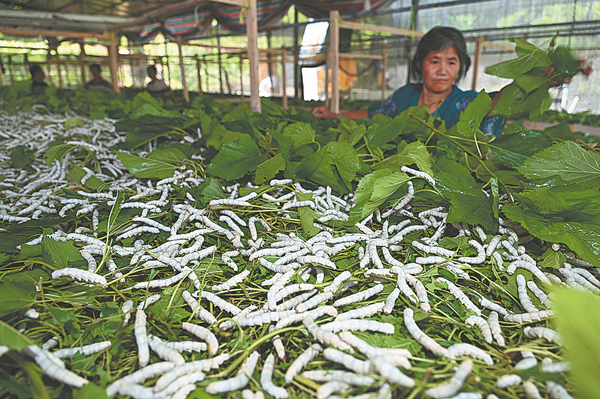
At the typical "men farming and women weaving" society in China, the raw material for weaving in the north is cotton and in the south is silk.
In the national ceremonies that date back to the Western Zhou Dynasty (C.11th century-771 BC), the emperor performs a sacrificial rite and symbolically pushes a plow in the field three times, to pray for a good harvest.
The empress performs a sacrificial ceremony to the silkworm deity, picks up mulberry leaves and feeds silkworms, as a role model for all female weavers in the country.