



'One country, two systems' best for HK









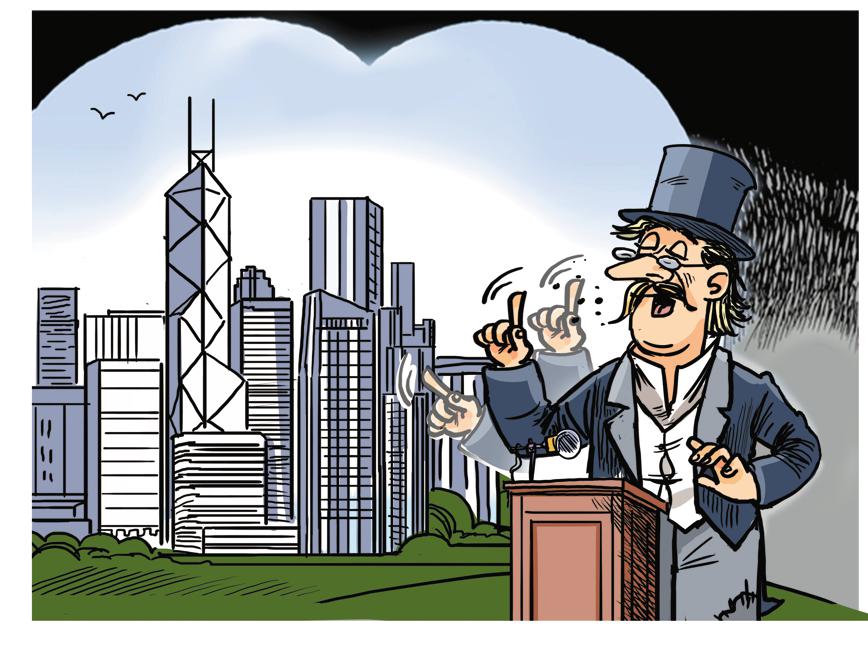
In the 1990s, the prevailing opinion among US officials was that the rest of China would follow the example of the Hong Kong Special Administrative Region in governance. The "one country, two systems" model, in the view of US policymakers, would help spread Hong Kong's system across the rest of China, beginning with big cities such as Guangzhou and Shanghai and spreading to other cities and finally the rural areas, in the next 10-15 years.
None of that happened.
Neither in Shanghai nor in Guangzhou, nor anywhere else, was there any pressure from the public to adopt the unique governance model of the SAR which has been in place since Hong Kong's return to the motherland in 1997. Those who had assumed "two systems" to be more consequential than "one country" were disappointed.
The SAR has its own currency, passport, economic policy, and enjoys a high degree of autonomy in several other areas, but all this is within the "one country" framework.
Despite their diminishing expectations, however, the United States-led West still hoped the "Hong Kong model" would jump boundaries and sweep across the cities on the Chinese mainland.
In Hong Kong, there were many who wanted "two systems, one country" rather than "one country, two systems" and launched protests leading to riots that convulsed the SAR in 2019. Diplomats from some countries, especially NATO member countries, were seen in some of the radicals' rallies. Indian diplomats were conspicuous by their absence.
To prevent foreign influences from interfering in Hong Kong affairs in the future and rule out a repeat of 2019, the National Security Law for Hong Kong was enacted in 2020.
This disappointed the policymakers of some countries that expected China's governance model to radically change as a consequence of the "Hong Kong example".
Whether people like it or not, "one country, two systems" is here to stay, and the Chinese government will not tolerate any challenge to its continuation. And only those who believe in "one country" will be allowed to contest the Hong Kong Legislative Council election to preempt a 2019-like situation.
Carrie Lam Cheng Yuet-ngor, the outgoing chief executive of Hong Kong, did not allow "two systems" to dilute the principle of "one country" through any interpretation. John Lee Ka-chiu, the chief executive-elect, is expected to adopt the same approach.
Although being part of China, Hong Kong enjoys substantial autonomy in matters not related to national security, such as in economic policy. This way, Hong Kong can continue to be a magnet for foreign investment, and remain a leading global financial and logistics hub.
Hong Kong residents have, through hard work, ensured for themselves a reasonably prosperous lifestyle and no longer have any doubt about the supremacy of the "one country" principle. It is therefore hoped John Lee remains a vanguard of development in Asia, as that's the best way of protecting the "one country" principle.
The laws in Hong Kong will henceforth reflect the primacy of "one country" over "two systems", in order to consolidate China's unity. Those disappointed that the "Hong Kong model" has not spread to the mainland, and the SAR in effect is not separate from the rest of China are naturally not happy. But they need to accept China as it is, not as what they want it to be.
That Hong Kong has continued to develop and prosper since 1997 has surprised some international observers, because they expected it to deteriorate after its return to the motherland. The truth is, Hong Kong has thrived under the "one country, two systems" framework and due to the central government's policies.
The times ahead are challenging for the world, including the mainland and the SAR.
After the devastating impacts of the COVID-19 pandemic on the world comes the turmoil caused by Russia-Ukraine conflict.
Wisdom in policy and stability in society are needed more than ever before by the world to tide over the multiple crises.
The author is a professor of geopolitics at Manipal University, India.
The views don't necessarily reflect those of China Daily.
If you have a specific expertise, or would like to share your thought about our stories, then send us your writings at opinion@chinadaily.com.cn, and comment@chinadaily.com.cn.





