Country will fight pandemic the scientific way: China Daily editorial









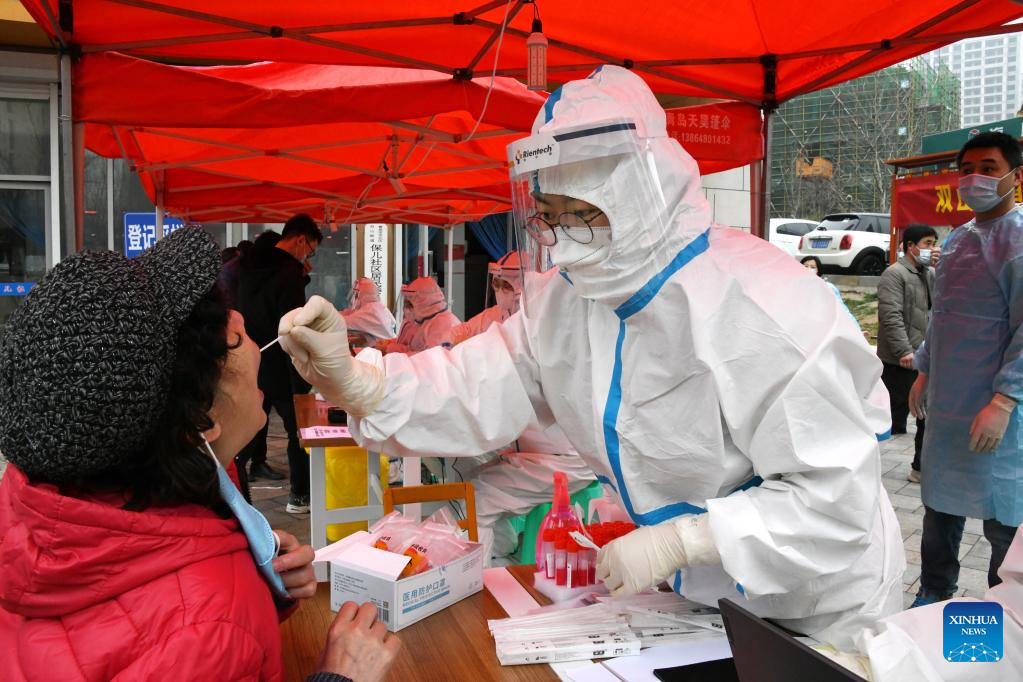
China is now facing its most severe COVID-19 pandemic situation for about two years, with 1,337 locally transmitted cases reported on the mainland on Sunday. The latest flare-up, driven by the highly transmissible Omicron variant, covers more than 100 cities in nearly 20 provincial-level regions, prompting local governments to scramble to conduct mass testing and impose lockdowns in a bid to cut the chain of transmissions.
Yet there is no cause for panic. We are in a much more advantageous position than when the public health crisis first broke out, mostly because we already know much about the virus and have ample tools to deal with it on both the medical and social fronts as we enter the third year of the pandemic.
Scientists have found that while the Omicron strain spreads much more quickly than the previously dominant Delta variant, the death rate now is much lower, in some cases even comparable with seasonal flu. In particular, vaccination has proved markedly protective, able to drastically cut the number of hospitalizations and deaths. In Hong Kong, for example, most of the victims are among the unvaccinated elderly people with underlying diseases.
Given that more than 3.1 billion doses of vaccines have already been administered on the Chinese mainland, with vaccination coverage now reaching around 90 percent of the population, the country has a good foundation for reducing the number of deaths and critical cases from the latest emergence of the virus. The authorities have already said that special attention will be paid to make sure that new infections do not put too much strain on medical institutions so that they can function normally and continue to provide public healthcare without disruptions from rising numbers of new COVID-19 cases.
To do that, a new approach based on differentiated treatment is to be employed so that only the most severe cases are transferred to hospitals. The National Health Commission has added antigen detection as an option for COVID-19 testing, indicating the exploration of a new set of methods to deal with the pandemic may be on the way.
The high transmissibility of the Omicron variant means the number of infections may surge in the short term, but the virus can be controlled as long as the transmission rate is slowed.
Local officials, while sticking to strict prevention and control measures to reach zero cases within the shortest time, must also bear in mind that people's livelihoods should not be compromised as a result. They must try their best to strike a rational balance between slowing and containing the spread of the virus and maintaining economic activities.