



Deputy takes remote Tibetan village's issues to the heart of NPC meetings









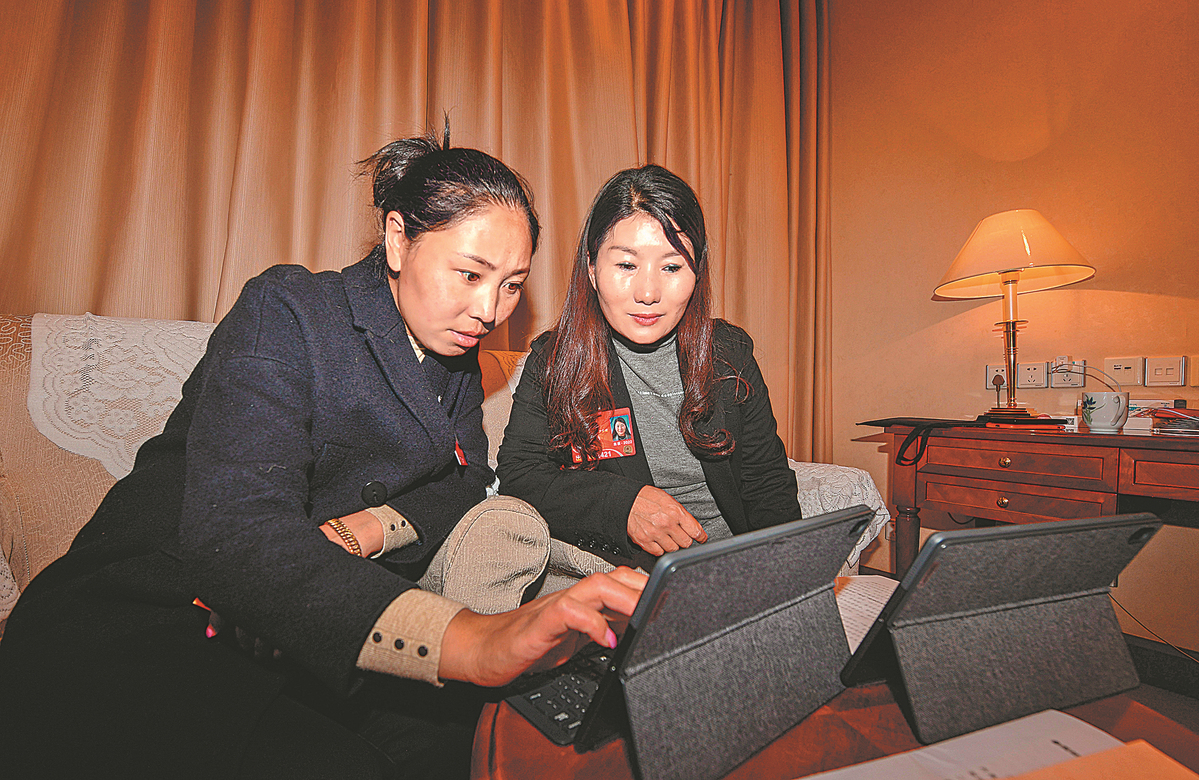
Unlike many Tibetan college graduates who long for stable jobs in urban areas after graduation, Tsering Tsodan chose to work in the remote village where she was born.
The 36-year-old, who grew up in Nagchu, the vast northern prairie area of the Tibet autonomous region, deeply understands the importance of rural vitalization, which is why she chose to serve her hometown.
"I always speak on behalf of my people and think of their benefit all the time because the government and the Party give me the faith and power to work for them," she said.
Tsering Tsodan has been a deputy to the National People's Congress since 2018 thanks to her special dedication to grassroots development in her hometown, where she has been the leader since graduating in 2014.
Now, she serves as Party secretary of Nag village in Chaktse township in Driru county and is tasked with leading rural vitalization work there.
Located at an altitude of 4,000 meters, Nag is about 80 km from Driru, which is about 400 kilometers from the regional capital, Lhasa. "With their low level of literacy and limited education, I know my fellow villagers need me, so I have always wanted to help and am pleased whenever I can do something for them," she said.
For the last few years, Tsering Tsodan has sent proposals to the government regarding the various difficulties the villagers face-among them, a proposed road project and the upgrading of village telecommunications in 2020.
"They live on steep hillsides, where the roads are narrow and are often blocked by mud and rain in the summer, and snow and ice in the winter," she said, adding that the 8-km road project she proposed has been funded by the government and is expected to start this year. "Once the road is operational, travel between our township and the village will be greatly improved," she said.
Nag is home to 173 households and 962 villagers. Thanks to Tsering Tsodan's efforts, every impoverished family was lifted out of poverty by the end of 2017.
"Their disposable income rose from less than 8,000 yuan before 2016 to an average of 10,000 now," she said.
Nag is blessed with good pasturelands and valuable herbs like the caterpillar fungus, so most villagers make a living from herding and gathering herbs.
"When some of them think of quitting herding after becoming rich by gathering herbs, I always remind them to stick to herding because it has been the most stable source of income for generations," she said, adding that herbs were becoming more scarce in the area and prices overall have dropped sharply in recent years.
During this year's two sessions in Lhasa, Tsering Tsodan sent two proposals on behalf of her village's herders. The first explored raising reimbursements from insurance companies when livestock are injured or killed by wild animals, and the second was about setting up an efficient waste disposal system in Driru.
"An adult yak costs over 10,000 yuan ($1,500), but payout for one that gets killed by a wild animal is only 1,500 yuan. This needs to be increased to protect the herders," she said.
Compared to medical insurance, she said, people are able to avoid disease, but it is hard to stop wild animals from harming livestock, as both often live in close proximity.
"The other thing I worry about is waste. We have dumps and trash cans in the villages, but these always attract Tibetan brown bears. This is a big headache, because the bears can pose a danger to residents," Tsering Tsodan said.
"I would like the county to have a way of disposing of waste that would reduce the chances of bears coming into residential communities seeking food and causing trouble," she said, adding that sometimes they even break into houses. "These are among the main topics I want to discuss during the two sessions."


- Seven dead, 12 hurt as vehicle rolls over in Yunnan
- Purple sea of?catnip flowers?blooms in Shandong town
- 'Blue tears' turn Fuzhou's beaches fluorescent
- China-made marine-derived antitumor drug to begin combination therapy trials soon
- Wild apple trees create a poetic spring landscape in Xinjiang
- Tianjin town plays leading role in global instrument trade





