



Sanctions against Russia to hit financial exchange and energy supply









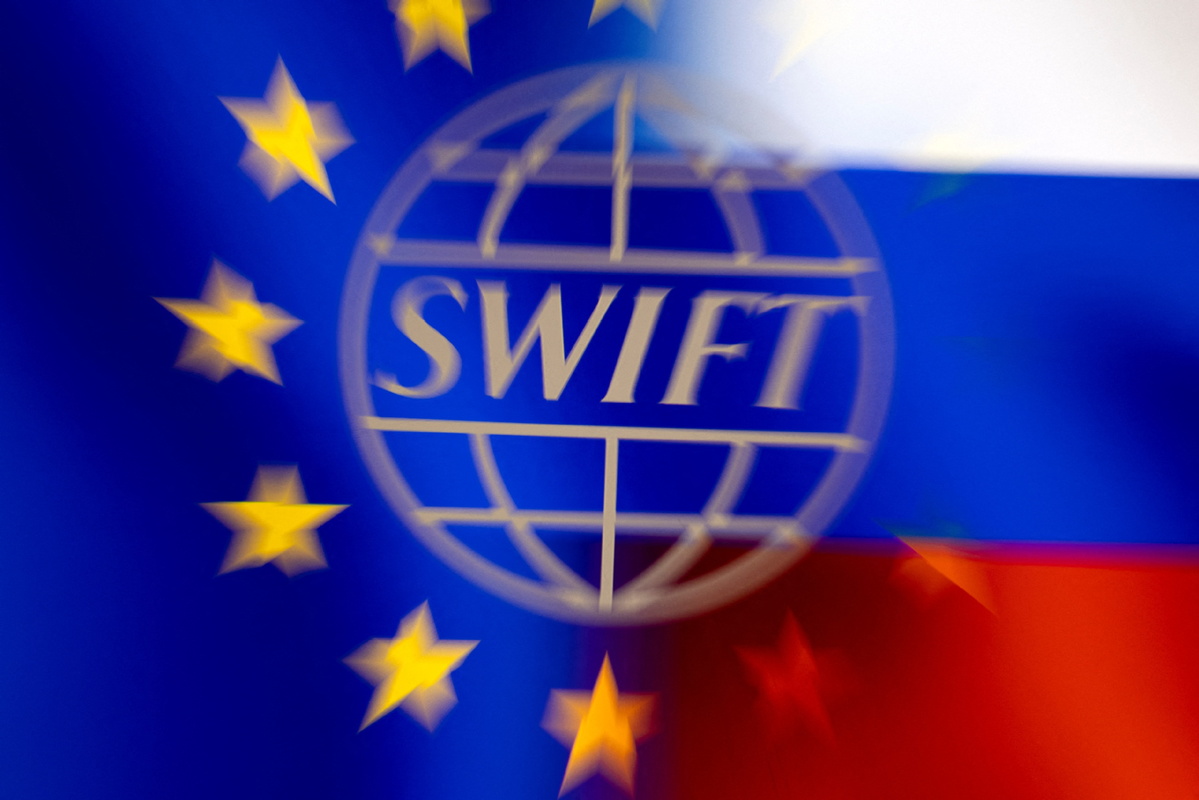
The United States and its European allies announced on Saturday that they would block access of "selected" Russian banks and financial institutions to the SWIFT international payment system, which would make it very difficult for them to operate globally. They also said that the assets of Russia's central bank will be frozen.
The delinking of Russian banks from the SWIFT global payment system will make it almost impossible for Russia to use the central bank's about $630 billion as war chest.
SWIFT, or the Society for Worldwide Interbank Financial Telecommunication, is a cooperative company based in Belgium which provides a network which enables financial institutions across the world to send and receive information about financial transactions in a secure, standardized and reliable environment.
Before Saturday's announcement, between Feb 22 and 25 to be precise, the US added five individuals with ties to the Kremlin, Nord Stream AG, the operating company of the Nord Stream 2 natural gas pipeline and its CEO, as well as three large financial institutions, including VTB and its subsidiaries, to the Specially Designated Nationals and Blocked Persons List.
The European Union, the United Kingdom, Canada, Australia, Japan and other economies have joined the US in imposing severe sanctions on Russia, which will have a huge impact globally.
The delinking of Russian banks and financial institutions from SWIFT will paralyze their cross-border transactions. Especially because an institution delinked from the SWIFT system cannot conduct cross-border transactions either in US dollars or euros, or the local currency.
Russian National SWIFT Association data show about 300 Russian financial institutions, accounting for more than half of all Russian financial institutions, are SWIFT members. The average daily value of Russian financial institutions' foreign exchange transactions through SWIFT before the Russia-Ukraine conflict broke out was about $46 billion, with 80 percent of it being in US dollars.
Also, in 2021, SWIFT member institutions sent on average 42 million messages a day through the network, with Russian financial institutions accounting for 1.5 percent of them.
Delinking Russian financial institutions from SWIFT will block financial transactions between Russian and international financial institutions, which will have global repercussions, because there is hardly any alternative to SWIFT, despite Russia launching its own cross-border payments network, System for Transfer of Financial Messages, to replace SWIFT after being hit by US-led economic sanctions in 2014.
As of May 2021, only 20 percent of financial transactions were done through the SPFS system in Russia, and most of the users were Russian institutions, making it difficult for Moscow to find an alternative to SWIFT any time soon.
The sanctions against Russian oil and gas could increase the volatility in the global energy market. Russia is a major exporter of crude oil and natural gas-it accounts for about 12 percent of the world's crude oil supply and 39.5 percent of the EU's energy imports, with Germany and Italy importing more than 50 percent of their natural gas requirements from Russia.
Although the US' liquefied natural gas exports to Europe surpassed Russian pipeline gas supply in January for the first time, if Russian gas supply to Europe is completely cut off, US oil and gas producers may not be able to fill in the supply gap. And the reduction in market supply will ultimately lead to higher energy prices.
Europe usually stores natural gas in summer for use in winter, so it can cope with the shortfall in supply due to the sanctions against Russian oil and gas in the short term. But the failure to make up the shortfall in gas supply and reserve could lead to an energy crisis.
The author is a research fellow on American studies, Chinese Academy of Social Sciences.
The views don't necessarily reflect those of China Daily.
If you have a specific expertise, or would like to share your thought about our stories, then send us your writings at opinion@chinadaily.com.cn, and comment@chinadaily.com.cn.





