


Fit for a prince










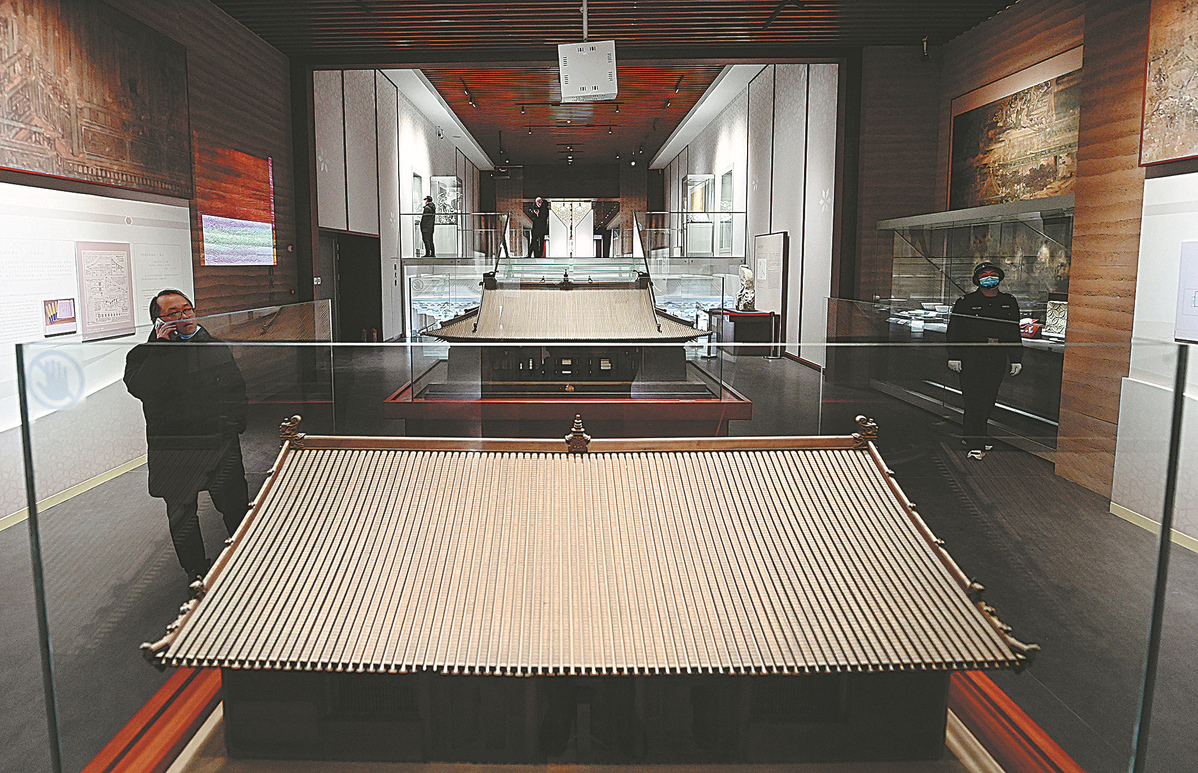
According to the archaeological study, the site, 140 kilometers from Beijing, was a temporary summer location-the Taihe Palace (later renamed the Qingning Palace) built by Emperor Zhangzong of the Jin Dynasty in 1202. Zhangzong was the sixth emperor in the middle and late Jin period, a time of increasing Mongolian power and influence that culminated in the subsequent Yuan Dynasty (1271-1368).
The emperor visited the site twice, with each visit lasting more than three months, according to History of Jin Dynasty accounts of activities and events of the imperial era. The site was destroyed in a fire in 1209, according to historical literature that was later confirmed by archaeologists.
"With the Taizicheng site at the center, we are showcasing society and people's lives during the Jin Dynasty, especially its Nabo customs or nomadic hunting, which the ancient palace was mainly used for," said Liu Jiapeng, curator of the exhibition.
Within that context, the exhibition shows 138 cultural relics unearthed from the Taizicheng site and others collected by the Palace Museum, the National Museum of China and the Chinese Academy of Cultural Heritage, including porcelain, sculptures, decorative objects and building elements.
"As the first temporary palace of the Jin Dynasty discovered by archaeological excavation, its significance is second only to that of the Jin capital. It is also a high-ranking Jin city site, with the largest excavation area of its kind and the most well-preserved structures found in recent years," said Huang Xin, deputy director of the Hebei Provincial Institute of Cultural Relics and Archaeology who was responsible for the excavation of the site.
The cultural relics unearthed from the site, including porcelain items, mark its royal status. For example, some porcelain exhibits were found to have the words shangshiju (imperial food bureau) on them-pointing to their use by the court. Such porcelain is rare and archaeologists say they may have been produced in the major Ding Kiln of Quyang county, Hebei.
"These objects serve as an important reference for us to identify the types of porcelain used by the Jin imperial family. We've found that they used white ceramics from the Ding Kiln, as well as celadon, which are of the same class of those from the Ru Kiln found in Qingliang Temple, Henan province," said Huang.





