


Royal fancy
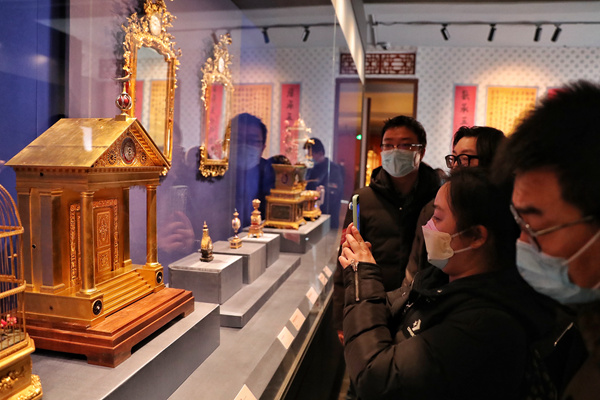
The ongoing exhibition includes 10 "pairs" of identical timepieces. Some were originally housed in one institution-either the Palace Museum or the Chengde Mountain Resort-while some were "reunited" after being separated for a long time.
"Many European artisans wondered why their clients would order clocks in pairs, as recorded in historical files," Guo says. "They speculated it was because Chinese emperors were rich or farsighted. After one was broken, it could be immediately replaced.
"The misunderstanding shows that China and the West should have known each other better then. In traditional Chinese culture, it's a common saying that good things come in a pair, but such a simple wish turned out to be a puzzle in Europe."
Nevertheless, it is the timepiece that helped to reestablish links between the Chinese royal court and Europe after the decline of the ancient Silk Road as a trade route in the 14th century, says Lou Wei, deputy director of the Palace Museum.
In 1601, Matteo Ricci, an Italian Jesuit, presented two mechanical clocks as gifts to Emperor Wanli of the Ming Dynasty (1368-1644), which then was lukewarm toward communication with the outside world. That successfully hooked the emperor's interest, and the foreign priest was later bestowed an official position in China and started a wave of Sino-Western cultural exchanges.
"They knocked at the door of the Forbidden City and got an answer," Lou says. "With the first two mechanical clocks ever collected by the palace, the nearly 300 years of history of Western timepieces in Chinese royal courts started."
The reign of Qianlong (1736-95) marked the peak of the royal timepiece collection. Following the emperor's passion for fine art, local Chinese studios making mechanical clocks also appeared in Guangzhou, Guangdong province, and Suzhou, Jiangsu province, and some such products that entered the royal collection are also on display in the ongoing exhibition.
Guo says these products feature strong characteristics of local cultures. For example, in Guangzhou, watchmakers preferred shapes of traditional architecture like pavilions and towers, and auspicious totems were often used. In Suzhou, wood clocks in the shape of folding screens were popular.
With the booming scene of watchmaking, the Qing royal court was not satisfied with simply being a collector. The Forbidden City had its own clock workshop during Qianlong's reign to not only fix components, but also make its own products. This period of history also explains why the exhibition is set in the gallery of the Hall of Heavenly Purity. That was where the imperial workshop once was.
The timepieces represent not only the glorious days of the imperial age, but also its decline. When Emperor Guangxu (1871-1908) was under house arrest by the powerful Empress Dowager Cixi, and helplessly witnessed the deep social crisis that led the monarchy toward its end, fixing antique timepieces was probably all the puppet ruler could do to feel the flow of time, according to legend.





