


Poem rings a bell










German composer Robert Zollitsch delves into old Chinese words and sounds, Chen Nan reports.
In his poem, Ju Song, or Ode to an Orange Tree, patriotic Chinese poet Qu Yuan from the Warring States Period (475-221 BC) praised the beauty of an orange tree in southern China. He compared the tree to a virtuous man who is determined and dedicated. The poem is often cited for its indication of the poet's loyal, unyielding and unselfish image.
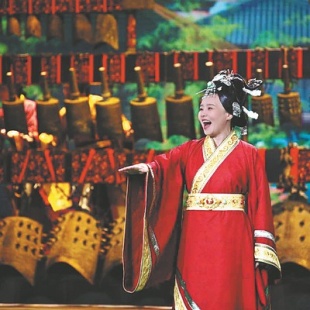
When German composer Robert Zollitsch was commissioned to write a song for a gala produced by China Central Television, marking Spring Festival, he chose to compose for the poem by using bianzhong, one of the oldest Chinese musical instruments that originated about 2,500 years ago, consisting of a set of bells of varying sizes that produce different sounds when struck. The song, performed by Zollitsch's wife, Chinese singer Gong Linna, will debut on Feb 1, Lunar New Year, the biggest traditional Chinese festival.
"We recorded the song in Beijing last November by working with a bianzhong band from the Hubei Provincial Museum and my own band," says Gong, adding that her husband composed the song in Germany.
"Like the poem, the song is an ode to Chinese traditional culture and values. With the performance of bianzhong, the song sounds like a ritual," she adds.
Besides the set of bells, the composer also used other traditional Chinese musical instruments such as sheng, dizi, guzheng and ruan, as well as big Chinese drums as live instruments in his composition.
"All other sounds are electronic sounds or computer-generated samples in this production. I like the merger of live recordings and production work on computer. For me, it became a very nice way to produce music, as I can write the scores I love as a composer, but also can use modern technology to produce the actual audio files for songs to be published,"Zollitsch says.
"My way of working, understanding classical lyrics and finding ideas for the right sound for these words became more and more intuitive. During the work process I let things happen naturally. Not that I would not use my brain, my technique and knowledge, but I do not seek control, nor do I reflect, it just happens," he adds.
This is not the first time that Zollitsch has composed songs for Qu's poems by using bianzhong and performed by Gong. The composer's first encounter with the instrument was in 2006 when he heard 65 Chinese bronze bells ringing during the Amsterdam China Festival in the Netherlands.