Breaking virus grip now possible









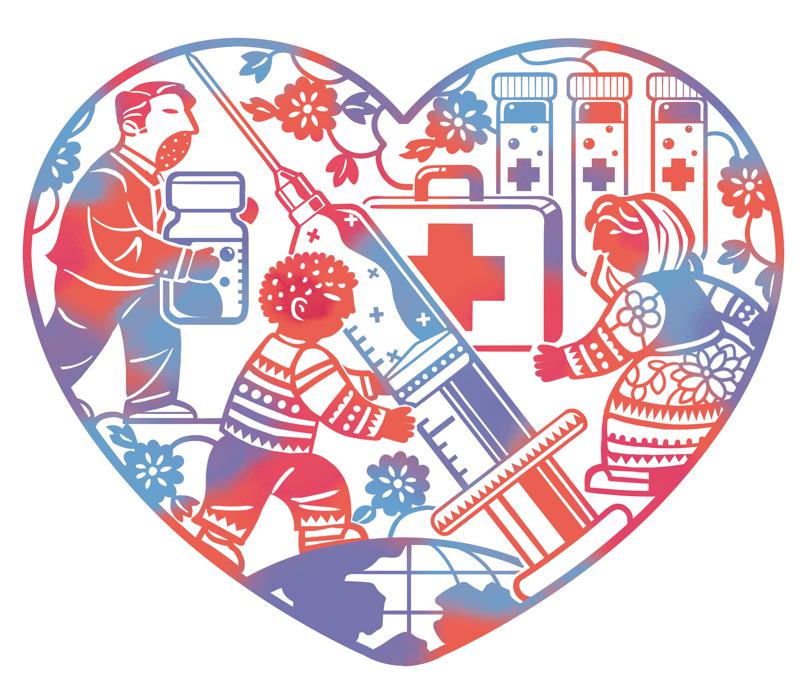
Two years into the worst pandemic in a century, it is tempting to think that the world is stuck in a time warp, unable to shake off a virus that has so far killed more than 5.54 million people and wrecked countless livelihoods. But the truth is that in the 15 months since the COVID-19 Vaccine Global Access (COVAX) facility first gained support of the international community, much has changed.
In September 2020, we did not know whether scientists would be able to develop a safe and effective COVID-19 vaccine. Now we have several. Nor did we know back then that the pharmaceutical industry would succeed in scaling up production. But, in the event, 11 billion doses were manufactured last year.
Sadly, these successes also serve to highlight where the world has failed in its efforts to combat the pandemic. Although the world produced enough COVID-19 vaccine doses in 2021 to vaccinate every adult on the planet, more than 3 billion people, most of them living in lower-income countries, have yet to receive their first dose. High-income countries have an average vaccination rate of over 75 percent and are now focusing on booster programs. In Africa, in contrast, roughly 10 percent of the population is fully vaccinated, on average, and healthcare systems are still catching up with primary vaccinations.
COVAX's recent delivery of its one billionth vaccine dose represents significant progress toward increasing supply, ensuring equitable access, and thus remedying the current appalling global disparity. This milestone also shows that COVAX-and multilateralism-can work, despite hoarding or restricting exports of vaccines and ingredients by some governments.
Given this momentum, it is essential that COVAX-a partnership established by the Coalition for Epidemic Preparedness Innovations, the World Health Organization, UNICEF, and Gavi, the Vaccine Alliance-continues to receive the world's backing. Otherwise, as rich countries press ahead with booster roll-outs in the face of the Omicron variant, lower-income countries risk falling even further behind.
Such an outcome would constitute not only a moral failure, but also a public health catastrophe. We all know by now that no one is safe from COVID-19 until everyone is safe. Until we can vaccinate people in all parts of the world, the novel coronavirus will continue to mutate, resulting in the emergence of new and potentially more dangerous variants. There is a significant risk that we will become trapped in an endless cycle of booster vaccinations, chasing the virus rather than getting ahead of it.
Alternatively, by protecting people everywhere, we can reboot the global economy and fully resume trade, commerce and travel. This will require renewed commitments by high-income countries and vaccine manufacturers to put orders for those most in need first. Providing equitable vaccine access also means ensuring that COVAX has the flexibility to respond to future needs, including those related to booster programs, variant-adapted vaccines, or simply additional doses.
Progress in combating the pandemic over the past year has been slower than everyone involved in COVAX-including me, as chair of Gavi-wanted and expected, and many lessons need to be learned. And despite the widespread and growing perception that Omicron is somehow less dangerous than previous variants, we are still very much in the midst of a global crisis.
But while further supply side and demand side challenges will arise in 2022, we are at last in a position where breaking COVID-19 is a realistic prospect. Speed is of the essence, and the faster we limit the virus's ability to spread, the sooner we will end the cycles of havoc it has wreaked on our societies and economies. That requires ensuring rapid, fair, and equitable access to COVID-19 vaccines to people in all countries.
The delivery of COVAX's one billionth dose proves that, when push comes to shove, we can collaborate effectively to tackle massive global challenges. But this achievement is also a timely reminder that much more remains to be done.
COVAX and the other international organizations committed to vaccine equity cannot end the pandemic without the help of governments, industry and civil society. By working together, we have a chance to break the grip of COVID-19 once and for all. We must make the most of it.
The author, a former president of the European Commission (2004-14) and prime minister of Portugal (2002-04), is chair of Gavi, the Vaccine Alliance.
Project Syndicate
The views don't necessarily reflect those of China Daily.