



Pulled noodles help Qinghai vitalize economy









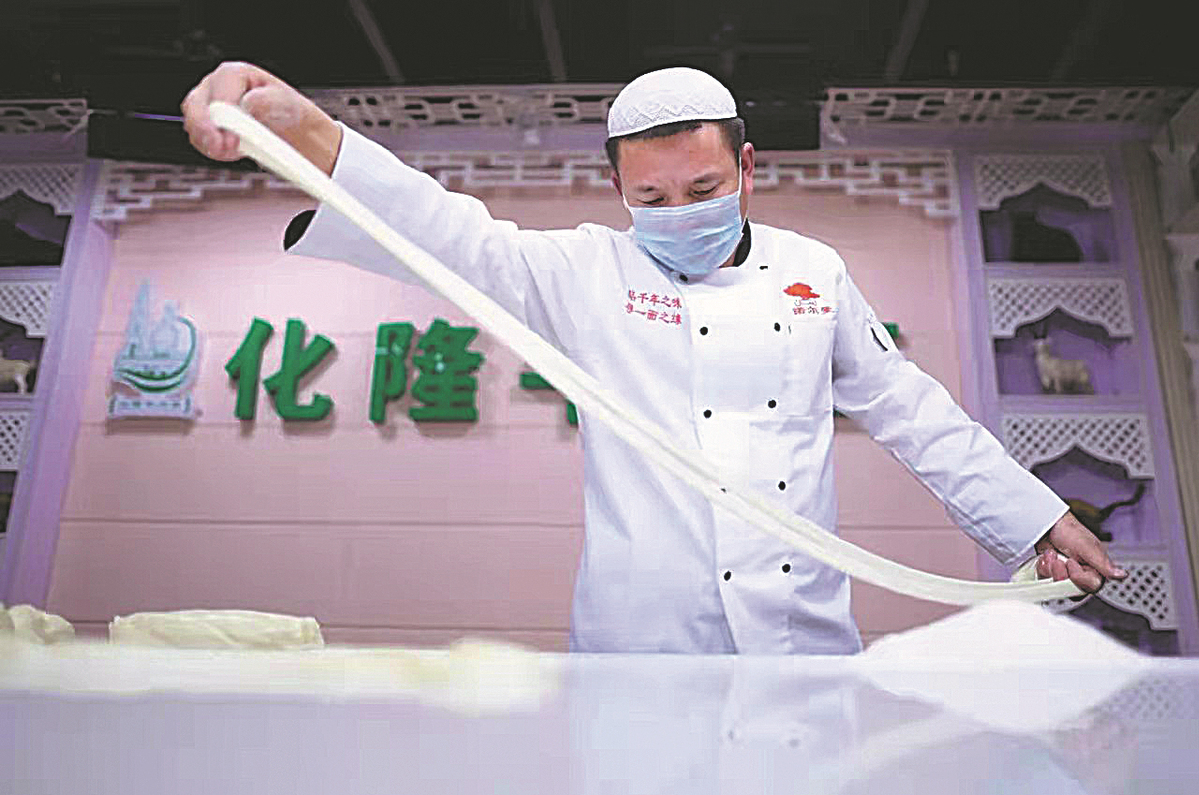
Skilled cooks from Qinghai province have been opening restaurants selling pulled noodles with beef, a common dish in Northwest China, at home or further afield in recent years to seek their fortune.
Ma Qingyun seized the chance in 2015, when he quit his job as a police officer in Xining, the provincial capital, and started an online pulled noodle network and an offline service center in Hualong Hui autonomous county, Haidong, where most people know how to cook the noodle dish and make a living out of it.
His WeChat social media account, called China pulled noodle network, provides restaurant management lessons, updates news about the pulled noodle industry and sells noodle seasoning. The offline service center offers local people recruitment, training and marketing information about the pulled noodle trade collected from the more than 15,000 Hualong pulled noodle restaurants across the country that are registered with it.
Under an agreement between the center, restaurants and the county government, restaurants train people in pulled noodle cooking skills and pay them when they are apprentices. If they pass a test held by the government, they can get about 3,000 yuan ($470) as a bonus from the local government.
The center has sent about 3,000 people to receive training so far.
Ma, 40, said he has special memories and feelings about Qinghai pulled noodles. In 2001, he received the 3,000 yuan he needed for tuition at a police school in Qinghai from his brother's earnings from selling 3,000 bowls of pulled noodles.
"The noodles have improved farmers and herders' lives. However, large numbers of people in my county who sell the noodles haven't formed a network to fend off risks from markets," he said.
"I would like to act as a bridge between the government and pulled noodle practitioners. I want to help people from my hometown adapt to bigger markets and make a living in big cities."
By the end of last year, Qinghai migrant workers had opened 33,000 pulled noodle shops in China and overseas. About 195,000 employees have an annual per capita income of more than 30,000 yuan, the Qinghai Provincial Human Resources and Social Security Bureau said.
Ma Junhai has registered with Ma Qingyun's online network. Under the agreement, Ma Junhai's catering company in Wuhan, Hubei province, has trained more than 200 villagers from Hualong.
In 2000, Ma Junhai left Hualong for Wuhan to start his pulled noodle career. He and his two employees, a chef and a server, slept in his 30-square-meter shop due to lack of money to rent a house. Now he earns at least 500,000 yuan a year.
"I am not a success only if I become well-off, so I take it as my responsibility to help my fellow villagers," Ma Junhai said.
Ma Qingyun said despite the development of the pulled noodle network, one hurdle to enhancing the pulled noodle economy lies in restaurant management ideas.
"Consumers are becoming increasingly demanding in terms of taste, variety of dishes, service and food delivery efficiency," he said. "They prefer reading comments on mobile phone review applications before choosing a restaurant. But pulled noodle shop owners, most of whom used to be farmers, don't know how to deal with the internet."
He said that he hoped the Qinghai government would provide more financial and training support, while other cities that welcome pulled noodle shop owners and employees from Qinghai need to aid the migrant group if necessary.
Since 2017, the Qinghai government has provided 50 million yuan for pulled noodle development to encourage people from the province to start pulled noodle businesses. Haidong signed agreements with cities including Shanghai, Tianjin, and Wuxi, in Jiangsu province, to set up offices that aid migrant pulled noodle workers with their children's education and handling business chores.
In addition to developing the pulled noodle economy, the Qinghai Provincial Rural Vitalization Administration also encourages industries including wolfberry planting, highland barley planting and animal husbandry cooperatives.


- 5.4-magnitude quake hits waters off China's Taiwan region: CENC
- Shanghai offers 'first cup of coffee' to May Day arrivals at airports
- China predicts over 344m inter-regional trips on first day of holiday
- Enjoy the May Day holiday
- Authorities warn of heavy rain, flood risks during holiday
- China launches immersive aerospace science center for kids, teenagers in Beijing





