



Milestone mission for private rocket









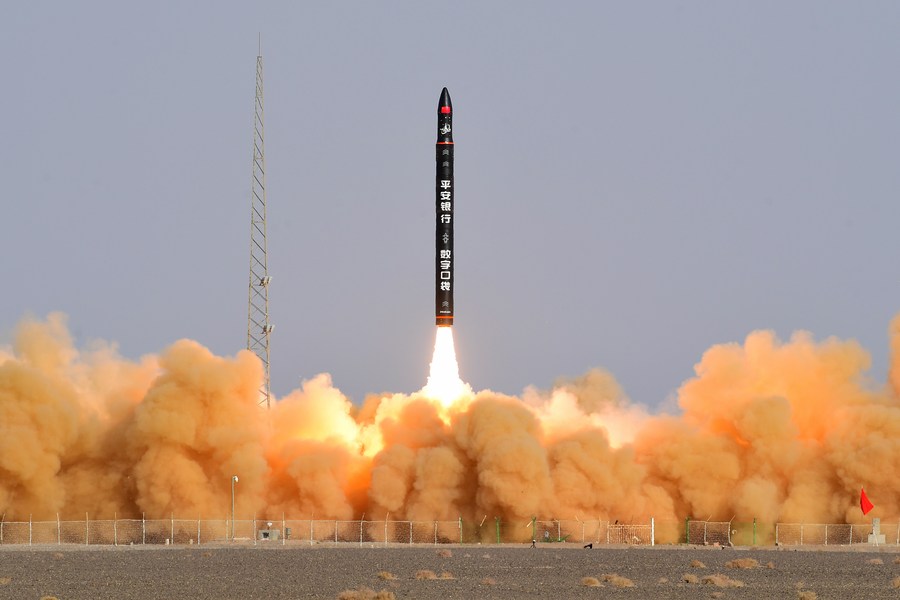
Galactic Energy, a carrier rocket maker in Beijing, has become the first private enterprise in China to have conducted two orbital missions that placed satellites in outer space.
The company's CERES 1 Y2 rocket, the second of its kind, blasted off at 12:12 pm Tuesday at the Jiuquan Satellite Launch Center in Northwest China's Gobi Desert and flew for about 14 minutes before deploying five small satellites into sun-synchronous orbits about 500 kilometers above the Earth, the private startup said in a statement.
The payloads lifted by the rocket are two scientific experimental satellites, two remote-sensing satellites and an infrared Earth-observation satellite.
The mission marked the first time a privately built Chinese rocket has successfully completed two orbital launches. The SQX 1 rocket developed by i-Space, another Beijing-based private rocket company, previously failed in its second orbital launch attempt.
Tuesday's launch was also the first successful launch by the country's private space sector this year.
An orbital mission is a spaceflight by a carrier rocket that deploys payloads into an orbit in outer space. In addition to i-Space and Galactic Energy, other Chinese private enterprises have also attempted orbital missions, a threshold for any serious newcomer in the global space sector that was first crossed by the United States' SpaceX.
CERES 1 made its debut flight in November last year from the Jiuquan center, becoming the second privately developed Chinese carrier rocket to successfully realize an orbital mission, after i-Space's SQX 1.
A CERES 1 is about 20 meters tall, has a diameter of 1.4 meters and is mainly propelled by solid propellant. With a liftoff weight of 33 metric tons, it is capable of sending a 300-kilogram satellite, or several satellites with a combined weight of 300 kg, to a 500-km sun synchronous orbit, or 350-kg payloads to a low-Earth orbit at an altitude of 200 km.
The rocket is ideal for domestic and foreign clients seeking a small, cost-efficient launch vehicle to deploy mini satellites, designers said.
Galactic Energy was established in February 2018 by some engineers from State-owned space conglomerates.
Its engineers are now designing the Pallas 1, a larger, liquid-propellant rocket model that can be reused, Xia Dongkun, a vice-president of Galactic Energy, said.
He said design of the new rocket's engine has been finalized and ground tests will soon start.
"We plan to complete the development of Pallas 1 and perform its maiden flight in the first half of 2023," he said at the company's Beijing headquarters after Tuesday's launch.
"In 2022, we will strive to carry out five to six commercial launches of the CERES 1."
Wu Peixin, an industry observer in Beijing, said Tuesday's successful launch will inject momentum and confidence into China's private space sector and will see private space companies attract more attention and resources.


- 5.4-magnitude quake hits waters off China's Taiwan region: CENC
- Shanghai offers 'first cup of coffee' to May Day arrivals at airports
- China predicts over 344m inter-regional trips on first day of holiday
- Enjoy the May Day holiday
- Authorities warn of heavy rain, flood risks during holiday
- China launches immersive aerospace science center for kids, teenagers in Beijing





