



Rivalry must not dominate B3W









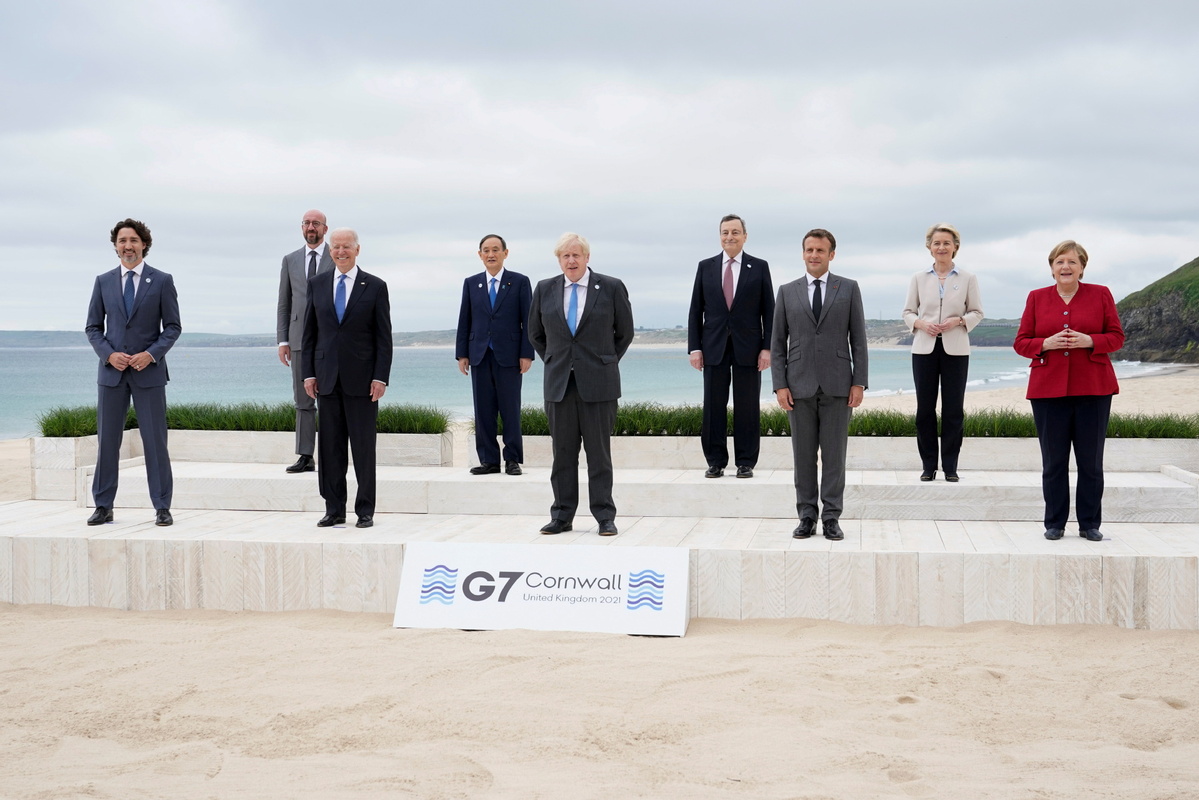
At their summit in June, the G7 leaders endorsed US President Joe Biden's global infrastructure initiative, "Build Back Better World Framework" and agreed to form a partnership led by "major democracies" to help narrow the $40 trillion infrastructure need in the developing world, which has been exacerbated by the COVID-19 pandemic.
Any move to help developing countries is welcome. But the US message also said Build Back Better World (B3W) is an alternative to the China-proposed Belt and Road Initiative, and will compete with it in fields such as technology and the economy.
Although the US has claimed Build Back Better will be better than the Belt and Road Initiative, as it will have values-driven, high-standard and transparent infrastructure partnerships, it is important to reiterate that the Belt and Road Initiative is intended to be a bridge for co-development across the world, not a strategy for competition and dismantling other ongoing inclusive cooperation mechanisms and efforts.
The Belt and Road Initiative is based on humanity and has a vision for common development. The initiative is inclusive in nature and doesn't lay stress on ideology, because its aim is to promote cooperation between countries with different political systems by improving connectivity and developing closer economic ties, not only in Eurasia but also in the rest of the world, so that countries can jointly achieve prosperity.
China has proposed the principle of "extensive consultation, joint construction and shared benefits" for the Belt and Road Initiative, and Belt and Road projects are based on equal consultation. In the eight years of the initiative's development, the participating countries have successfully implemented many projects and learned many lessons. And the initiative, which began as macroscopic infrastructure cooperation project, has become even more inclusive and innovative, while upgraded high-quality cooperation has turned it into an open, green, clean and digital cooperation project.
The Belt and Road Initiative reflects China's vision of helping build a community with a shared future for mankind, despite rising populism in some countries and efforts to decouple the Chinese and US economies. Countries across the world are still highly interdependent and their interests intertwined. And the Belt and Road projects are in line with the global trends and continue to seek the common ground of cooperation and communication in order to build a more integrated world.
The initiative has made remarkable achievements, and is especially focused on five areas: policy coordination, unimpeded trade, financial integration, connectivity, and people-to-people bonds. China has been making increasing efforts to build and/or improve roads, railways, airports, seaports, power plants and other infrastructure facilities. Its success can be seen in improved global connectivity and poverty alleviation.
So far China had signed 206 Belt and Road cooperation documents with 140 countries and 32 international organizations, while Chinese enterprises have invested $34 billion in the economic and trade cooperation zones in Belt and Road countries, paid more than $3 billion in taxes, and created over 330,000 jobs.
True, the Build Back Better Framework has an attractive blueprint, but it is ideologically biased and its goal is to form a clique of so-called democracies. And the values-driven, high-standard, transparent and rules-based infrastructure partnerships the Build Back Better Framework intends to build will be based on the standards and rules of the US and its G7 partners, not on universal rules and values. Not to mention that the Build Back Better's goal, as the US said, is to compete against China.
As such, Build Back Better is a tool to force other countries to take sides between Washington and Beijing rather than a plan to promote cooperation-oriented development. So it cannot meet the needs of developing countries.
Besides, Biden signed a $1.2 trillion infrastructure plan early this month, which was less than the $2.25 trillion infrastructure package he announced in March. The plan's budget shrunk not only due to the Democrat-Republican political rivalry but also because of the discord within the Democratic Party.
That the US has taken about a year to pass a domestic infrastructure plan should give people an idea about how long it will take for it to implement Build Back Better projects, especially when the other G7 countries and a lot of third-party recipients would be involved. Above all, what will be the respective contributions of the G7 countries to the Build Back Better funds?
Chinese enterprises are known for their infrastructure technology, fast and high-quality construction, and strict work discipline. In fact, Tesla CEO Elon Musk has praised China's infrastructure efficiency. Moreover, the inclusion of 10 more Chinese companies in the 2021 Fortune Global 500 took the total to 143, more than that of the US for the second year.
The Belt and Road projects have strived to build a better world through inclusive global cooperation based on equality and openness. The world still needs more roads and bridges to enable more countries to enjoy the benefits of global development, and China and the US can and should work together to build a better world despite their differences.
The author is a research fellow at the Chinese Academy of Social Sciences' Institute of West-Asian and African Studies and a senior research fellow at the Charhar Institute.
The views don't necessarily represent those of China Daily.
If you have a specific expertise, or would like to share your thought about our stories, then send us your writings at opinion@chinadaily.com.cn, and comment@chinadaily.com.cn.





