'Them and us' situation must be avoided amid vaccination resistance









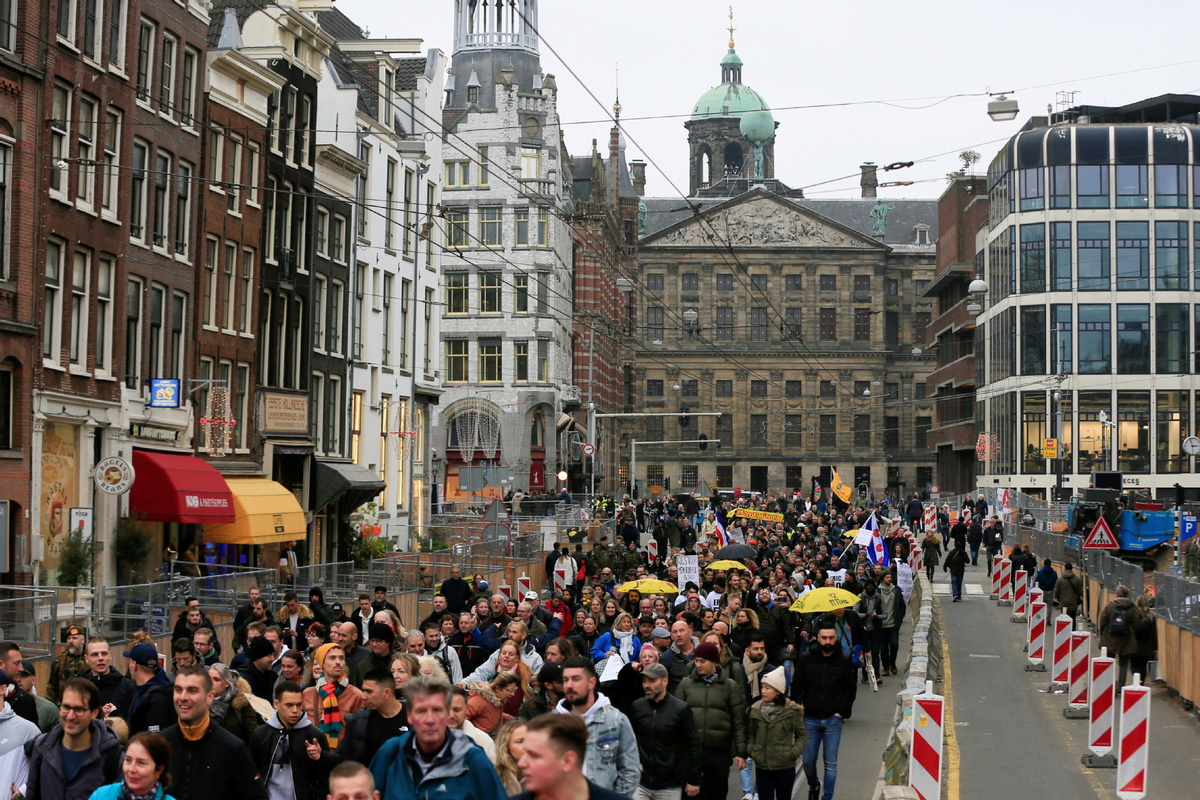
As Europe confronts a dangerous COVID-19 surge, thousands of demonstrators took to the streets and clashed with police in a number of cities to protest tough new lockdown measures.
Over the weekend, violent protests spread from the Netherlands to neighboring Belgium, where police in Brussels used tear gas and water cannons to contain rioters.
In Croatia and Italy, demonstrators also marched to protest pandemic measures, and in Austria, tens of thousands of people took to the streets of Vienna to oppose plans to make vaccination compulsory.
The backdrop to the protests is a pandemic surge that has seen infections across the European Union quadruple in recent weeks, particularly in countries with low vaccination rates. Austria, Belgium, the Netherlands and areas of eastern Europe are among the hot spots.
On one level, the protests can be seen as an expression of frustration at the prospect of further stringent lockdown measures. Young people in particular, who rightly or wrongly believe they are at minimal risk from the virus, oppose rules that require vaccine passports for entry to bars and restaurants.
Others who might otherwise accept the benefits of vaccines are opposed on principle to them being made compulsory for all.
Then there are those, inspired by months of consuming fake news on social media, who believe both the virus and the vaccine are fake and part of some ill-defined plot to undermine their rights.
However, the one unifying factor in the protests has been the organizing presence of far-right groups who have seized on the pandemic as an opportunity to sow public distrust in current governments.
Groups such as Austria's Freedom Party and the Dutch Forum for Democracy have been prominent in the COVID-skeptic, anti-vaccination movement throughout the health emergency.
In March, ahead of elections in the Netherlands, Forum's leader Thierry Baudet described lockdown measures as "corona dictatorship" and cast doubt on the existence of the virus.
That sentiment was echoed more recently by Austrian Freedom Party leader Herbert Kickl, who denounced measures being introduced by the government as totalitarian.
In Italy in mid-October, members of the neo-fascist Forza Nova party were accused of playing a leading role in violent protests against measures requiring workers to show proof of vaccination.
Just as they have traditionally exploited public fears about immigration to garner support, these and other far-right groups appear to have consciously latched on to the pandemic as an opportunity to sow dissent.
As with the immigration issue, these groups have used misinformation to exploit the fears of ordinary citizens who would not normally be attracted to them on ideological grounds.
They have sought to politicize what is essentially a nonpolitical public health issue by trying to convince people that wearing a medical mask or having a vaccine shot is somehow a surrender of their rights.
In the face of vaccine hesitancy, particularly prevalent in eastern Europe, governments and health authorities have so far focused on campaigns of persuasion to calm the fears of those reluctant to receive COVID-19 inoculations.
As infections surge, however, they have increasingly opted for coercive measures to protect their populations. That risks playing into the hands of groups seeking to exploit the situation.
Moderate politicians are aware of the dangers of reducing unvaccinated people to a status equivalent to second-class citizens. Germany's Green Party co-leader Robert Habeck said that new rules to contain the pandemic amounted to a "lockdown for the unvaccinated".
The anti-vaccination movement has had limited success, at least in western Europe, where a majority of people have opted to receive COVID-19 shots. Many of them may now share the exasperation of their governments that a minority risks prolonging the pandemic by refusing to get vaccinated.
It is an environment in which European states risk being pushed into a divisive "them and us" situation that would be welcomed by the groups that helped generate it.
As Europe approaches yet another winter of lockdown discontent, governments and health authorities need to ramp up their campaigns of persuasion among vulnerable groups that have been misled by the propagandists.
They should also avoid draconian measures that target the minority that remain unconvinced. That would be to hand victory to groups that have sought to weaponize the pandemic for political motives and that do not genuinely have the public's health and welfare at heart.
The author is a senior media consultant for China Daily UK.