



China-ASEAN partnership solid, progressive









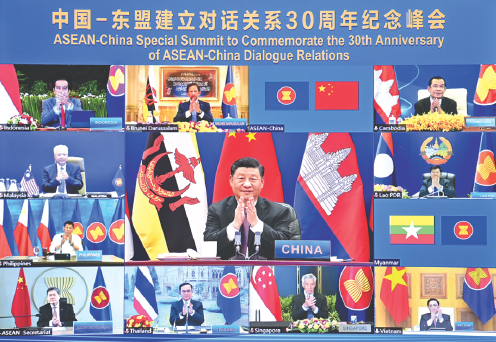
The special summit commemorating the 30th anniversary of ASEAN-China dialogue relations held in Beijing on Nov 22 is a milestone event for deepening all-around cooperation in the region and making it a center for global peace in the midst of some countries’ predilection for inciting competition, tension and conflicts. It was made more significant by the announcement from President Xi Jinping, who chaired the summit, on the two sides’ comprehensive strategic partnership calling it a “a new milestone in the history of our relations" which "will inject new impetus into peace, stability, prosperity and development”.
Highlighting the commemoration of the China-ASEAN special summit, the agreement provides a new impetus to a 30-year history of a relationship based on the principles of friendship and solidarity, respect, mutual trust, and mutual support. The cooperation and partnership which has shaped the relationship far outweighs whatever differences exist, which are being resolved through peaceful diplomacy and dialogues.
In accordance with its “good neighbor diplomacy” China in 2003 became the first dialogue partner of ASEAN to accede to the Treaty of Amity and Cooperation, making the instrument a code of conduct for interstate relations in the region. In the same year, China was also the first non-ASEAN country to accede to the Protocol to the Treaty on Southeast Asian Nuclear Weapons-Free Zone.
While the rest of the world was unsettled on environmental issues, China and ASEAN agreed as early as 2010 on an Environmental Protection Cooperation Strategy leading to the establishment of the Environmental Cooperation Center in Beijing. Then in 2019, the two sides agreed to cooperate on rural development and poverty eradication with specific programs where China would share its valuable lessons in lifting millions of people out of poverty and meeting ahead of schedule the UN’s sustainable development goals. In response to the COVID-19 pandemic, China and ASEAN agreed as early as February 2020 to share information and best practices in combating the common challenge. As a responsible regional partner, China has donated hundreds of millions of vaccines and sent medical assistance delegations to countries in the region and other parts of the world.
The constructiveness of the China-ASEAN partnership can be measured by positive gains in various dimensions. For instance, trade has increased 85 times to $412 billion in the first half of 2021, making China the regional group’s largest trading partner. What's expected to boost the trade partnership is the world’s largest trading pact - the Regional Comprehensive Economic Partnership - signed by the ASEAN’s 10 member-countries and by China, South Korea, Japan, New Zealand and Australia, which will take effect in 2022. Trade expansion is bolstered by the Belt and Road Initiative high-speed cross-border railway interconnectivity that involves Laos, Thailand, Malaysia and Singapore, to make the supply chain and distribution of goods faster. Interconnectivity is made not only in trade but also in the exchanges of culture, people-to-people diplomacy, as well as science and technology.
Of greater importance is that the 30-year old cooperation and partnership between China and ASEAN along with Beijing’s new commitments as articulated by President Xi are expected to enhance regional peace and shore up the member-countries’ stance against tension and conflicts. ASEAN welcomes and supports Beijing’s good neighbor policy while playing its central role in regional and global affairs. There is no question that ASEAN opposes hegemonism by outside powers – a position which some leading members have amplified by assailing the recent formation of the Australia, UK and US trilateral alliance and the new threat by Australia to militarily intervene in regional affairs by building nuclear-powered submarines for future operations in the South China Sea.
The ASEAN will as a whole honor its commitment to use bilateral and multilateral dialogue mechanisms instead of confrontation and defense alliances in settling remaining existential issues such as maritime disputes.
In this regard, President Xi’s five-point proposals are noteworthy. Standing out are his proposals to practice true multilateralism, to build a “health shield” to thwart pandemics, to speed up the implementation of the UN's 2030 Agenda for Sustainable Development, to open a dialogue with ASEAN on climate response, and to build an amicable home anchored on the common values of “peace, development, equity, justice, democracy and freedom".
President Xi’s perspective will help ensure that the China-ASEAN cooperation and partnership endure. The cooperation and partnership are founded on a common history and culture as well as shared values regarding the peaceful resolution of issues based on a win-win approach. A high level of trust has been built which is further buoyed by China’s undeterred commitments to the ASEAN – with tangible results - and the consistency of Beijing’s foreign policy.
The author is the director for policy studies of the Philippine-based think tank Center for People Empowerment in Governance.The special summit commemorating the 30th anniversary of ASEAN-China dialogue relations held in Beijing on Nov 22 is a milestone event for deepening all-around cooperation in the region and making it a center for global peace in the midst of some countries’ predilection for inciting competition, tension and conflicts. It was made more significant by the announcement from President Xi Jinping, who chaired the summit, on the two sides’ comprehensive strategic partnership calling it a “a new milestone in the history of our relations" which "will inject new impetus into peace, stability, prosperity and development”.
Highlighting the commemoration of the China-ASEAN special summit, the agreement provides a new impetus to a 30-year history of a relationship based on the principles of friendship and solidarity, respect, mutual trust, and mutual support. The cooperation and partnership which has shaped the relationship far outweighs whatever differences exist, which are being resolved through peaceful diplomacy and dialogues.
In accordance with its “good neighbor diplomacy” China in 2003 became the first dialogue partner of ASEAN to accede to the Treaty of Amity and Cooperation, making the instrument a code of conduct for interstate relations in the region. In the same year, China was also the first non-ASEAN country to accede to the Protocol to the Treaty on Southeast Asian Nuclear Weapons-Free Zone.
While the rest of the world was unsettled on environmental issues, China and ASEAN agreed as early as 2010 on an Environmental Protection Cooperation Strategy leading to the establishment of the Environmental Cooperation Center in Beijing. Then in 2019, the two sides agreed to cooperate on rural development and poverty eradication with specific programs where China would share its valuable lessons in lifting millions of people out of poverty and meeting ahead of schedule the UN’s sustainable development goals. In response to the COVID-19 pandemic, China and ASEAN agreed as early as February 2020 to share information and best practices in combating the common challenge. As a responsible regional partner, China has donated hundreds of millions of vaccines and sent medical assistance delegations to countries in the region and other parts of the world.
The constructiveness of the China-ASEAN partnership can be measured by positive gains in various dimensions. For instance, trade has increased 85 times to $412 billion in the first half of 2021, making China the regional group’s largest trading partner. What's expected to boost the trade partnership is the world’s largest trading pact - the Regional Comprehensive Economic Partnership - signed by the ASEAN’s 10 member-countries and by China, South Korea, Japan, New Zealand and Australia, which will take effect in 2022. Trade expansion is bolstered by the Belt and Road Initiative high-speed cross-border railway interconnectivity that involves Laos, Thailand, Malaysia and Singapore, to make the supply chain and distribution of goods faster. Interconnectivity is made not only in trade but also in the exchanges of culture, people-to-people diplomacy, as well as science and technology.
Of greater importance is that the 30-year old cooperation and partnership between China and ASEAN along with Beijing’s new commitments as articulated by President Xi are expected to enhance regional peace and shore up the member-countries’ stance against tension and conflicts. ASEAN welcomes and supports Beijing’s good neighbor policy while playing its central role in regional and global affairs. There is no question that ASEAN opposes hegemonism by outside powers – a position which some leading members have amplified by assailing the recent formation of the Australia, UK and US trilateral alliance and the new threat by Australia to militarily intervene in regional affairs by building nuclear-powered submarines for future operations in the South China Sea.
The ASEAN will as a whole honor its commitment to use bilateral and multilateral dialogue mechanisms instead of confrontation and defense alliances in settling remaining existential issues such as maritime disputes.
In this regard, President Xi’s five-point proposals are noteworthy. Standing out are his proposals to practice true multilateralism, to build a “health shield” to thwart pandemics, to speed up the implementation of the UN's 2030 Agenda for Sustainable Development, to open a dialogue with ASEAN on climate response, and to build an amicable home anchored on the common values of “peace, development, equity, justice, democracy and freedom".
President Xi’s perspective will help ensure that the China-ASEAN cooperation and partnership endure. The cooperation and partnership are founded on a common history and culture as well as shared values regarding the peaceful resolution of issues based on a win-win approach. A high level of trust has been built which is further buoyed by China’s undeterred commitments to the ASEAN – with tangible results - and the consistency of Beijing’s foreign policy.
The author is the director for policy studies of the Philippine-based think tank Center for People Empowerment in Governance.
The views don't necessarily reflect those of China Daily.
If you have a specific expertise, or would like to share your thought about our stories, then send us your writings at opinion@chinadaily.com.cn, and comment@chinadaily.com.cn.





