



The vote that shook up the world









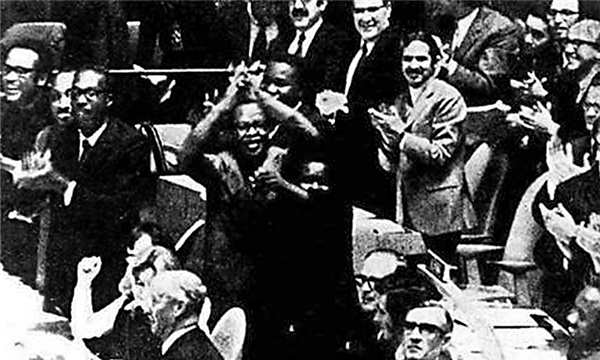
Yet the feelings among certain segments of New York's Chinese community were "quite raw" after the PRC triumph at the UN, Lai says. "The KMT had for many years focused enormous attention and resources on our communities in their efforts to cultivate support for Taiwan and the Nationalists. And remember, those were the days when the only business exchanges we had were with Hong Kong and Taiwan. It was no surprise if people didn't want to rock the boat."
As some residents of New York's Chinatown were harboring apprehension and even misgivings about PRC replacing Taiwan in the UN and its potential political implications, a cloud of "suspense" was hanging low over Patricia Koo Tsien and her fellow Chinese colleagues at the UN.
"These have been difficult days, and the future is bound to continue with some suspense," she wrote to her father, who lived in New York at the time, in a letter dated November 1, 1971, one week after Resolution No. 2758 was adopted.
"Although the general assurance is that the Chinese staff with Nationalist passports will not be affected, I think each case will probably be decided individually," she wrote. The letter and two others were provided to China Daily by Tsien's daughter Ying-Ying Yuan.
The all-too-wary US media were quick to pick up concerns such as Tsien's. "The some 400 Chinese in the UN Secretariat may present a problem," a New York Times article said. "Most are in uncontroversial posts as interpreters, translators and clerks, and in any event all members off the Secretariat are supposed by the explicit provisions of the Charter to be international civil servants responsible not to any country but only to the UN. However, experience with other Communist UN members shows that in general they treat their nationals in the Secretariat as full-fledged employees of their own Government and owing allegiance only to it."
Tsien's father V. K. Wellington Koo (Koo Vi Kyuin or Gu Weijun in modern Chinese pinyin), although in his 80s at the time, had every reason to be informed.
On June 26, 1945, as World War II was drawing to a close, Koo led an eight-person Chinese delegation at the signing of the UN Charter in San Francisco. Thanks to the fact that, alphabetically, China was the first country among the 50 whose representatives attended, Koo was the first person to sign, followed by the other Chinese delegates including Dong Biwu, a founding member of the Chinese Communist Party.
During the Chinese civil war between 1946 and 1949, Koo, as the Nationalist Government's ambassador to the US, worked tirelessly to drum up US support for the KMT. After Chiang Kai-shek's defeat, Koo continued in his role until 1956, focusing on maintaining the alliance between the US and Taiwan.
In fact, given the animosity between Beijing and Taiwan at the time-the fight for the UN seat had certainly aggravated the matter-even the UN secretary-general Kurt Waldheim felt compelled to send a mild alert to Tang Ming-chao (Tang Mingzhao), whom he appointed under-secretary-general in April 1971, following the UN tradition that each of the five permanent members of the Security Council be entitled to a top-level post in the UN Secretariat.
In Serving the United Nations: a Collection of Memoirs of Chinese Former International Civil Servants, a book coedited by Tsien and her fellow Chinese colleague Shing-Yi Huang, the ambassador's daughter recounted the incident:
"When Mr Tang was appointed to the Department of Trusteeship and Non-Self-Governing Territories he was informed by the secretary-general that the daughter of Wellington Koo was a member of the department and that if he found it inconvenient, I could be transferred to another department," she wrote. "But Mr Tang graciously told me of his decision to keep me, and this was for me the beginning of a new experience.
"Not only did Mr Tang not avoid me, but he would often call me in to ask me for some information or to meet his American friends. He would then introduce me as the daughter of Ambassador Koo."
In fact, none of the aforementioned worries that had informed what Tsien called "corridor talk" among UN's Chinese employees materialized.
"Just a note to tell you that word has gone around that Huang Hua told the SG (secretary-general) that the Chinese delegation does not intend to affect the continued service of the Chinese staff in the secretariat,"Tsien wrote to her father on Nov 11,1971. Huang, the head of the PRC's first permanent mission to the UN, would later met Tsien many times at tea parties given by the mission to Chinese UN staff, and as her host during her visits to China in the 1980s.
In fact, immediately after Resolution No 2758 was adopted, the 26th session had a position paper prepared by Shing-Yi Huang in anticipation of the resolution's possible effects on personnel arrangements in the secretariat.
"The PRC decision ... is a correct one as it upheld the SG's authority," says Huang, who by his own account was "enjoying his (professional) golden age" in the early 1970s. "It's also a smart one for the PRC to retain the multitude of veteran Chinese staff members who are well experienced and have distinguished themselves in many fields of UN activities."
A friendship soon developed between Tsien and Tang, so much so that years later Tsien would take her daughter Ying-Ying to visit Tang in his home in Beijing. But before that was a trip by Tsien and her husband Kiachi Tsien in the autumn of 1972 to see what Tang called "the new China".
"Arrangements were made for us to visit various places and institutions," Tsien wrote in Serving the United Nations. "Wherever we went we received detailed briefings. We thoroughly enjoyed this educational trip, which was a welcome for us to visit China on future home leave."
In doing that, Tsien found her life trajectory paralleling that of her friend Shing-Yi Huang: both first came to the US around 1947, and both waited for 25 years to return home.
"I was educated to be a diplomat at the Central Political University in China's wartime (World War II) capital Chungking (Chongqing) and joined (the Nationalist Government's) Ministry of Foreign Affairs as a junior officer," Huang, 98, says. "Two years later I was sent by the ministry to its embassy in Washington, DC to serve as an attache."















