


A man of character










Fascination with the history of Chinese language has been a driving ambition, Wang Linyan reports.
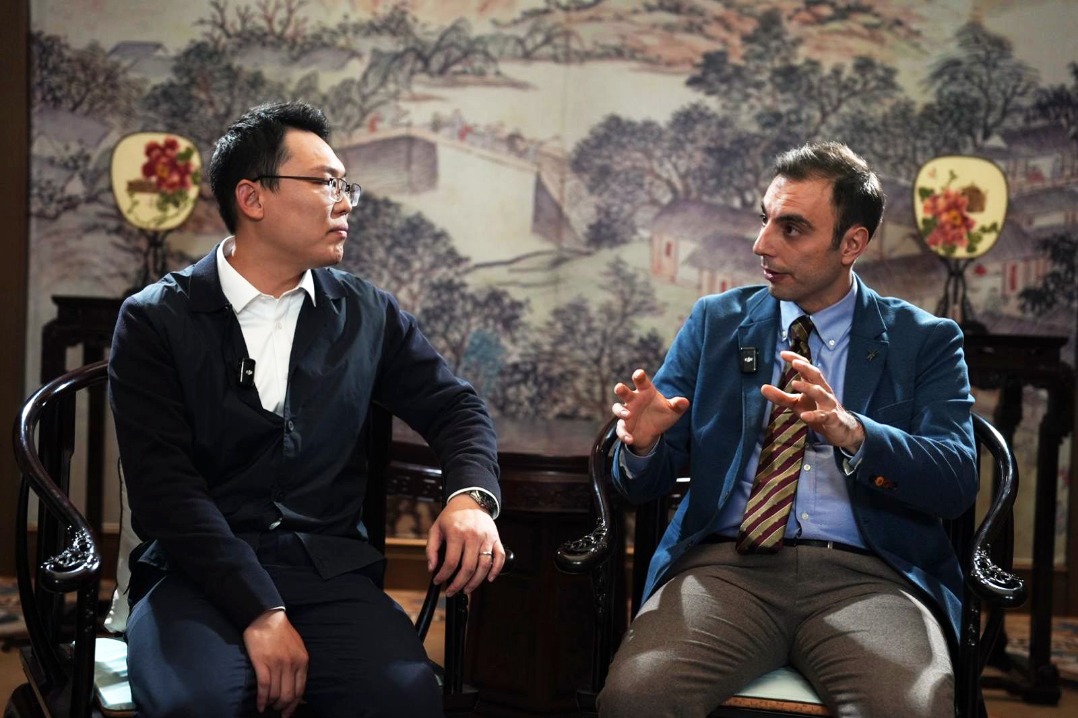
For the past three decades, Richard Sears, 71, has been focused on one thing: telling stories behind Chinese characters.
"What I do is to take every character and try to find its original pictographs and explain its original logic," he says.
Sears, nicknamed Uncle Hanzi by Chinese netizens, even designed a website for his sole passion. Hanzi means Chinese characters.
In order to explain the Chinese characters, he has built a database of 31,000 oracle bone characters from the Shang Dynasty (c.16th century-11th century BC), 24,000 bronze characters from the Zhou Dynasty (c.11th century-256 BC), and 48,000 seal characters (or zhuanti) of the Qin (221-206 BC) and Han dynasties (206 BC-220), as well as 11,000 from the book Shuowen Jiezi (an explanation of Chinese characters). The book was written in AD 121 in the Eastern Han Dynasty (25-220), one of the earliest books on Chinese characters' forms and origins.
Early interest
His interest in Chinese language and characters goes back to 1972, when he was a 22-year-old physics major at Portland State University in Oregon, the United States.
"I had checked across Canada and the US. And I was on my way to Africa," he recalls. "I wanted to see the world. But then I realized only 7 percent of the world speaks English as a mother tongue. So I wanted to know what it was like to speak another language."
Sears bought a one-way ticket to Taiwan to learn Chinese.
In Taiwan, Sears supported himself by teaching English. Two years later, he returned to the US to finish his study and went on to get a master's degree in computer science. He became a researcher at a US national lab after graduation, later worked as a software engineer at several companies in Silicon Valley.
By 1990, at 40, Sears was already pretty fluent in Chinese, but he did not know how to read, so he decided to learn to read and write Chinese. An average Chinese, for example, a high school graduate, knows about 5,000 characters and 60,000 character combinations. But to Sears, the characters were complex with many strokes and almost no apparent logic.
He says he found on some rare occasions, when he could get a step-by-step evolution of a character from its original pictographic form with an explanation of its original meaning and an interpretation of its original pictographs, it would suddenly become apparent how all the strokes had come to be.
"I'm a physicist, so I don't like blind memorization. I knew that Chinese characters came from pictographs and I wanted to know the stories behind the Chinese characters."
But all he had at that time was a book in English that was based on Shuowen Jiezi.