



Traditional brands lose edge against startups









Newcomers and domestic rivals doing better job at offering customers smart functions
The electric vehicles of traditional overseas carmakers are struggling to gain the same level of market penetration as their newer and domestic competitors.
The demands of Chinese customers vary from those in Europe or the United States as there is a much stronger emphasis on connectivity, smart functions, operating systems and driver assistance, analysts said.
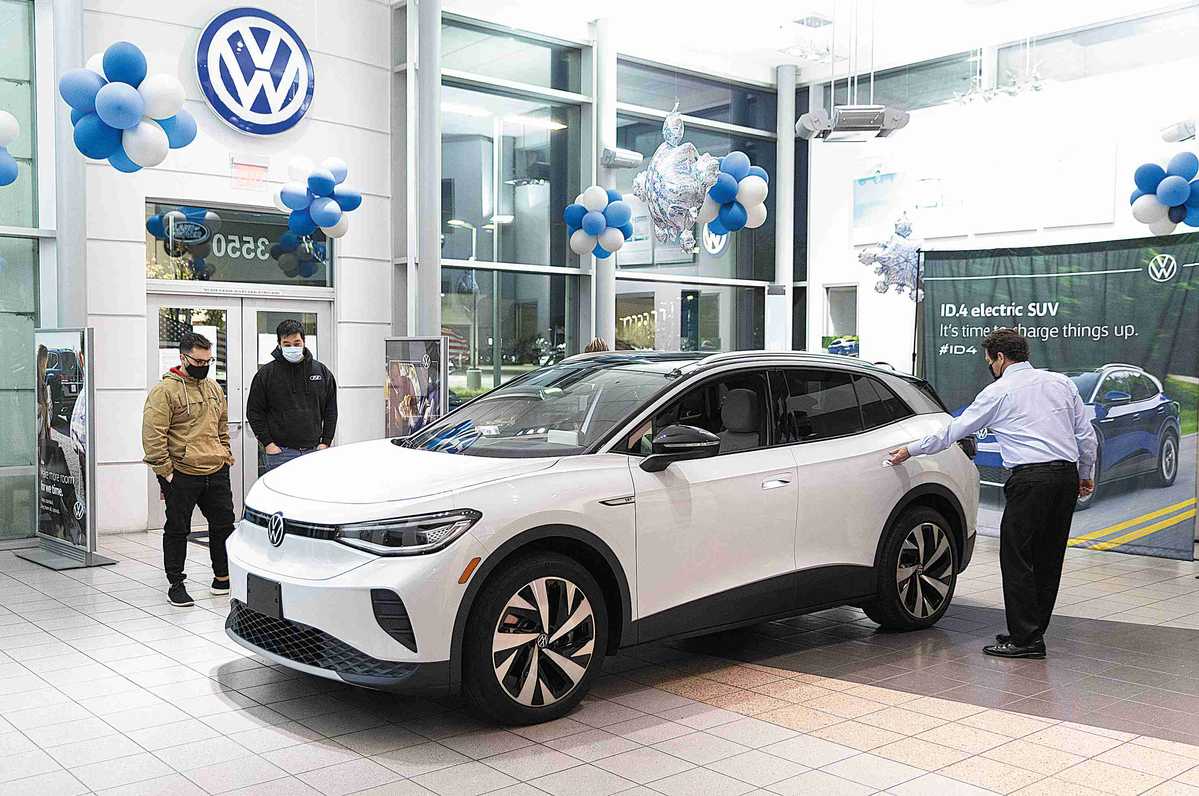
Germany's Volkswagen is the most popular car brand in China, with a roughly 20 percent market share. And it was one of the first international carmakers to offer electric vehicles in the country.
Its first two models based on the costly MEB platform started to be delivered in late March, another two larger ones followed in the middle of the year, and a fifth was launched last week to further enrich the offerings.
However, Volkswagen's target of selling 80,000-100,000 electric vehicles in China this year is falling way short. By the end of September, the German car company sold only 30,000 electric vehicles in China.
The automotive giant is lagging behind China's young startups, not to mention Tesla and BYD, who each sell over 30,000 cars a month and around 3 million NEVs a year in China.
"Electric cars designed and built with the idea of gasoline cars, which means they are good in every aspect but excellent in none, will not sell in this age," said Yale Zhang, managing director of consulting firm Automotive Foresight.
Zhang said it is especially true in the Chinese market, where dozens of startups are vying to present models that boast futuristic features including big screens, facial recognition, the latest in lidar and powerful computers.
He said that also explains why Volkswagen's ID series are popular in Europe but not in China.
"European buyers are usually older, more traditional, and they have better brand loyalty. But here, consumers prize new technology when it comes to electric cars," Zhang said.
Volkswagen is not alone. What Chinese consumers complain about most over electric cars from major international brands from Chevrolet to Hyundai is poor connectivity and difficult-to-use navigation systems, although they agree that their models have good handling.
Fu Chunyu, a 30-year-old office worker in Beijing, said she recently test drove a Hyundai but finally chose a local GAC Aion, admitting that what won her over was a better onboard operating system and its driving-assist functions.
Cui Dongshu, secretary-general of the China Passenger Car Association, said international volume brands' failure to offer smart and connectivity features on par with those provided by local ones are hurting their electric car sales.
The association's statistics show that 350,000 electric cars and plug-in hybrids were sold in September, up 184 percent year-on-year.
For Chinese carmakers, such vehicles accounted for 33 percent of their total sales, but for international joint ventures the figure was just 3 percent.
Cui said the situation may change in the coming years with international brands coming to realize the problem and begin tailoring electric models to appeal more to local customers, whose standards for electric cars have been set by Tesla and startups like Nio.
Besides customers, investors are refusing to value conventional carmakers the same way as startups too.
Last week, Swedish carmaker Volvo set the price for its initial public offering at 53 Swedish kronor ($6.18) per share, the lower end of its target of up to 68 kronor.
The offering would value Volvo at just over $18 billion, much less than the $23 billion valuation that the company had hoped to achieve.
Volvo seeks to sell only electric vehicles by the end of this decade and build a battery plant in Europe.
Potential new investors refused to value Volvo's business using the same math as used for new EV makers, saying Volvo's transformation strategy was bold but still unproven, according to The Wall Street Journal.
Instead, they indicated to Volvo that they were willing to value the company based on the lower multiples that traditional carmakers attract, one person familiar with the discussions said.
In comparison, New York-traded Nio is valued at $66.8 billion, New York-traded Xpeng $39.5 billion, and Nasdaq-listed Li Auto $35.7 billion, although they are much younger and sell fewer cars. And Tesla, which is expected to sell 1 million vehicles this year, is now the first-ever carmaker with a valuation of over $1 trillion.











