Xinjiang Population Dynamics and Data









II. Latest Demographics of Xinjiang
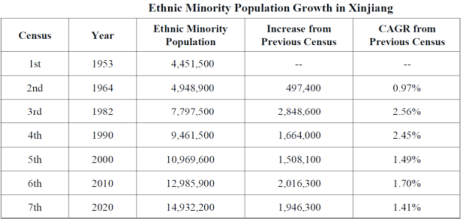
According to preliminary data from the seventh national census in 2020, the total population of Xinjiang was 25.85 million, among which the Han ethnic group numbered 10.92 million, and ethnic minorities 14.93 million.
Compared with the data from the sixth national census in 2010, Xinjiang ranked fourth among 31 provinces and equivalent administrative units on China's mainland in terms of the population growth rate. It ranked eighth in terms of the actual increase in population over that period. By 2020, Xinjiang's total population ranking had risen from 25th to 21st in the country.
Gender composition: Of Xinjiang's population in 2020, 13.35 million (51.66 percent) were male while 12.5 million (48.34 percent) were female. The male to female ratio was 106.85:100, basically the same as in 2010.
Age breakdown: In 2020, there were 5.81 million in the 0-14 age group, accounting for 22.46 percent; 17.13 million in the 15-59 age group, accounting for 66.26 percent; and 2.92 million in the age group of 60 and above, accounting for 11.28 percent. Compared with 2010, the proportions of people in the age groups from 0 to 14, and 60 and above were up by 2.01 and 1.62 percentage points.
In 2020, Xinjiang's share of people in the 0-14 age group was 4.51 percentage points higher than the national average of 17.95 percent; and its share of people in the age group of 60 and above was 7.42 percentage points lower than the national average of 18.7 percent. The aging of its population was relatively moderate.
Education: The average years of schooling for people aged 15 and above rose from 9.27 years in 2010 to 10.11 years in 2020, 0.2 years higher than the national average of 9.91, and ranking 10th across the nation.
Compared with 2010, the number of people with university education rose from 10,613 to 16,536 per 100,000 persons; those with high school education grew from 11,669 to 13,208; those with middle school education dropped from 36,241 to 31,559; and those with primary education fell from 30,085 to 28,405.
Health: The average life expectancy of people in Xinjiang was 74.7 in 2019, up 2.35 years from 2010. Infant mortality rate, mortality rate for children under five years of age, and maternal mortality rate went down from 26.58 per 1,000, 31.95 per 1,000, and 43.41 per 100,000 in 2010 to 6.75 per 1,000, 10.91 per 1,000, and 17.89 per 100,000 in 2020.
In 2019, practicing doctors and hospital beds per 1,000 persons numbered 2.7 and 7.39, up 0.58 and 1.93 over 2010.
Rural, urban and floating populations: In 2020, there were 14.61 million people living in the urban areas of Xinjiang, accounting for 56.53 percent; 11.24 million living in the rural areas, accounting for 43.47 percent. Compared with 2010, the urban population increased by 5.28 million and the rural population decreased by 1.24 million. The share of urban population went up by 13.73 percentage points.
As of 2020, the floating population in Xinjiang numbered 8.05 million, with 4.66 million moving within the autonomous region and 3.39 million moving to Xinjiang from other parts of the country. Compared with 2010, the floating population grew by 4.06 million, an increase of 101.78 percent.
Regional distribution: Xinjiang now has 14 prefectural-level areas-9 in northern Xinjiang and 5 in southern Xinjiang. In the past, there was a big population gap between north and south. The population of southern Xinjiang once accounted for over two thirds of the region's total. This gap has been gradually bridged thanks to economic and social development.
In 2020, the population of northern Xinjiang was 13.31 million, making up 51.48 percent of the total, up by 1.96 million from 11.35 million in 2010. The population of southern Xinjiang was 12.54 million, accounting for 48.52 percent of the total, an increase of 2.08 million from 10.46 million in 2010.





- 17 rescued Filipino crew members transferred
- Team of Chinese, US scientists identifies key tumor cell state driving cancer growth, drug resistance
- China successfully conducts first metal 3D printing experiment in space
- Debt-ridden children's hospital gains strong public support, but future still uncertain
- China hands over 17 Filipino sailors from shipwreck to Philippines
- Topography, extreme rainfall causes of Guizhou landslide, report says