China lead gives Chile faith in jabs for children









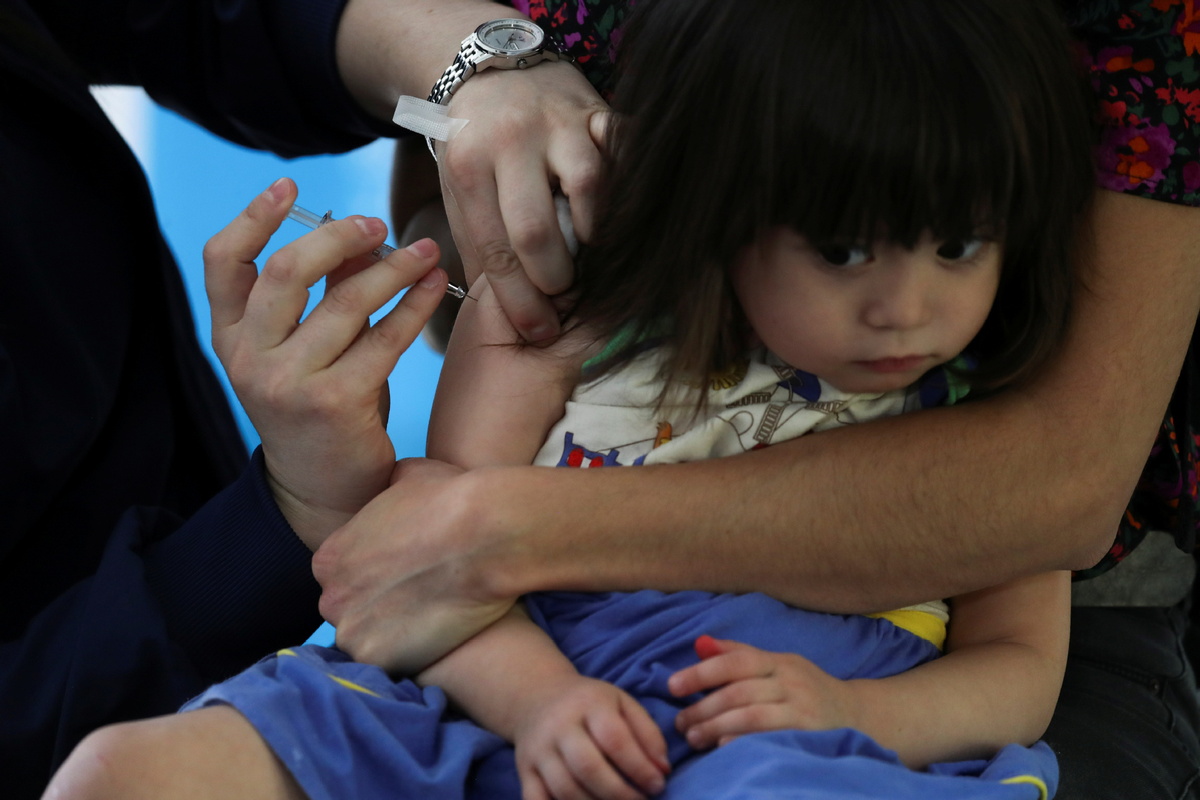
Pediatrician Juan Pablo Torres believes China's experience in vaccinating young children against COVID-19 gives him confidence that Chile is on the right path in following suit.
Torres, who is with the Faculty of Medicine of the University of Chile in Santiago, was speaking after the Public Health Institute of Chile gave the green light early this month for children as young as 6 to be vaccinated. They are getting a vaccine from Chinese drugmaker Sinovac Biotech.
"It has been administered to children with chronic diseases, as well as (those) with obesity," Torres said of the vaccination campaign, which has seen around 35,000 children get jabbed since Sept 13.
From Monday, "all children aged between 7 and 11 years old will be able to receive the vaccine", Torres said.
Chile's approval for the use of the Sinovac vaccine, called CoronaVac, for young children marks another milestone in the fight against COVID-19. Only a few countries, including China, are vaccinating children that young.
In granting the approval, Chilean regulators analyzed studies done on children in China. Torres was on the committee that reviewed and approved the use of the vaccine for minors.
"The phase I/II study was published in The Lancet Infectious Diseases (journal), and (Sinovac) also added a phase IIb study with safety data and adverse events data, for about 40 million children in China, with 63 million doses," Torres said. "That data showcased similar effects as those in older populations, without generating any safety concerns."
For the approval, it helped that Sinovac uses vaccine technology that relies on an inactivated version of the virus that causes COVID-19. The company has published its research widely in international peer-reviewed publications.
"The information published in international journals, going through all the review processes, has allowed us to provide the scientific basis to move to this new stage," said Sebastian Ugarte, director of the Critical Care Medicine Program at Andres Bello University in Santiago.
"But not only that, Chile is also joining a research project, with the recruitment of minors, to add evidence in a phase III study."
Ugarte praised the move by Chile's regulators to extend the vaccination campaign in the country. To date, Chile has vaccinated about 88 percent of the target population, excluding minors.
"With the emergence of new variants, higher infection rates occur in some cases," he said. "This makes it more difficult to reach the elusive threshold of herd immunity and it is not enough to vaccinate 70 or 75 percent of the adult population. Even higher numbers are required.
"In that sense, vaccinating schoolchildren could be an important addition to the vaccination program that has already advanced in Chile."
'With calm, safety'
Torres said: "The data already shows that (unvaccinated) children are increasing the number of those who get infected. This vaccination strategy has to do with calm, safety and trust for the children, while also protecting teachers at the same time."
Data shows that only about 12 percent of COVID-19 cases in Chile are in people aged under 18 and just 1.7 percent of those required hospitalization.
Jerome H. Kim, director-general of the International Vaccine Institute in Seoul, South Korea, said: "The approval of Sinovac for children 6 years of age and older is an important step in the establishment of broad immunity in a population.
"Importantly, we need to verify that vaccination of this age group has similar effectiveness and, more importantly, impact in the control of COVID-19 in countries."
Overall, the Sinovac shot has accounted for about three-quarters of all COVID-19 vaccine doses given out in Chile.
The South American country has also approved the use of the Pfizer vaccine on children as young as 12. At the time of the regulator's approval for the Sinovac vaccine on children, Chile did not have any stock of the Pfizer vaccine left, said Lorena Bustos, a director of LabCom, a healthcare public relations firm in Santiago.
"It is now expected that the vaccination campaign in minors will be well accepted. A key fact of the vaccination campaign is that it will be conducted at schools," Bustos said. "It is important for children to be vaccinated, to prevent them from becoming reservoirs (for the virus)."
Doris Yu in Hong Kong contributed to this story. The writer is a freelance journalist for China Daily.