



Despite COVID woes, Epson set to seize 'new opportunities in China'









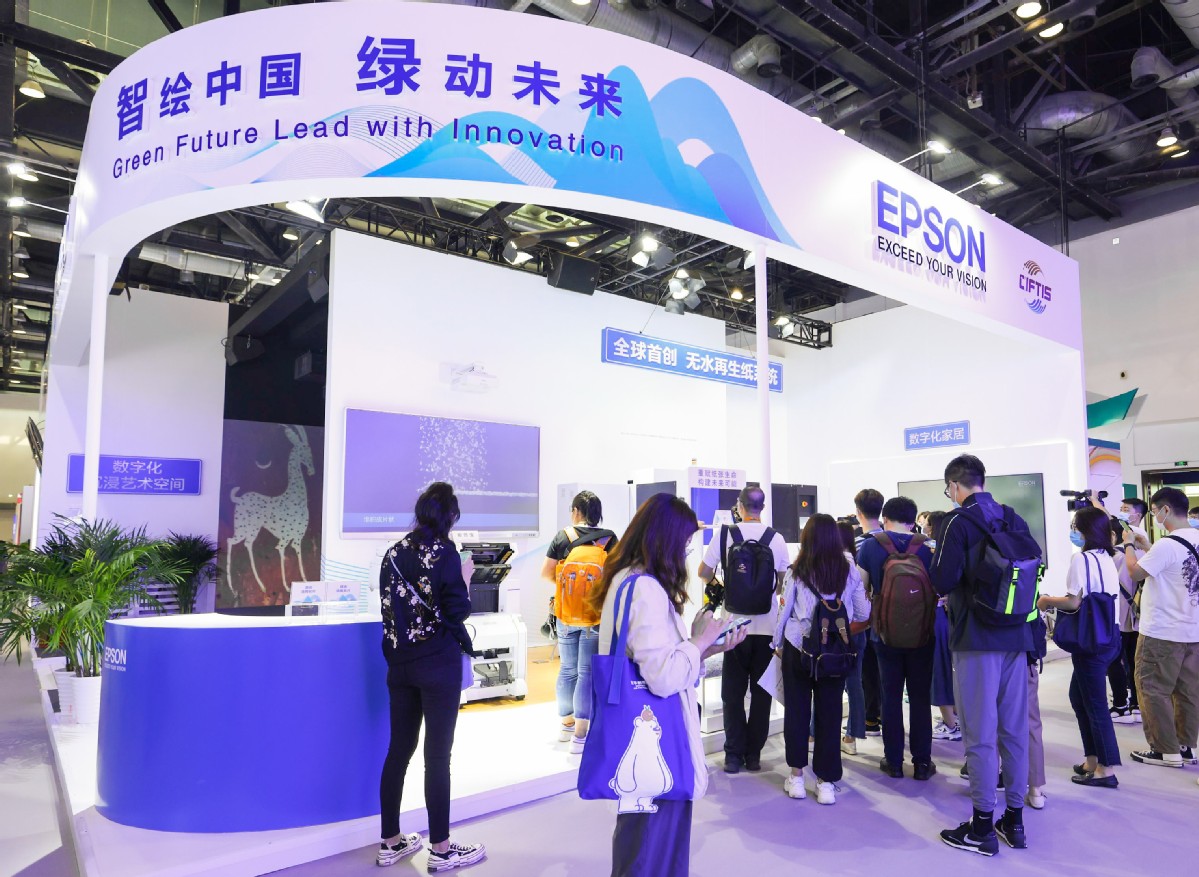
Japanese electronics maker Seiko Epson Corp, commonly known as Epson, is accelerating efforts to expand its presence in China through technology innovation and by enhancing its localization strategy, in a bid to offer more eco-friendly products in the Chinese market.
Akihiro Fukaishi, president of Epson China, said the company's sales revenue in China increased 14 percent in fiscal year 2020, compared with the same period in 2019, and it aims to achieve double-digit growth this year.
Fukaishi said the Chinese market is one of the most important markets in Epson's global layout. It has witnessed rapid growth in three domains in China, including inkjet printers, robotics, and print heads-its core technology.
Epson began to sell print heads separately in China in 2019. Fukaishi said the print heads are expected to bring new business opportunities for large-format printing equipment manufacturers. Moreover, the robotic technology will help bolster the development of China's smart factories, and greatly improve the working environment of employees, he added.
"China has effectively controlled the COVID-19 pandemic with scientific and potent prevention and control measures, and the economy is recovering steadily. Although the contagion has brought about some shocks to Epson's business, we have seen new opportunities in China," Fukaishi said.
He said working and learning at home have become the norm for Chinese clients during the pandemic, which has stimulated the sales of Epson's ink tank printers and home projectors.
"Along with the development of digital printing, our print head business has grown rapidly, so we have full confidence in the Chinese market," he said, adding they may consider expanding product lineups in Chinese factories and increase the production capacities.
Founded in 1942, Epson is focusing on leveraging its efficient, compact and precision technology and speeding up localization efforts in China to boost technology innovation. So far, Epson has invested more than $822 million in the Chinese mainland, and owns six manufacturing, sales and service organizations.
Market consultancy Futuresource Consulting Ltd said the cumulative sales of Epson ink tank printers in China reached 9 million units. Its projector business has continued to be market leader in China for 19 consecutive years, accounting for 42 percent in the global market.
In addition, Epson has carried out cooperation with Chinese partners in the field of printing, visual communications and robotics. It launched printers supporting Huawei's smart home connection standard HiLink. With wireless networks and Huawei's application, all Android phones can connect to Epson's new printers, enabling people to easily print documents and pictures directly from their phones.
The company also carried out cooperation with Tencent Video Aurora TV to jointly build intelligent projection products.
China's new dual-circulation development pattern, which takes the domestic market as the mainstay while letting domestic and foreign markets reinforce each other, is a great opportunity for Epson, Fukaishi said.
Epson showed some new products at the 2021 China International Fair for Trade in Services, held in Beijing from Sept 2 to Sept 7. It showcased green and eco-friendly products and innovations, such as PaperLab, which employs Epson's dry fiber technology to produce new paper from used material without water, and heat-free technology that does not require heat in the ink ejection process.
As stated in Epson's Environmental Vision 2050, which was revised on March 18, the company seeks to become carbon negative and eliminate use of exhaustible underground resources such as oil and metals by 2050.
Fukaishi agreed with China's goal to peak carbon emissions by 2030 and achieve carbon neutrality by 2060. "Our vision is consistent with China's dual carbon goals and in line with the concept of green development," he said, adding they will make contributions to the environment issue.
In recent years, foreign companies have stepped up localization efforts in China and foreign investment will grow into a very important part of the country's economy, along with China's further opening-up, said Zhang Yansheng, chief researcher at the China Center for International Economic Exchanges, adding more efforts are needed to create a better business environment.




















