


On the body of a stone statue of a mythical creature placed inside a mausoleum in Gongyi city, Henan province, a line traced by muddy yellow water is clearly visible. The relic dating to the Song Dynasty (960-1279) has endured wind and rain for over 1,000 years but never before did any of the storms cause such a lasting impact.
Starting from July 16, record rainstorms inundated the province. Multiple cities in Henan reported staggering precipitation.
The region has been long known for its cultural relics, and emergency work was already going on to safeguard the heritage.
Raging rainstorms had battered the provincial capital, Zhengzhou, for over 36 consecutive hours, affecting urban life. Traffic, electricity and telecommunication were all suspended due to the downpour.
Part of its ancient city walls dating back more than 3,600 years was mistakenly reported to be washed away by the flood in Zhengzhou.
"Fortunately, it was merely the protective layer of rammed earth that had been carried away," says Ren Wei, director of the city's cultural heritage administration.
But the nearby archaeological sites were not lucky enough.
The low terrain near the sites, coupled with deep excavation pits, made the sites vulnerable to flooding, says Liu Haiwang, head of the provincial institute of cultural relics and archaeology.
On July 22, an archaeological site at the Yin Ruins, a UNESCO World Heritage Site, and a workshop site that used to make pottery and bone artifacts in the Shang Dynasty (c.16th century-11th century BC) were flooded.
"The flooding at the workshop site once reached 50 centimeters higher than the surrounding maize seedlings," says He Yuling, deputy chief of the Anyang station, part of the Institute of Archaeology, Chinese Academy of Social Sciences.
Henan boasts more than 65,500 immovable cultural heritage sites, occupying about one-tenth of China's total, and over 23,000 of these sites are ancient architectural spots. Most of the cultural relics are ancient city and tomb sites-most vulnerable during prolonged rain.
More than 400 sites, cultural relic institutions and museums had been affected by the heavy rainfall in the province.
"I cannot save all the relics or guarantee that none of them will be harmed by the floods," writes Tian Kai, director of the Henan Provincial Administration of Cultural Heritage, in a social media post.
"Luckily, five world cultural heritage sites in the province were safe and intact. No destructive damage has been found in Henan's protected cultural relic sites and relics preserved in our museums had not sustained any damage," Tian adds.
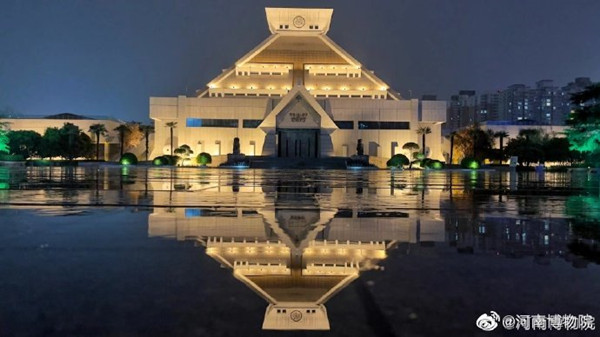
The Zhengzhou Museum had just been moved to a new location before the devastating rainfall. The water on the museum's roof soon topped the ventilation pipes and ran down the pipes into the hall, recalls Guo Chunyuan, deputy curator of the museum.
Ten pumps were rushed to the site, but they could hardly resist the crushing blow of the rainstorm. Museum staff members relocated stone carving works on the first floor and bronze ware on the second floor to the storage area upstairs. The rescue mission continued until the early morning of the following day.
"Carrying a colossal tripod cooking vessel in my left hand and an ancient wine vessel in the right hand on my way up the stairs evoked a strong sense of mission in me," says Fan Xueyang, who is with the museum.
These museum workers are not alone in keeping China's past footprints safe and sound.
Over 1,500 soldiers and volunteers worked concertedly to reinforce and raise the walls of the river dam as ancient city walls were flooded in Xunxian county.
Meanwhile, the Longmen Grottoes, a UNESCO World Heritage Site in the city of Luoyang, had nearly 1,000 staff members and volunteers clean up the sludge and maintain the facilities.
Rescue workers were also stationed on a bridge traversing the Grand Canal, which links Beijing and Hangzhou in Zhejiang province, holding long poles to clear anything that might block the bridge's entry point.
The central government and people from all walks of life pooled relief materials and collected funds to support the rescue of relics. Pumps, display cabinets and other facilities were donated to the province to help facilitate restoration work after the disaster.
The rain-ravaged Henan also got people thinking.
"Though some sites have reserved drainage channels in advance, their design can only handle precipitation a bit higher than the region's average annual rainfall. They are not capable of avoiding being waterlogged in the face of surging water levels," says Ren, director of Zhengzhou's cultural heritage administration.
The Henan Provincial Administration of Cultural Heritage has vowed to initiate a feasible post-disaster repair and protection work plan on the basis of sufficient investigation and research as soon as possible.
"Cultural relics are central to the Chinese civilization, and none shall be easily discarded," says Tian.








