



Kamala Harris can't rescue US' credibility in Southeast Asia









Kamala Harris's visit to Southeast Asia aims to convey that the US has an enduring commitment to the region and is in Southeast Asia to stay to counter China's influence in the region. It will have little success.
China's ties with the region are at an all-time high as US' credibility took a nose dive. Harris is visiting a region still smarting from a series of US diplomatic gaffes dating back to the Trump era. Most recently, the decision of Secretary of State Antony Blinken to visit Japan, India and South Korea but not Southeast Asia was widely viewed as a snub. This followed Blinken's no-show at a virtual meeting in which he kept Southeast Asian foreign ministers staring at a blank screen before cancelling citing technical glitches.
What's more damaging is what happened and is still unfolding in Afghanistan. Countries like Singapore and Vietnam look to the US for security guarantees, and they are watching US bungling up its longest military operation in history. The US' decision to pull out all of its forces, leaving behind a potential humanitarian disaster and a risk of civil war is casting doubts around the world about the superpower's commitment to its defense partners.
Harris's trip to Vietnam after Singapore will take her to a country which US abandoned in the 1970s after years of intervention in a civil war that tore the fabric of Vietnamese society and cost an untold number of lives. No matter what Harris says in Vietnam, her words will be overshadowed by the parallel between chaotic evacuation in 1975 from the former Saigon, now Ho Chi Minh City, and the panicked scenes of Afghans who cooperated with US occupiers being abandoned in Kabul – something that President Joe Biden calls inevitable.
Indeed, it seems that being abandoned is inevitable if you put too much faith in the United States. Words come easy. But former President Barak Obama's so-called pivot to the Asia-Pacific and former President Donald Trump's "Free and Open Indo-Pacific" had led to few concrete results. Obama's proposed Trans-Pacific Partnership was abandoned by the US at the last minute, opposed by Democrats and Republicans alike, letting down countries like Malaysia, Singapore and Vietnam. The only remaining trace of Obama's pivot policy is periodic cruises through the South China Sea by US warships.
The question is: Would the US actually engage in a war in the South China Sea or the Taiwan Straits? Events in Afghanistan, Syria and Iraq cast doubt on the political will of the US to make a lasting military commitment overseas.
And on a more fundamental level, does the US have the military capacity to wage war successfully half-way around the world? US top military officials fear they would lose this battle. During a discussion of a war-game simulation involving Taiwan, Vice Chairman of the Joint Chiefs of Staff General John Hyten told an audience last month that efforts to defend the rogue island failed miserably. Separately, the US top military officer in the Asia-Pacific, Admiral Philip Davidson, said during a US Senate Armed Services Committee hearing earlier this year that China could "unilaterally change the status quo" in Taiwan "before our forces may be able to deliver an effective response."
Vice President Harris is trying to persuade Southeast Asian leaders that the US still has the will and capability of providing security assurances in the South China Sea and the Taiwan Straits. But as the US focuses its diplomatic energy in Asia on the Quad with India, Japan and Australia and with its goal of slowing China's rise, the countries of Southeast Asia may start questioning how many common interests the region shares with the US After all, Southeast Asia is now China's biggest trading partner, ahead of the EU, US, Japan and South Korea.
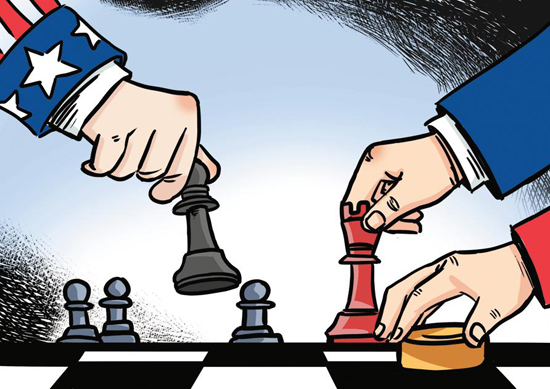
When China prospers, the entire region prospers. The last thing they want is to choose between the US and China or be a chess piece in US' grand game to contain China.
Harris's visit to the region cannot change these historical and current realities. Her promises, however glowing they may be, will be shadowed by a series of failures and betrayals. She can't rescue the tanking US credibility.





