



Document offers guide to heritage protection









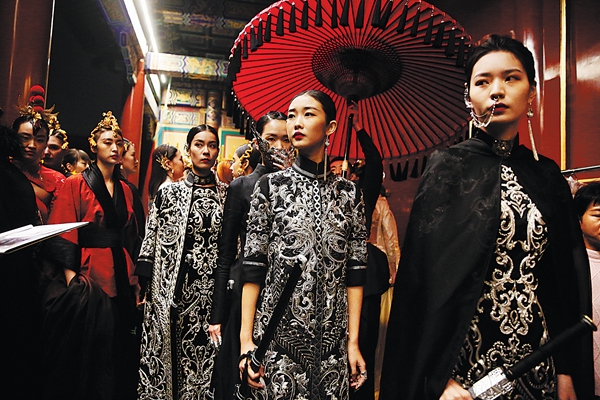
A new national-level guiding document for the protection and inheritance of intangible cultural heritage was released last week.
The document, Opinions on Further Enhancement of Protection of Intangible Cultural Heritage, was co-released by the general offices of the Central Committee of the Communist Party of China and the State Council, China's Cabinet.
Twenty terms are included in the framework document to comprehensively guide the protection work from various fields, ranging from registration and recording, nurturing of young inheritors through relevant publicity and education programs, to stronger support for the legal and fiscal systems.
For example, courses on intangible cultural heritage will be included throughout the syllabus of the national public education system. More efforts are urged to better enable protection of intangible cultural heritage to serve the country's general national strategies and international communication.
The new document was drafted to inherit and develop traditional culture in a creative way, to match the outline of the 14th Five-Year Plan (2021-25) and the Long-range Objectives Through the Year 2035, says an official of the Ministry of Culture and Tourism.
"In recent years, many precious, endangered and significant heritage items were saved, with the participation of the public," the official says.
"But our protection work still faces challenges due to industrialization and urbanization. Also, young people still lack awareness of the inheritance of heritage."
Top-level design of the system still needs to be improved to better reflect the country's long history and rich culture through intangible cultural heritage, he adds.
The official points out that a highlight of the document is promoting intangible cultural heritage protection in the construction of key infrastructure in Xiong'an New Area and the Beijing subcenter in Tongzhou district, and fully displaying its role in rural revitalization, especially in areas that have emerged from absolute poverty.
In June, the Ministry of Culture and Tourism released a new set of 325 national-level intangible cultural heritage items, increasing the list, started in 2006, to 1,557 items.
Sun Dongning, executive director of the National Intangible Cultural Heritage Exhibition and Research Center, says the new framework document emphasizes the importance of publicity for the items, which is a key to usher intangible cultural heritage into modern people's daily life.
Sun says elements of intangible cultural heritage will be developed into fashionable products of today. "That's how traditional culture can be cherished by modern people."
The annual China Intangible Cultural Heritage Expo and the events celebrating the National Natural and Cultural Heritage Day, which falls on the second Saturday of June, among other platforms have become crucial avenues for the promotion and publicity of traditional culture.
However, the veteran industry observer says the previous approach to protecting intangible cultural heritage often focused on individual items, and that the systematic work of creating a larger picture of intangible cultural heritage still needs more effort.
In 2020, a regional base of the National Intangible Cultural Heritage Exhibition and Research Center was established in Guangzhou, Guangdong province, to cover the country's south. The center also functions as part of the national plan to promote traditional crafts.
Sun says the facility also offers opportunities for the joint exhibition of relevant items from the Guangdong-Hong Kong-Macao Greater Bay Area, and areas along the ancient Maritime Silk Road.
A protection alliance on intangible cultural heritage along the Yellow River was also launched last year in Jinan, Shandong province. A major exhibition on relevant items is planned in the future. Both the Bay Area and the Yellow River area are among places listed in the new document.
Separately, 30 national-level protection zones of cultural ecology and 20 national exhibition centers for intangible cultural heritage will be set up by 2025.