


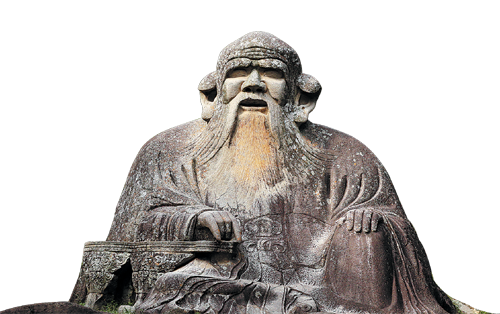
"That religion was quite adaptive," Wu says. "When it spread to the West, it absorbed some doctrines of Christianity, and when it came to the East, it fused with Buddhism, and was thus acceptable for locals. Manichaeism is a perfect example of East-West cultural communication."
Manichaeism had no idolatry in its original tradition, and that explains why Mani statues were so rare around the world. However, during the Yuan Dynasty, when Quanzhou became a world-class trading center and its rulers showed great inclusiveness toward various religions in the city, Manichaeism became localized at a deeper level.
"Consequently, this statue of Mani in Cao'an wears a Taoist robe while he sits on a lotus throne, which is a typical Buddhist image," Wu says. "And its appearance was also influenced by folk beliefs of the local community."
A group of contemporaneous stone inscriptions by the statue also offer a precious reference for people to see the doctrines and rituals of Manichaeism, as well as how it was developed in Quanzhou.
Manichaeism in Quanzhou faded away during the Ming Dynasty (1368-1644), but the statue remained and was protected by locals for generations as their patron god.
"The statue survives to testify to a dialogue between foreign and indigenous cultures," Wu explains.
Numerous religious relics in Quanzhou may combine to portray a harmonious picture on cultural diversity during the Song-Yuan era, ranging from the Christian tomb stones exhibited in the Quanzhou Maritime Museum to the Qingjing Mosque, which was first built in 1009 as the first mosque in the city, also part of the World Heritage inscription. The mosque was rebuilt in 1310 thanks to the patronage of a pilgrim from Shiraz, Iran. It thus features the typical medieval Middle Eastern architectural style.
In the archaeological ruins of Deji Gate site-the southern gate of ancient Quanzhou city which is also among the 22 inscribed heritage sites-Christian and Islamic patterns were even found on the same stone carving.
In spite of all the diverse cultures gathering in this harbor, the indigenous culture in Quanzhou during the Song-Yuan era still proved its vitality and influence through other temples included in the World Heritage List.





