


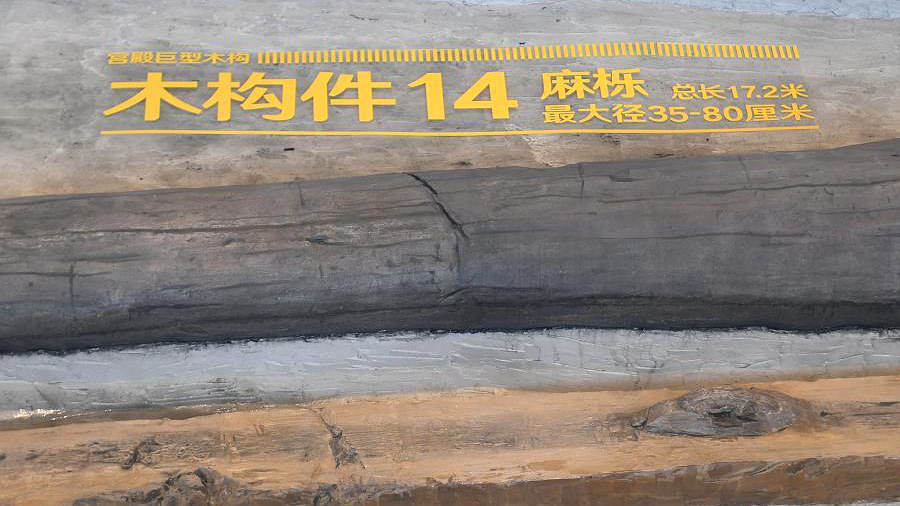
Six restored giant wooden pillars of an ancient palace at the Archaeological Ruins of Liangzhu city, a UNESCO World Heritage Site in East China's Zhejiang province, have been unveiled to the public for the first time.
Made with 3D printers, the columns on display are high-tech, full-scale replicas of some 5,000-year-old components unearthed at the archaeological ruins of the ancient city that existed between 3300 B.C. and 2300 B.C.
According to the archaeologists, the components date back to the period when the Mojiaoshan Palace was constructed.
A total of 15 giant wooden components were found in the watercourses at the 5,300-year-old archaeological site. The discovery showed that people living at the time were able to build large-scale structures, such as palaces, over 5,000 years ago.
The longest component on display is 17.2 meters and the thickest is 80 centimeters in diameter, said Qian Qinying, a tour guide at the site.

Square holes called mortise, important building structures used to connect two wooden parts in ancient Chinese architecture, can be seen on some of the components.
Sun Haibo, deputy director of the Cultural Relics and Heritage Administration under the Liangzhu Archaeological Site Management Bureau, noted that the wooden components might have been used to strengthen the stability of the palace during its construction. They might also be part of the building blocks of the palace, much like beams or pillars.
The components required several years of dehydration treatment. The exhibits are almost indistinguishable from the original ones in appearance.
"This is our first time to use 3D printing technology for relic restoration. Visitors will be able to look closely at the components and imagine what the palace would have looked like 5,000 years ago," said Sun.
The new technology can protect the cultural relics from the damage caused during the mold reversal and demolding process.
The wooden components are on display as part of the Liangzhu Cultural Week from July 6 to 12. The annual event, now in its second edition, invites experts to discuss the protection and promotion of the Liangzhu ruins and its culture.
The Liangzhu Archaeological Site was declared a World Heritage Site in 2019 as it provides profound and compelling evidence that Chinese civilization started 5,000 years ago, 1,000 years earlier than previously thought, and is a testimony of an early organized state featuring an agrarian economy centered on rice cultivation and social status hierarchy.





