


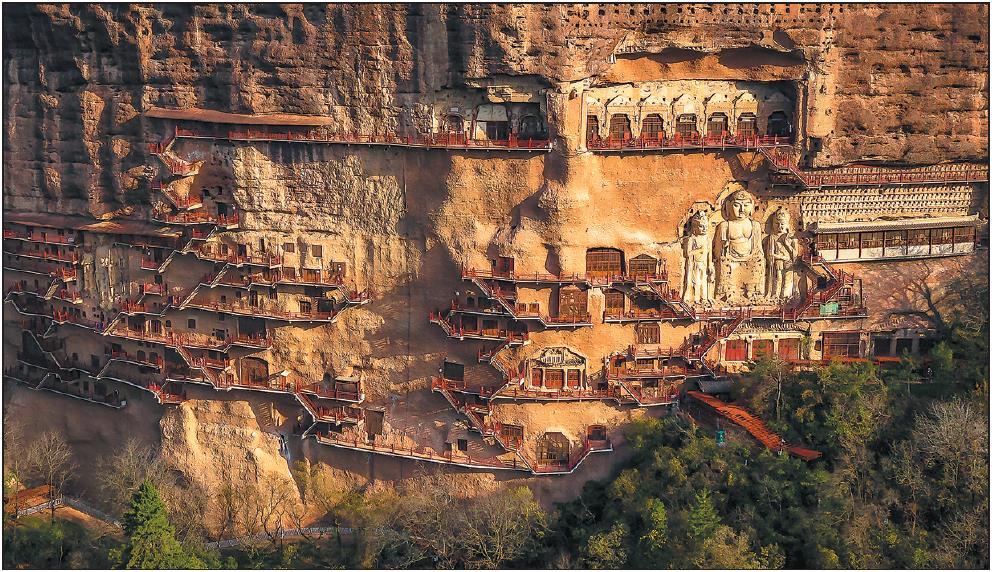
The steep canyons, deserts and grasslands make the natural landscape of the Yellow River basin magnificent and beautiful. The basin also has many cultural relics. Along the river path, there are 20 World Heritage Sites, more than 300,000 non-movable cultural relics, 649 national intangible cultural heritages, 47 national holistic tourism demonstration areas and 84 national top-rated tourist attractions.
In September 2019, President Xi Jinping emphasized the importance of ecological conservation and high-quality development of the Yellow River basin. Xi says that protecting the Yellow River-China's second-longest river at 5,464 kilometers-is crucial to national rejuvenation and the sustainable development of future generations.
The Ministry of Culture and Tourism recently launched 10 themed routes around the Yellow River. China Daily takes a look at some of the highlights.
Civilization charm
Both the Yangtze River and the Yellow River have nurtured the nation and bred Chinese civilization. A number of museums in the region showcase the great charm the civilization holds.
? Qinghai Museum
Located mostly on the Qinghai-Tibet Plateau, Northwest China's Qinghai province has long been a melting pot for ethnic groups including the Han, Tibetan, Hui, Tu and Mongolian. The Qinghai Museum preserves a collection of more than 14,000 cultural relics. It is especially known for the chipped stone tools from the Paleolithic Age, colored pottery from the Neolithic Age, bronze mirrors and inscriptions from the Han (206 BC-AD 220) and Tang dynasties (618-907), paper money and stone statues from the Yuan Dynasty (1271-1368), and porcelain and paintings from the Ming (1368-1644) and Qing dynasties (1644-1911).
? Ningxia Museum
The museum is a great place to spend an afternoon in Yinchuan, the Ningxia Hui autonomous region. There are a vast array of exhibits ranging from historical records and texts dating back to more than 1,000 years ago to the remains from prehistoric inhabitants of Ningxia, including primitive tools and artifacts, stone weaponry, jade ware, ancient currencies and totems.
? Inner Mongolia Museum
The museum displays a large number of fossils from paleontological eras, including dinosaurs from across the Inner Mongolia autonomous region. There are also 44,000 relics bearing witness to life in ancient times. In particular, Mongolian female clothing from different places and statues as well as religious relics are the biggest attractions for most visitors to the museum.
? Shanxi Museum
The museum in Shanxi province houses over 400,000 cultural relics, epitomizing historical and cultural development in Shanxi over a long course of history. The museum has exhibitions that follow history in chronological order and showcase highlights of civilization. The exhibits also define the unique contributions Shanxi has made to the 5,000-year evolution of Chinese civilization.
? Henan Museum
Located in Henan province, the museum is home to a collection of 170,000 relics and is particularly known for its prehistoric artifacts, bronzes from the Shang Dynasty (c.16th century-11th century BC) and the Western Zhou Dynasty (c.11th century-771 BC), as well as ceramics and jade ware. The central plain area is a major cradle for Chinese civilization to thrive, and cultural relics from the museum are testament to the development of Chinese civilization and history.
? Shandong Museum
The museum from East China's Shandong province hosts a collection of historical bronze vessels, paintings and calligraphy works, rare books, as well as animal and plant specimens and ancient fossils. Not to be missed are relics bearing the Neolithic Dawenkou and Longshan cultural elements, bronze artifacts from the Shang and the Western Zhou dynasties, and stone carvings from the Han Dynasty.





