


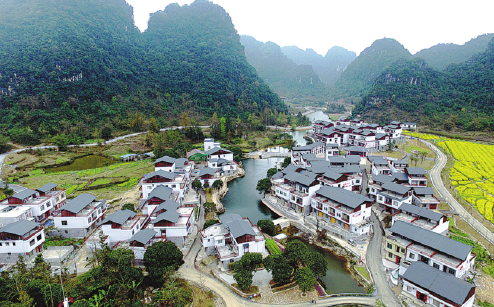
A city steeped in revolutionary history is cultivating agricultural produce that is significantly changing people's lives
Today, Baise, a city in South China's Guangxi Zhuang autonomous region, is no longer only known as a crucial former revolutionary base where Deng Xiaoping, "chief architect" of the reform and opening-up policy, and other great leaders started the Baise Uprising against imperialism and feudalism in 1929.
That year, they founded the Youjiang Revolutionary Base in the city, and the following year, Deng led the Longzhou Uprising and established the Zuojiang Revolutionary Base.
The two bases covered an area of more than 50,000 square kilometers and involved more than 1 million people, according to Wang Changwen, a senior official with the Baise Uprising Memorial Hall, which opened in 1999.
"They were among the nation's most prominent revolutionary bases at the time," Wang said, adding that the uprisings ignited the people's desire for freedom and emancipation.
Ma Gao, a researcher at the memorial hall, said those early revolutionary activities left a host of valuable Red cultural heritage items and spiritual wealth for the locals in Baise.
Over the past 70 years, people of various ethnicities in the city have continued to follow the leadership of the Communist Party of China and strive for prosperity through socialism with Chinese characteristics.
Guangxi sits in the subtropical zone, and its unique geographical location and climate mean the land is fertile and highly suitable for the cultivation of a rich range of fruit.
In 2015, mango cultivation in Guangxi surpassed that of Hainan province, ranking it number one in China. Two years later, mango cultivation in the autonomous region accounted for about 35 percent of all such activity nationwide.
Meanwhile, in 2019, Mangoes accounted for about 4 percent of Guangxi's total fruit production and for 21 percent of the production of tropical fruit in the autonomous region. Since the 1980s, Baise has used mango cultivation as a pillar industry to revitalize the economy and improve local lives, especially for people living in former revolutionary areas.
The city's Youjiang district and Tianyang and Tiandong counties are renowned for their mangoes, while the locally grown fruit has become a national brand during the past three decades of industrial development and played a positive role in alleviating poverty.
In 2014, the Baise government decided to step up efforts to develop the mango industry and raise rural incomes.
By 2016, the city's mango plantations covered 80,000 hectares, the biggest such plantations nationwide, according to local authorities. By the end of 2019, Baise's plantations covered an area of 86,000 hectares, with annual production of 627,400 metric tons and total production value of 4 billion yuan ($608.5 million).





