



China's artificial sun brings nuclear fusion energy closer









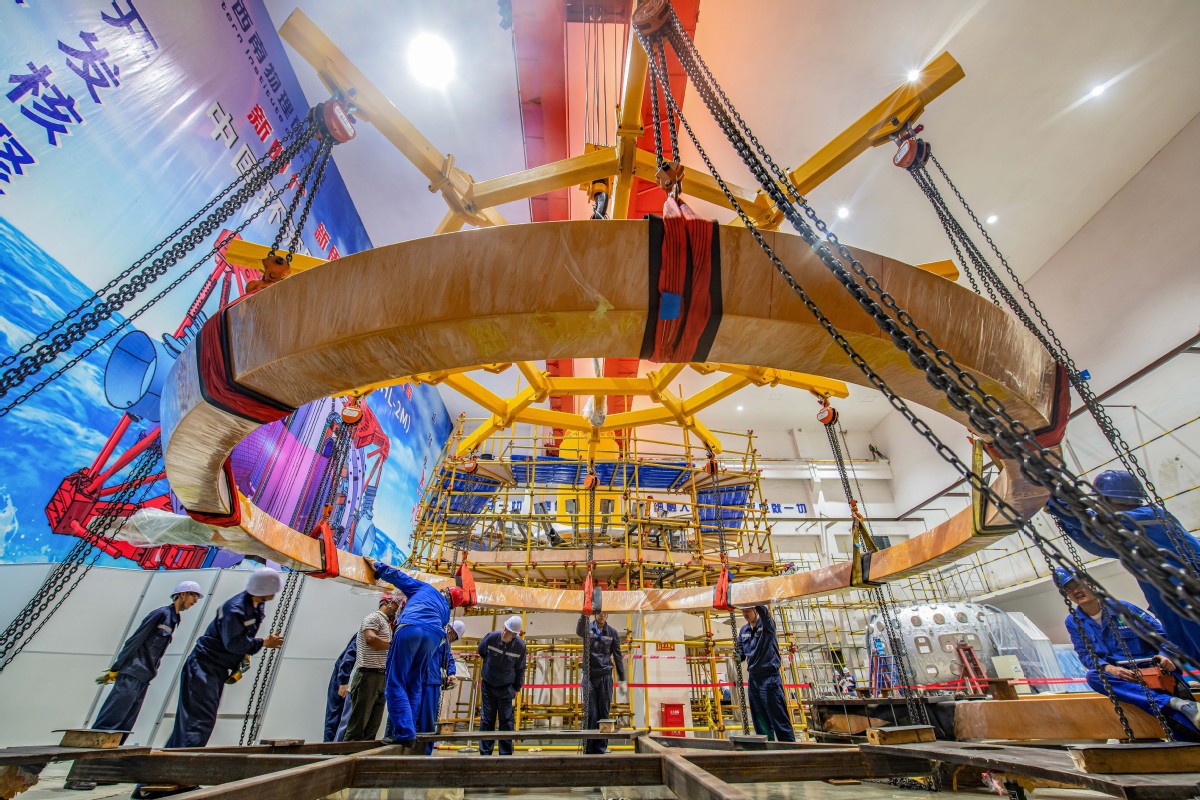
On Friday, Hefei Institutes of Physical Science, part of the Chinese Academy of Sciences, ran its experimental controllable nuclear fusion device and kept the plasma stable at a temperature of 120 million degrees C for 101 seconds and at 160 million C for 20 seconds.
The previous record was 20 seconds at 100 C set by the Korea Superconducting Tokamak Advanced Research (KSTAR), the Republic of Korea's superconducting fusion device, on Dec 28.
In popular reports, the Chinese device is nicknamed the "Chinese artificial sun", and its latest milestone means humankind has made further progress toward the goal of using nuclear fusion as a source of energy.
Unlike nuclear fission power plants which split atomic nuclei apart, nuclear fusion merges atomic nuclei to potentially create huge amounts of cheap and clean energy. The deuterohydrogen contained in one liter of seawater would provide energy equivalent to burning 300 liters of gasoline, without emitting any pollutants that harm the environment, since the by-products are helium and neutrons. That's why researchers are paying huge attention to this technology.
The challenge is maintaining high-enough temperatures for a long enough period of time for the technology to be viable. The device needs to raise the temperature of the plasma to above 100 million C, as well as confine it within a small space.
In order to solve this problem, there is both competition and cooperation among major researchers. On July 28, 2020, China, the European Union, India, Japan, the Republic of Korea, Russia and the United States co-launched the International Thermonuclear Experimental Reactor in Paris, which is a major collaborative project. Scientists in various countries are also doing separate research.
Although nuclear fusion power still remains a possibility rather than a certainty, China's efforts are helping to bring it closer.
-ZHANG TIANKAN, A SCIENCE COMMENTATOR FOR BEIJING NEWS REVIEW





