



Let's hope EU realizes investment deal's value









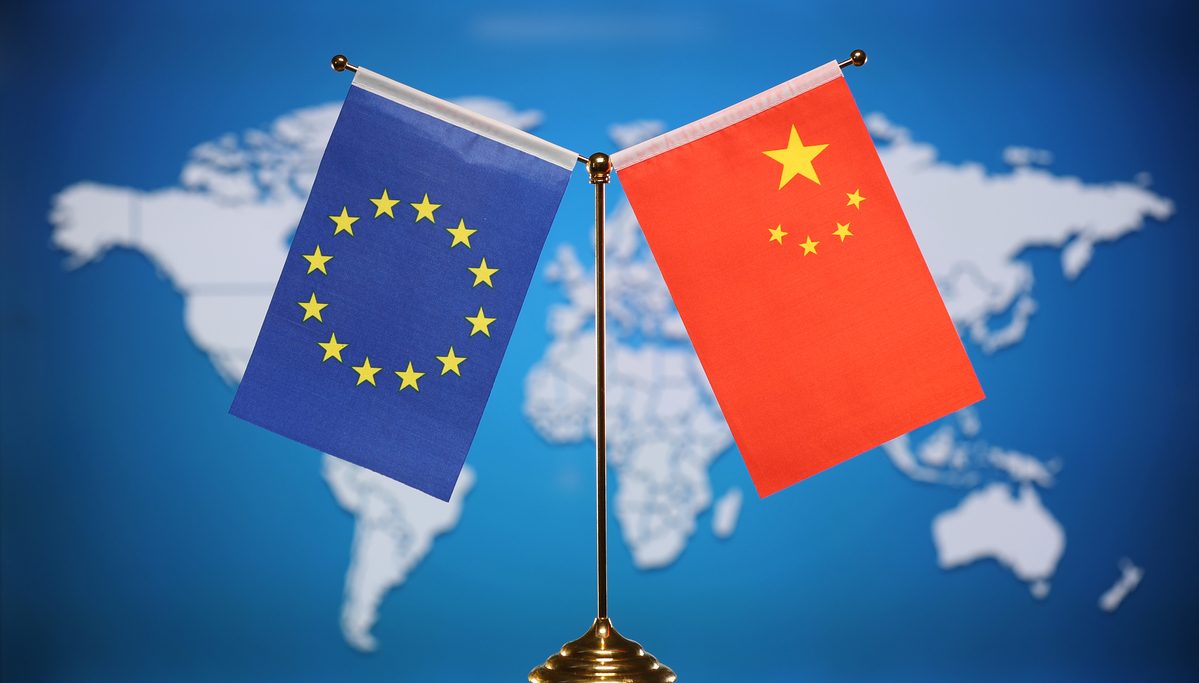
With China-EU ties strained due to the European Union's interference in China's domestic affairs of Xinjiang and Hong Kong, many wonder whether the EU will delay ratifying the China-EU Comprehensive Agreement on Investment because EU politicians have been sending mixed signals.
The EU business community is understandably more worried than its Chinese counterpart about the deal being put on hold, because despite benefiting both sides, the Comprehensive Agreement on Investment is more of a "help in time" for the EU and only an "icing on the cake" for China.
The EU, mired in a "double dip" recession, is in desperate need of an economic booster such as the investment agreement. According to the International Monetary Fund, China's real GDP in 2020 accounted for 18.3 percent of the world's total, compared with 12 percent of the 19-nation eurozone.
A comparison of the actual year-on-year economic growth rates of China, the United States, the EU and Japan since 2016 shows China's growth rate has been significantly higher than that of the three other economies. In general, the EU's growth rate has been lower than the US' and its ability to overcome the impacts of the novel coronavirus pandemic is weaker than Japan.
Since two consecutive quarters of economic contraction is technically defined as recession, the US economy slipped into recession in the first half of 2020 but recovered in the second half. In contrast, after two consecutive quarters of economic contraction in the first half of last year, the eurozone suffered another two consecutive quarters of contraction with an interval of only one quarter.
At a time when new virus variants are raging across the world, especially in India, the EU lags behind China and the US in vaccine R&D and production, as well as containing the virus. For example, when the Chinese people were celebrating the five-day May Day holiday, many EU countries saw mass demonstrations against pandemic prevention and control measures.
Unemployment, which is closely related to people's livelihoods, is not just an economic issue but also a political issue that determines social stability.
And the EU's performance has been poor on this front, especially because it has not been able to reduce the high unemployment rate-among the youth in particular. It remains to be seen whether the EU economy begins to bottom out in the second quarter as forecast.
After the outbreak of the subprime mortgage crisis in 2008, the youth unemployment rate in many EU countries exceeded 50 percent and the phenomenon lasted several years. And following the outbreak of the pandemic last year, the EU's labor market froze once again. No wonder the unemployment rate in the EU has been twice as high as that in the US, China and Japan since 2016.
Moreover, while the Chinese economy achieved 18.3 percent growth year-on-year in the first quarter, the eurozone's GDP continued to shrink, which, together with its high unemployment rate, shows the EU, much more than China, needs the Sino-EU investment agreement.
Besides, China has been the world's largest auto producer and market for more than 10 years in a row, with its capability to resist such major shocks as the subprime crisis-and the pandemic has enhanced its status as a global market, including for cars.
And in the first quarter of this year, China's auto production and sales showed a rapid growth momentum, increasing 81.7 percent and 75.6 percent year-on-year respectively.
Given these facts, and considering that the world sees China as the backbone of international manufacturing, shouldn't EU politicians seize the opportunities offered by the Chinese market to create a better, more competitive environment for European industries?
The global auto industry is undergoing major technological changes, and new energy vehicles could replace gas-powered vehicles in a matter of years, ending the dominance of Europe's century-old car-making technologies.
So the new energy vehicle manufacturers must seize the opportunities offered by China's huge market if they want to survive and flourish in the new era. Realizing this fact, foreign automakers, from traditional auto companies to new energy vehicle makers, are shifting their production units to China.
Against such a backdrop, the EU leaders should realize that the politicization of purely economic issues will damage the long-term sustainable development potential of the European bloc, and cash in on the opportunities offered by the world's largest exporter and a leading importer.
We believe the investment agreement, as a mutually beneficial treaty, will withstand objective scrutiny, and hope the EU, based on the objective needs for its long-term and fundamental interests, will create a sound environment for China-EU trade and economic development without politicizing the issue.
The author is a researcher at the Chinese Academy of International Trade and Economic Cooperation.
The views don't necessarily reflect those of China Daily.





