'Smart city' vision creates a new industry, jobs









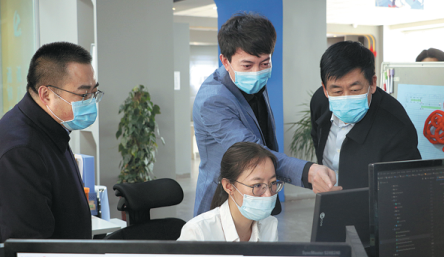
Wang Dalin (center) discusses the design of a platform to assist epidemic control work on COVID-19 in Hohhot, Inner Mongolia autonomous region, in March last year. CHINA DAILY
Wang Dalin's belief that smart cities with digital urban management systems are the way forward for China began when he was a child.
Born in Ordos, a city in the Inner Mongolia autonomous region known for its wool, Wang, 39, said his interest in the internet and software started when he was in junior high school, and when he was 13 he began designing apps.
After graduating from high school, he studied business administration in Beijing and New York before returning to China. He worked for a software company in the capital and was responsible for its operations in Inner Mongolia.
"That gave me the chance to look carefully at my home region's services. The overall impression I got was of its poor performance when it came to digitalization. Most public services relied on manual operations, which were costly and inefficient," he said.
In 2012, he quit his job in Beijing and opened his own software company in Hohhot. "Inner Mongolia is known by outsiders for its grassland, dairy products and mineral resources. My career aim is to make my home region known for its high-tech industry," he said.
His company, Huaxun High Tech, formerly known as Inner Mongolia Huaxun Software, initially focused on providing digital services for local companies and government bodies to enhance their efficiency and cut communication costs through online solutions.
However, Wang gradually worked out there was bigger potential in constructing a smart city.
"Nowadays, the physical spaces where we work, live and play are being transformed into digitalized omnichannel experiences. A lot of countries around the world are rushing to understand and exploit the value of data," he said.
He said data is now used everywhere, from work places to our daily lives. "It helps us find smarter ways to travel from one place to another. It guides builders to reduce work accidents. Conservationists also use data to design plans for reducing carbon emissions and utility costs," he said.
Wang believes that using data to enable smarter placement of goods, shops and services in buildings, complexes and neighborhoods, is the "magic" a smart city of the future will provide.
His progressive ideas are echoed by the country's development goals.
In 2014, several ministries released a blueprint on promoting the construction of smart cities around the country. A group of smart cities should be constructed over the next 10 years, with the aims of improving people's livelihoods and enhancing governance in public sectors, it said.
Under the strategy, Huaxun High Tech piloted construction of a smart city in Hohhot, providing solutions to the city's traffic jams and tax collection.
The company expanded rapidly, and by 2018 it had branches in Shanghai, Beijing and other cities.
So far, Huaxun High Tech has provided plans for more than 15,000 clients on the construction of a smart city and smart management plans for traffic, medical service, schools and community services.
The company's revenue surged from only 500,000 yuan ($77,380) in its first year of operations to more than 100 million yuan last year.
During the COVID-19 outbreak last year, it designed an online platform for the registration of Hohhot residents, under the supervision of the public security bureau.
Earlier this year, his company developed an online platform to assist in providing information on nucleic acid tests for the virus. The platform made it easier for healthcare professionals and authorities to better control and monitor the outbreak.
During his visit to the company last year, Shi Taifeng, secretary of the Inner Mongolia's Party committee, emphasized that social participation from young people was an indication of the city's vitality.
Having nearly 200 employees whose average age is only 27, Wang said young people will create more possibilities for society and the region.
"Technology is now bringing miracles to people's lives with more convenience. The digitalization trend also provides them with more opportunities. It's a great pleasure to see the growth of my company and also the future of young people in my hometown," he said.





- China's light sports aircraft gains core independence with homegrown engine and avionics
- Record number of black-necked cranes arrive at Guizhou's nature reserve
- New morning and evening peak-hour trains to run between Beijing and Xiong'an
- College student rediscovers figure skating passion
- Wuhan scientist honored for turning lab science into real-world farming solutions
- Citizen rewarded 200 yuan for turning over ancient sword to Hubei museum