Wheat whiz has dream to feed country









Agriculturist devotes career to creating water-saving, high-yield varieties
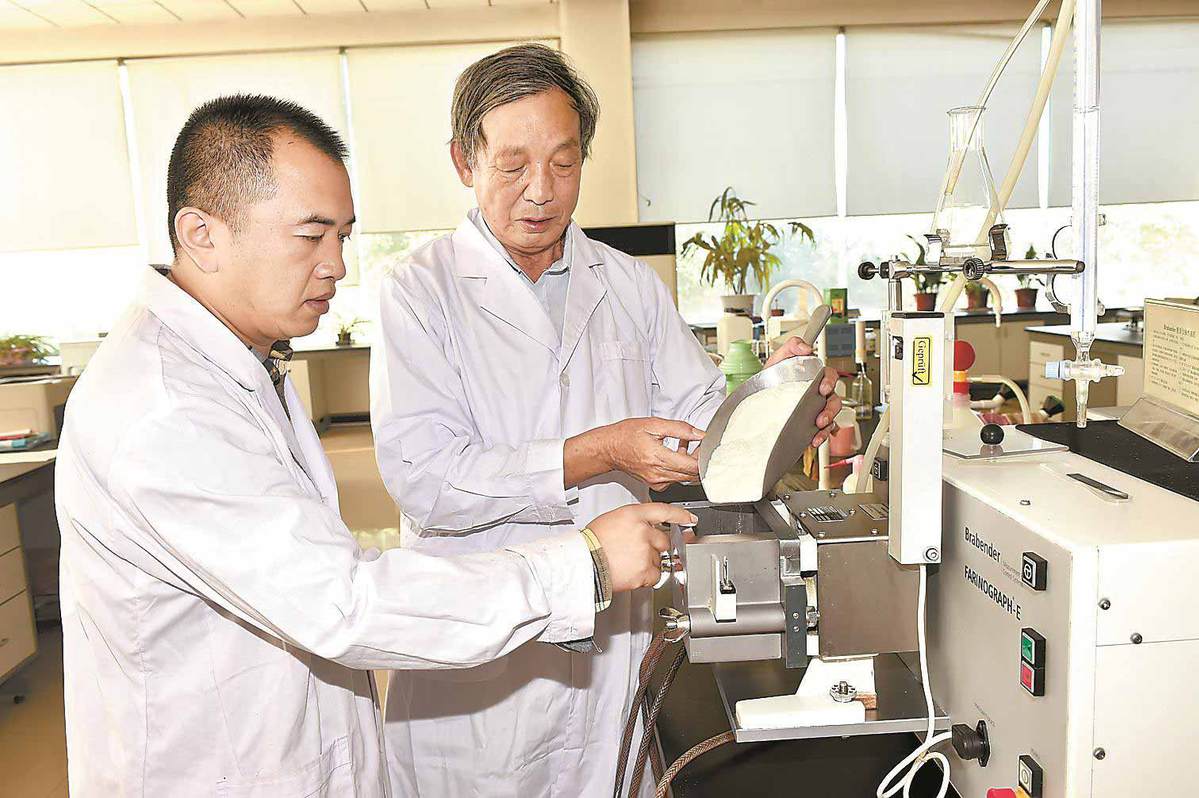
Dubbed "Hebei province's Yuan Longping", the father of hybrid rice, Guo Jinkao, 70, has devoted much of his career to developing high-yield wheat varieties that can thrive in his home province and other regions grappling with water shortages.
His rice strain has been planted in eight provincial regions over the past few decades, increasing grain output by more than 10 billion kilograms while reducing water consumption by 13 billion cubic meters.
"Let every drop of water produce more food," said Guo, honorary president of the Shijiazhuang Academy of Agricultural and Forestry Sciences and a wheat breeding expert.
He was born in 1951 to a poor rural family in Xinle, a county-level city in southwest Hebei.
As a teenager, he had survived on daily meals of coarse food and wild herbs, as China was beset with widespread famine in the early 1960s.
Steamed buns were luxuries reserved for major events such as the Spring Festival.
The constant hunger even prompted Guo to eat a poisonous weed, which put him in a coma for two days.
But the experience also planted a seed in his mind. He said his childhood dream was to make it so common people could "eat steamed wheat buns every day".
Guo studied agriculture at a secondary vocational school. Upon graduating in 1973, he was offered a job at a newly established agrarian science institute in Shijiazhuang, the provincial capital.
At the time, the institute was a dilapidated farm with a row of bungalows. There was no tap water, no heating and not even a proper office. Sandy land served as an experimental field for Guo and his colleagues.
To fulfill his wheat breeding ambitions, Guo worked in the field during the day and read extensively at night about topics including statistics, genetics and breeding.
He also traveled to Beijing as well as Shandong, Henan and Shanxi provinces to collect breeding data from big names in the field.
In the 1980s, North China sought a high-yield wheat variety that could be harvested sooner. Creating such a variety became his goal in the coming decade.
One single closed-loop experiment-from preparing the land to reaping the harvest-takes a whole year to complete, and it normally takes about a decade for a variety to become mature for mass planting.
Additionally, Guo needed to take extra care during every experiment because a minor mistake could have erased gains accumulated over years of work, he said.
The experiments would often entail Guo venturing into the field in the harshest weather-on the chilliest days to study a breed's cold-resistance and on sweltering days to observe drought resistance.
He recalled that on a night of thunderstorms, farmers were racing home while he went the opposite way, into the field.
Guo's devotion eventually paid off. In the late 1980s, the test for the Hebei Wheat 26 variety was successful, raising the output of each hectare from 3,000 kg to 4,500 kg.
It was soon introduced to more northern provinces and laid the foundation for an updated version-Hebei Wheat 38, the output of which hit a record of more than 9,400 kg per hectare at the turn of the century.
But for the dry, northern provinces, the high-yield feature is not enough.
"Apart from being high-yield, it also needs to save water for it to be well received by farmers," he said. Drought-resistance became the major target of his research in the 1990s.
A string of new varieties, which include Shijiazhuang 8 and Shijiazhuang Wheat 15, are high-yield, lodging resistant-or resistant to damage-and water-saving. They were included in a promotion plan by the central government.
The planting of these new varieties has halved the irrigation water consumed per hectare in the 1980s, which stood at 4,500 cu m.
According to Guo, the annual water consumption in Hebei province was about 19 billion cu m. About 60 percent of that was spent on irrigation, and roughly half of that irrigation total was used for wheat.
That has strained the water supply in Hebei, where the per capita water resource is just one-seventh of the national average. The province also suffers from chronic over consumption of groundwater.
Speaking about the secret of the wheat varieties' success, Guo said: "They have very strong root systems that can dive deeper into the soil, as deep as 2.5 meters below the ground."
Over a span of 47 years, Guo's team has developed 28 new varieties that are high-yield and drought resistant.
"There's no age limit over scientific research, and there's no retirement age," he said.




- Fire in a residential building claims 12 lives in Guangdong
- International experts share innovative poverty solutions
- Guangdong to launch campaign to identify and rectify major fire hazards
- Vocational school dismisses official over voting scandal
- China sees steady growth in railway sector in 2025
- Chinese architect confirms economic feasibility of integrating tradition and modernity