



Core capsule of space station launched









President extends congratulations on major project's start
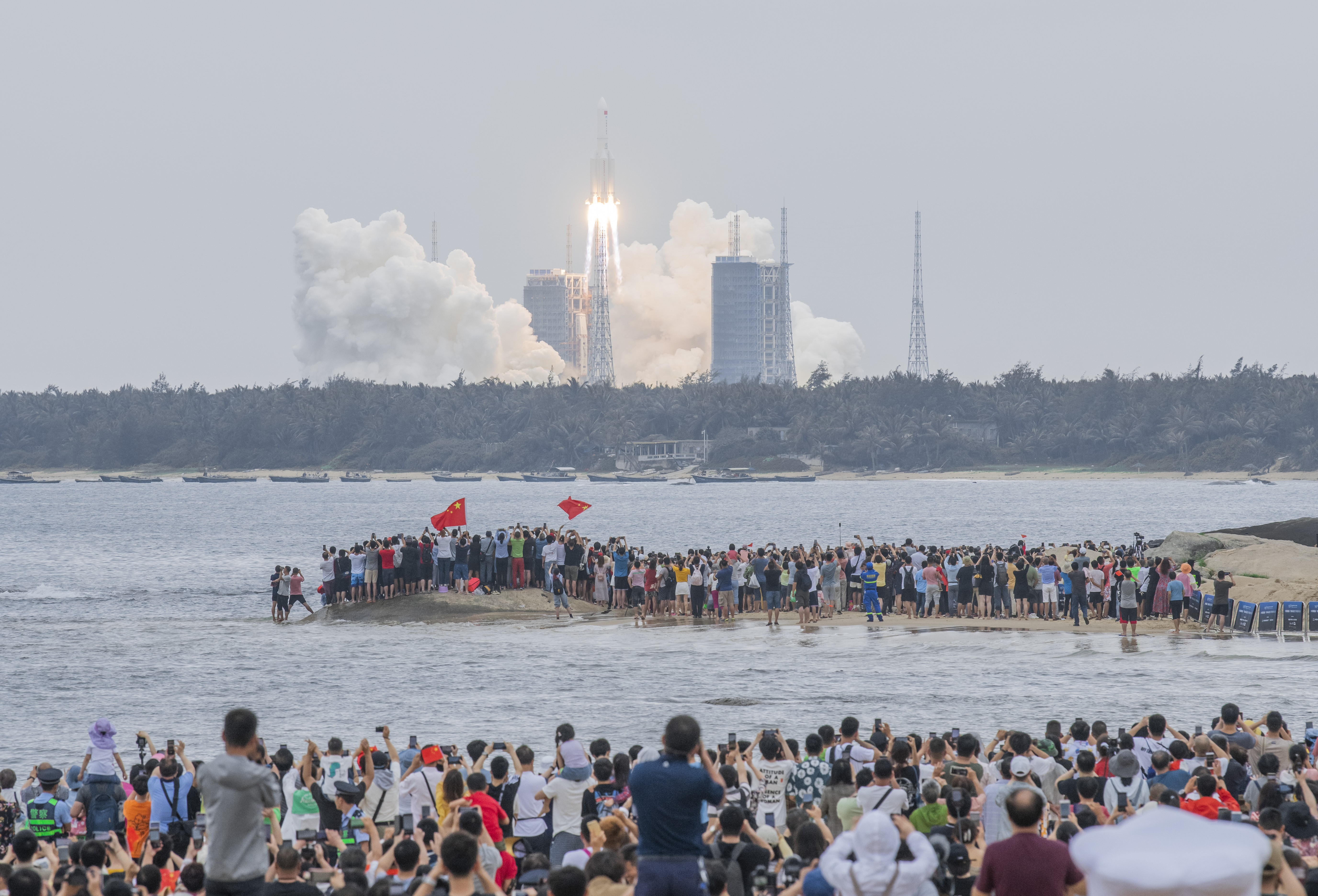
Sixty years after Yuri Gagarin undertook mankind's first space journey, China launched the core capsule of its space station on Thursday morning, formally embarking on the construction of one of the world's largest and most sophisticated space-based facilities.
President Xi Jinping sent a letter after the launch, extending congratulations and greetings to those involved in the landmark mission.
Xi, who is also general secretary of the Communist Party of China Central Committee and chairman of the Central Military Commission, said that building the station, which will also serve as a space-based national laboratory, is a significant goal in China's manned space endeavor and a major project that will help to push China toward being a strong power of science, technology and space.
The successful launch of the core capsule marked the commencement of the space station's construction, he said.
Xi encouraged mission workers to continue striving for the ultimate success of the space station program.
As the countdown ticked down to zero at 11:23 am at the Wenchang Space Launch Center in Hainan province, 10 engines at the bottom of a Long March 5B heavy-lift carrier rocket roared to life, generating a thrust power of 1,068 metric tons to lift the 18-story-tall vehicle through thick rain clouds covering the coastal city of Wenchang.
After flying more than eight minutes, the rocket successfully put the 22.5-ton capsule, the biggest and heaviest spacecraft China has ever constructed, in a low-Earth orbit about 400 kilometers above the Earth, settling the first piece of the country's space station in place.
The capsule's solar panels unfolded at 12:36 pm and began generating power for the spacecraft.
Premier Li Keqiang and member of the Secretariat of the CPC Central Committee Wang Huning, both also members of the Standing Committee of the Political Bureau of the CPC Central Committee, and a group of high-ranking leaders witnessed the launch at the Beijing Aerospace Control Center in the capital's northwestern suburbs.
China's most adventurous space endeavor, the multimodule space station, named Tiangong, or Heavenly Palace, will have three main components-a core module attached to two space laboratories-with a combined weight of nearly 70 tons.
The core capsule, named Tianhe, or Harmony of Heavens, is 16.6 meters long and has a diameter of 4.2 meters. The craft's weight is equal to the combined weight of 15 standard-size automobiles. It has three parts-a connecting section, a life-support and control section and a resources section.
The capsule will be central to the space station's future operations, given that astronauts will live there and control the entire station from inside. It will also be used to host scientific and technological experiments.
Thursday's launch marked the second flight of a Long March 5B, the most powerful Chinese rocket when it comes to carrying capacity to low-Earth orbit.
With a core stage and four side boosters, the rocket has a liftoff weight of 849 tons and is capable of putting a 25-ton payload into orbit near Earth.
It is now the only rocket in China that can launch Tiangong's heavyweight components.
The launch vehicle is so big that each of its side boosters is nearly 28 meters tall-the height of a nine-story building-and 3.35 meters wide. Each has a thrust power of 240 tons.
To hold huge spacecraft, the rocket has China's largest payload fairing-a type of nose cone used to protect a spacecraft payload against dynamic pressure and aerodynamic heating during launch-at 20.5 meters tall and 5.2 meters wide.
Long March 5B made its debut flight in May 2020 at the Wenchang space complex, deploying the prototype of China's new-generation manned spacecraft, an experimental cargo retrieval craft, and more than 10 experimental payloads into low-Earth orbit.


- 5.4-magnitude quake hits waters off China's Taiwan region: CENC
- Shanghai offers 'first cup of coffee' to May Day arrivals at airports
- China predicts over 344m inter-regional trips on first day of holiday
- Enjoy the May Day holiday
- Authorities warn of heavy rain, flood risks during holiday
- China launches immersive aerospace science center for kids, teenagers in Beijing





