



To Mars and beyond, as China's cosmic journey continues









Saturday marks the sixth Space Day of China. Five years after it was established in 2016, the nation has made tremendous progress in various aspects of space exploration.
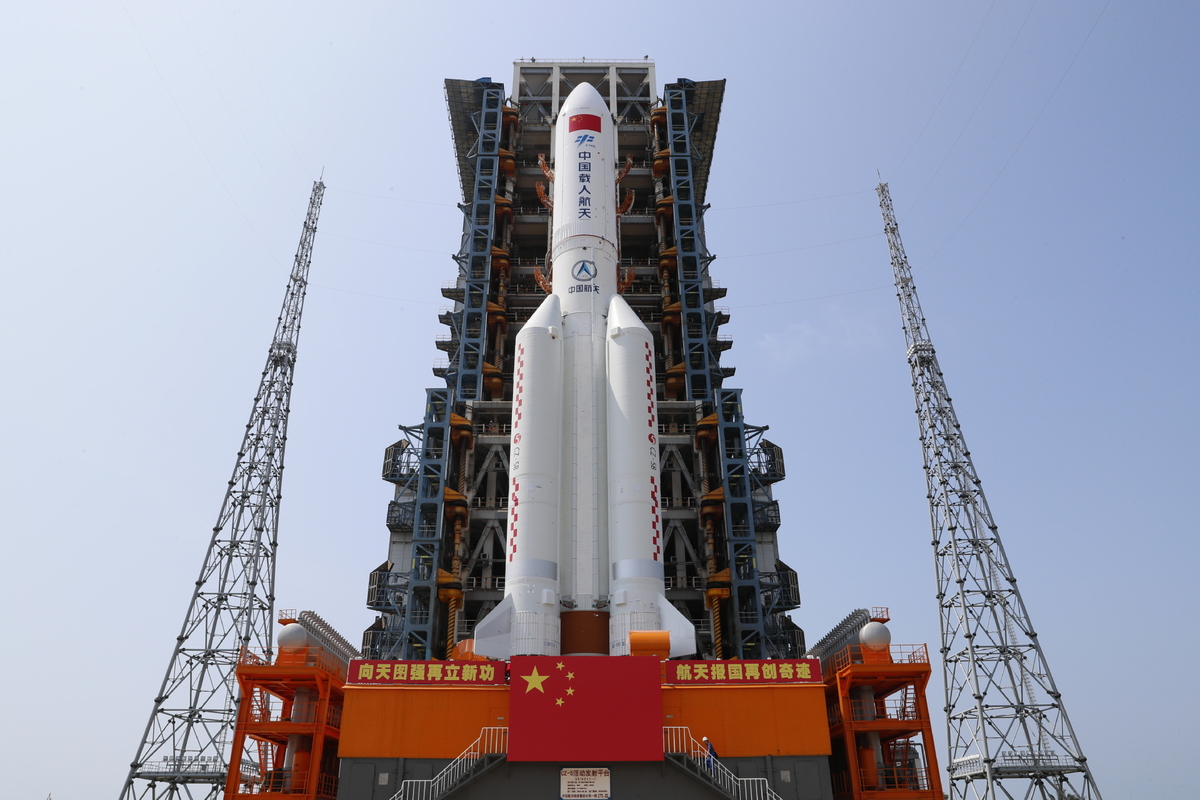
On the first Space Day in 2016, Tiangong 1 space lab, China's first, had just finished its mission and fallen into the atmosphere. Tiangong 2 would not be launched until five months later. Now, with all the data collected from the two pioneers, Tianhe, the core capsule of China's multimodule space station Tiangong is already in the launch tower, and the whole space station is expected to be fully operational next year.
In January 2016, China officially approved its first mission to Mars and announced the plan of launching a probe for that purpose in 2020. The combination orbiter, lander and rover, named Tianwen 1, was launched in July 2020 and it is now in orbit around Mars. It has already transmitted high-resolution photos of Mars back to Earth, and soon the lander will be detaching from the orbiter and will descend to the landing site Utopia Planitia with the rover.
In October 2016, China launched Shenzhou XI, its sixth manned space mission. Now Shenzhou XII has already entered the launch site at Jiuquan in Northwest China's Gansu province, ready to carry three astronauts into space in June. The astronauts will stay in space for an estimated four to five months, with new experiments to be made and multiple key new technologies to be tested.
In 2016, the number of China's space launches reached 22. The number rose to 39 in 2018, 34 in 2019, and 39 again in 2020. In 2021, China Aerospace Science and Technology Corporation (CASTC) alone has over 40 space launches planned, and the total number might be higher with other companies, especially the commercial space companies also planning launches.
All these show China's rising capabilities to explore the space and help humankind gain a deeper knowledge of the universe we live in. And that in turn is deeply rooted in the fast progress of society in the new era, which lays a solid foundation for aerospace and astronautics as industries with top technologies.
In an interview on April 15, Wu Renwei, chief designer of China's lunar probe project, said that Chinese spacecrafts will go further to 15 billion kilometers, or about 100 Astronomical Units (AU) away to do experiments and explorations. "We hope to see the point where the solar wind balances universe wind", he said, adding this will be a contribution to human knowledge.
With efforts of generations of space staff and support from all over the nation, that hope will definitely come true.





