Water discharge call draws fire










Lack of precedent
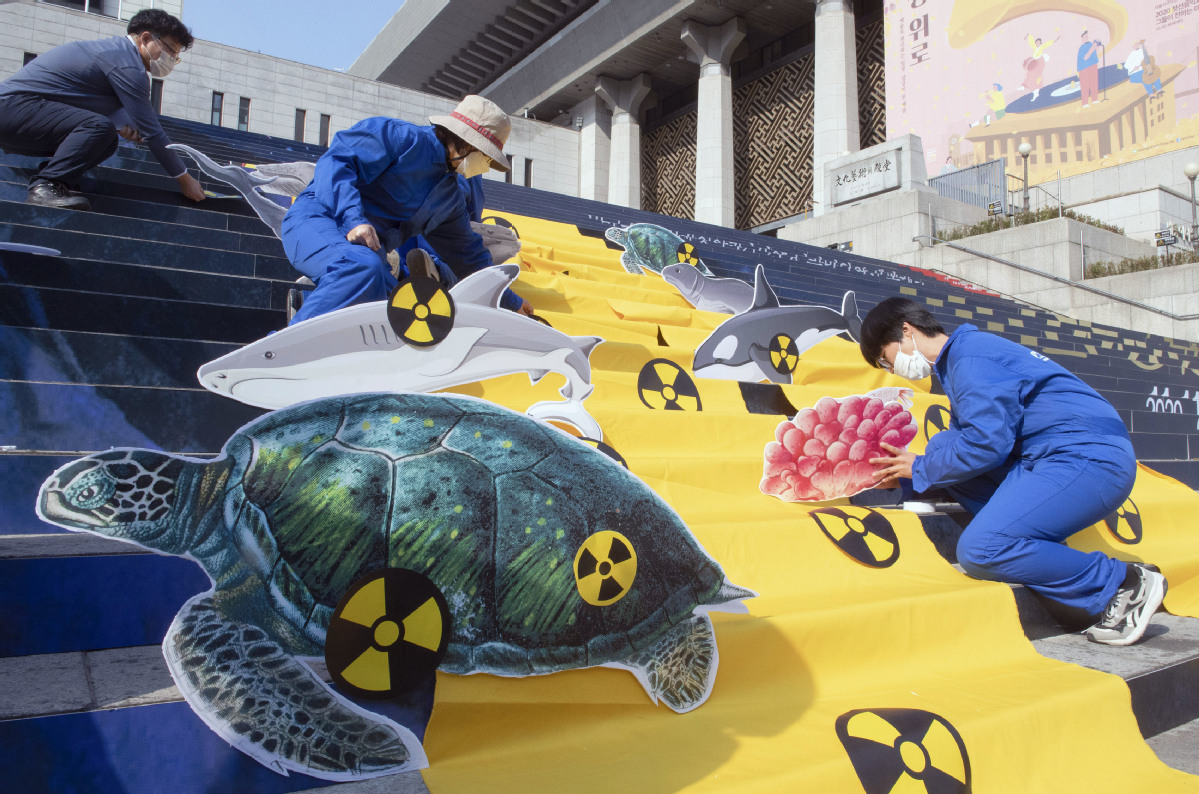
Liu Xinhua, chief expert at the Ministry of Ecology and Environment's Nuclear and Radiation Safety Center, told Science and Technology Daily, "The release of the large amount of wastewater from Fukushima will unavoidably result in radionuclide enrichment in sediments and marine organisms in locations near the release point.
"Some of the radionuclide could disseminate with the current, eventually affecting countries neighboring Japan, including China and North Pacific nations."
He said there is no precedent for the disposal of a large amount of wastewater generated as the result of a nuclear accident, adding that discharging it into the ocean is just one of five solutions the Japanese government has considered.
Liu said releasing the water into the sea is obviously the easiest option, as the other solutions are more costly, require advanced technology and take longer.
"The Japanese side needs to make public the evaluation results of the release plan … The decision should be made based on full consultation with neighboring countries," he said.
The equipment TEPCO uses cannot remove tritium, which has a half-life of about 12.5 years, he said.
While the concentration of tritium in the wastewater is generally higher than the limit for release stipulated in Japanese laws and regulations, the density of at least two of the other six types of radionuclide in wastewater in some of the storage tanks also exceeds the limit.
Zhou Jinfeng, secretary-general of the China Biodiversity Conservation and Green Development Foundation, said once the radionuclide enters the ocean, it will be difficult to follow and monitor, and its negative impact on marine biodiversity and sea farming cannot be predicted.
"Although it is time-and labor-saving, releasing the wastewater into the ocean is a very irresponsible act by the Japanese government. Japan should organize scientists from stakeholder states for research and discussion. The impacts on the environment and ecosystems should be fully evaluated to seek the best solutions," he said.
Zhou Yongsheng, professor and deputy director of the Japanese Studies Center at China Foreign Affairs University, said Japan's decision is a "tricky" one, as it will wait for two years to discharge the water, by which time opposition "could be greatly reduced".
Zhang Yunbi contributed to this story.