


Museum showcases vital clues to past










TV broadcast fuels interest in numerous artifacts
Rising numbers of visitors are heading to Sanxingdui Museum in Guanghan, Sichuan province, despite the COVID-19 pandemic.
Luo Shan, a young receptionist at the venue, is frequently asked by early-morning arrivals why they cannot find a guard to show them around.
The museum employs some guides, but they have been unable to cope with the sudden influx of visitors, Luo said.
On Saturday, more than 9,000 people visited the museum, over four times the number on a typical weekend. Ticket sales reached 510,000 yuan ($77,830), the second-highest daily total since it opened in 1997.
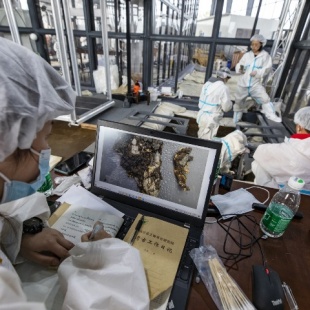
The surge in visitors was triggered by a live broadcast of relics excavated from six newly discovered sacrificial pits at the Sanxingdui Ruins site. The transmission aired on China Central Television for three days from March 20.
At the site, more than 500 artifacts, including gold masks, bronze items, ivory, jade and textiles, have been unearthed from the pits, which are 3,200 to 4,000 years old.
The broadcast fueled visitors' interest in numerous artifacts unearthed earlier at the site, which are on display at the museum.
Situated 40 kilometers north of Chengdu, capital of Sichuan, the site covers 12 square kilometers and contains the ruins of an ancient city, sacrificial pits, residential quarters and tombs.
Scholars believe the site was established between 2,800 and 4,800 years ago, and the archaeological discoveries show that it was a highly developed and prosperous cultural hub in ancient times.
Chen Xiaodan, a leading archaeologist in Chengdu who took part in excavations at the site in the 1980s, said it was discovered by accident, adding that it "seemed to appear from nowhere".
In 1929, Yan Daocheng, a villager in Guanghan, unearthed a pit full of jade and stone artifacts while repairing a sewage ditch at the side of his house.
The artifacts quickly became known among antique dealers as "The Jadeware of Guanghan". The popularity of the jade, in turn, attracted archaeologists' attention, Chen said.
In 1933, an archaeological team headed by David Crockett Graham, who came from the United States and was curator of the West China Union University museum in Chengdu, headed to the site to carry out the first formal excavation work.
From the 1930s onward, many archaeologists conducted excavations at the location, but all of them were in vain, as no significant discoveries were made.
The breakthrough came in the 1980s. The remains of large palaces and parts of the eastern, western and southern city walls were found at the site in 1984, followed two years later by the discovery of two large sacrificial pits.
The findings confirmed that the site housed the ruins of an ancient city that was the political, economic and cultural center of the Shu Kingdom. In ancient times, Sichuan was known as Shu.