



English must not be dropped as a core subject









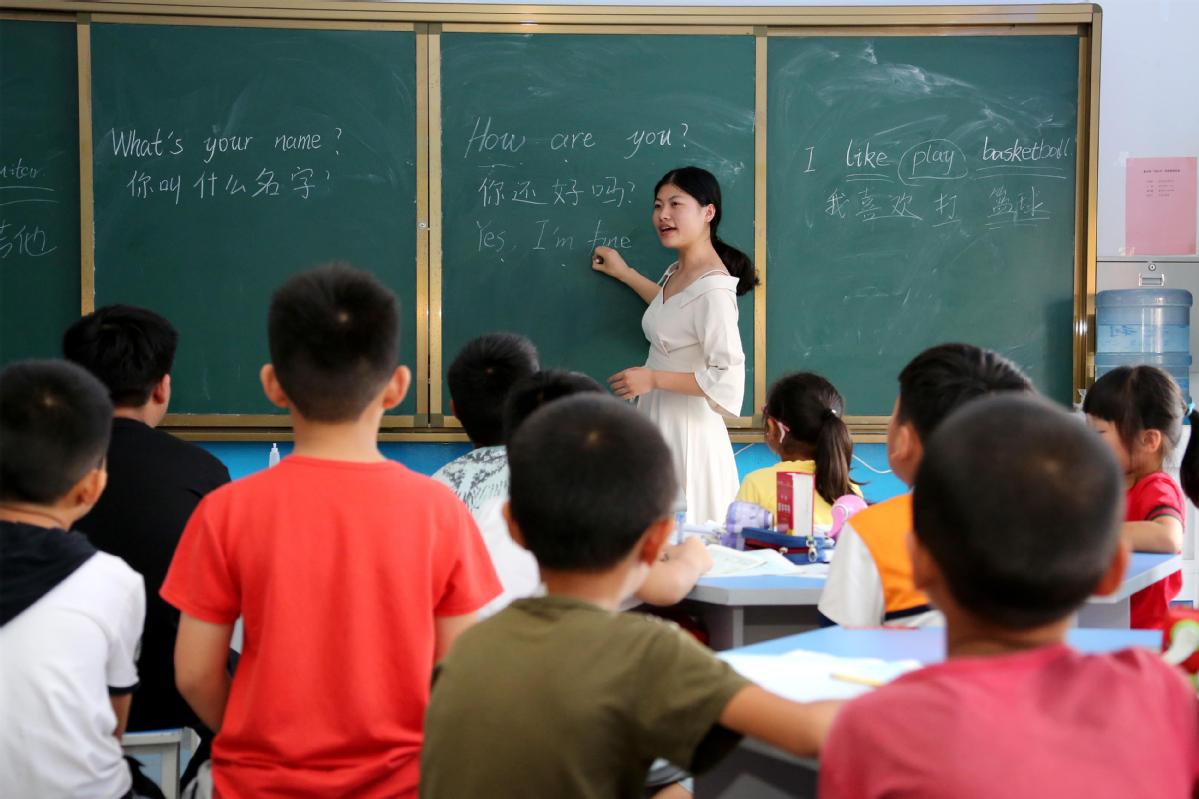
A proposal to remove English (as a foreign language) as a core subject in primary and secondary schools at this year's two sessions has triggered a fierce public debate online.
To answer the question whether a foreign language should be taught as a core subject in primary and secondary schools today, we have to take into consideration two factors.
First, when the education authorities included science (for example, physics and chemistry) in the new academic system in 1922 following a survey conducted in the preceding years, the decision encountered fierce opposition, because some believed these subjects were "useless", while others thought the time was not ripe or teaching resources were inadequate to include science in the syllabus.
But later facts proved that most of the students who had learned physics and chemistry might not have directly used them in their daily lives, but the knowledge they had acquired about science played a key role in improving science literacy in China and changing the Chinese people's way of thinking.
And second, the education authorities issued a document 20 years ago making the English language a core subject in primary and secondary schools. The move came at a time when China was making great strides on the development front thanks to reform and opening-up and yet needed to catch up with the developed world and modernize the nation. Although English language teaching exposed some problems of the education system, China's development in the following decades, especially the improvement in education quality, proved the decision was right.
Whether or not a foreign language should be made part of compulsory education is determined by the students and their development as individuals, as well as their ability to learn a new language, cultural awareness, thinking, and horizon of vision. On the other hand, social development requires individuals to enhance their knowledge and learn new languages and modes of communication, deepen their cross-cultural understanding, and participate in global competition and development. These factors also help a country to improve its global competitiveness and discourse.
If we do not teach English, which is the world's most common language, to children during the compulsory education period, we will risk confining the younger generation to an "island" cut off from the rest of the world and ruin their chances of excelling in global competitions.
Overall, the foreign language learning level of Chinese people is relatively low, and the number of foreign languages they learn is still few. Even today, many in China consider learning a foreign language an elitist pursuit, ignoring the importance of language literacy.
In general, Chinese people's ability to communicate in different languages is low, which has affected the expansion of China's political, economic, cultural, scientific and technological interests.
Teaching foreign languages as core subjects in primary and secondary schools is key to improving Chinese people's proficiency in foreign languages. Contrary to what the skeptics claim, foreign languages are important components of quality and accomplishment, just like science. A person who can read, write and speak multiple languages has a definite edge over those who are monolingual in the age of information and economic globalization.
Besides, it is wrong to equate foreign language teaching in primary and secondary schools with foreign language courses offered by professional and commercial language-learning institutes, as schools impart formal education and professional institutes prepare candidates for competitions and career promotion.
It is also wrong to attribute the heavy academic burden on students to foreign language learning. Will the students' academic burden ease if English is removed as a core subject from primary and secondary school syllabuses?
To expect translation software to solve students' English language learning problem and to believe translators and interpreters will be rendered jobless by artificial intelligence is to simply regard people as mere tools, which is an insult to human intelligence, knowledge, ability-and the power of thinking.
In short, foreign languages should be taught as a compulsory subject in schools, and the necessity to do so is stronger today than it was decades ago.
True, foreign language teaching efficiency is still low in China and there are some problems with its evaluation. But that can be resolved by taking more targeted measures to improve foreign language teaching, rather than removing the most common global language from the list of mandatory subjects.
The author is a senior researcher at the National Institute of Education Sciences. The views don't necessarily reflect those of China Daily.





