



Trump's trade war a disaster for US









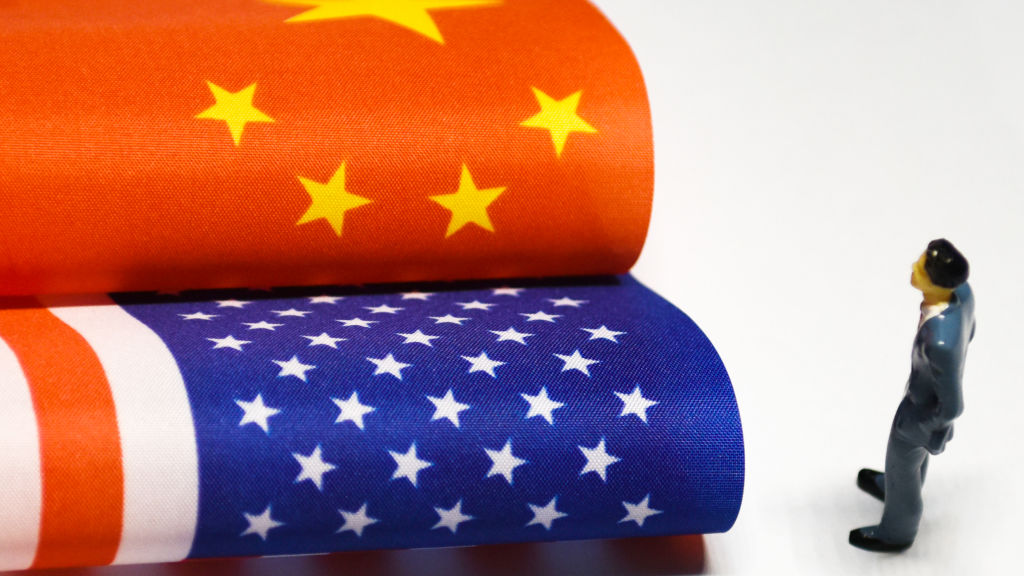
Former US president Donald Trump launched a trade war against China on July 6, 2018, by imposing 25 percent tariff on $34 billion of Chinese imports, the first in a series of such punitive tariffs. In 2019, the US administration increased tariffs on practically all imports from China.
Trump claimed the tariffs were imposed to reduce the US' trade deficit with China, the largest in the world since 1975, and create more jobs in the United States.
So what was impact of Trump's trade war on the two countries' economies?
In January 2020, China and the US signed the "phase one" trade deal, and China agreed to buy at least $200 billion more in US products and services than it did in 2017 over the 2020-21 two-year period. Trump called the agreement "an important step... towards a fair and reciprocal future of trade with China".
China was ready to fulfill its obligations. But it is now emerging that American exporters have not been able to supply China with enough goods and services that their government insisted they would.
According to China's customs, the country's total imports of US goods and services in 2020 added up to $94 billion, more than 40 percent short of the target. The figure was about the same as in 2017, that is, before Trump triggered the trade war.
Most of the deficit was in manufacturing, which accounted for 70 percent of the phase one trade deals' goods. American exports to China in this category were agreed at $99 billion. However, the actual worth of US exports was only $57 billion in 2020, even lower than a year earlier. The supply of energy resources proceeded at a languid pace, totaling only $10 billion against the planned $26 billion. And the export of US agricultural products, which was overly sensitive for Trump, was only $27 billion compared with the agreed $33 billion.
It is important to highlight here that American farmers were happy to take advantage of the billions of dollars in subsidies that the Trump administration disbursed to protect them from the consequences of the trade war.
However, there are several positive examples, too. For instance, the export of US medical products to China exceeded targets, even though it was driven by the COVID-19 pandemic. The same happened with export of semiconductors, which accelerated because the US' threat to restrict chip sales in the future prompted Chinese companies to stock them ahead of time.
Contrary to Trump's claim, however, the imbalance in Sino-US trade increased. In fact, China's trade surplus with the US in 2020 increased to $317 billion, up 7 percent year-on-year and just $7 billion less than in 2018 when Trump launched the trade war.
As for increasing employment in the US, a study commissioned by the US-China Business Council shows the trade war with China cost the US 245,000 jobs. Which indicates the complete failure of Trump's China trade policy.
It is logical to ask whether the novel coronavirus pandemic is to blame for the low volume of American exports to China. Probably it is, but not significantly, because the Chinese economy recovered relatively quickly and achieved 2.3 percent year-on-year growth last year. And by June 2020, China's import volume had returned to pre-pandemic levels.
There is also a need to analyze the development of trade and economic relations between China and the European Union. The import of goods and services from EU member states by China increased an impressive 21 percent from 2017 to 2020, while China's imports from the US fell by 8 percent in 2020 despite Beijing agreeing to many of Washington's conditions in the first phase of the Sino-US trade deal.
The EU wrapped up the negotiations on the Comprehensive Agreement on Investment with China more than two months ago, achieving the same results as the US did in the phase one deal with China, including new financial service market access.
But by keeping the negotiations on the investment agreement free of blackmail and intimidation, China and the EU have proven that mutually beneficial agreements can be reached without forceful actions, injunctions and arm-twisting.
It seems the new US administration will adopt a different, perhaps more balanced, approach to China. And it is up to President Joe Biden to decide whether or not to end the trade war.
But it will be politically risky for Biden to remove all the tariffs at one go. No wonder he said in a recent interview that he will not lift the tariffs immediately and instead review the phase one trade deal.
When he began imposing punitive tariffs on Chinese goods in 2018, Trump famously tweeted that "trade wars are good and easy to win". He was wrong on both counts. Judging by the considerable loss of jobs in the US, the surge of imports from China, and a drop in exports to China, it is fair to say that Trump's cavalier approach to the laws of economics and his trade war have been a complete disaster for the US.
To improve their citizens' lives and livelihoods, countries should not wage trade wars and instead must work harder to increase their competitiveness and boost their economic development. The events of the past two years have once again confirmed this indisputable fact. Which should be an important lesson for the whole world.
The author is former prime minister of Kyrgyz Republic, and a distinguished professor of Belt and Road School of Beijing Normal University.
The views don't necessarily reflect those of China Daily.





