Openness to boost trade, FDI, spending









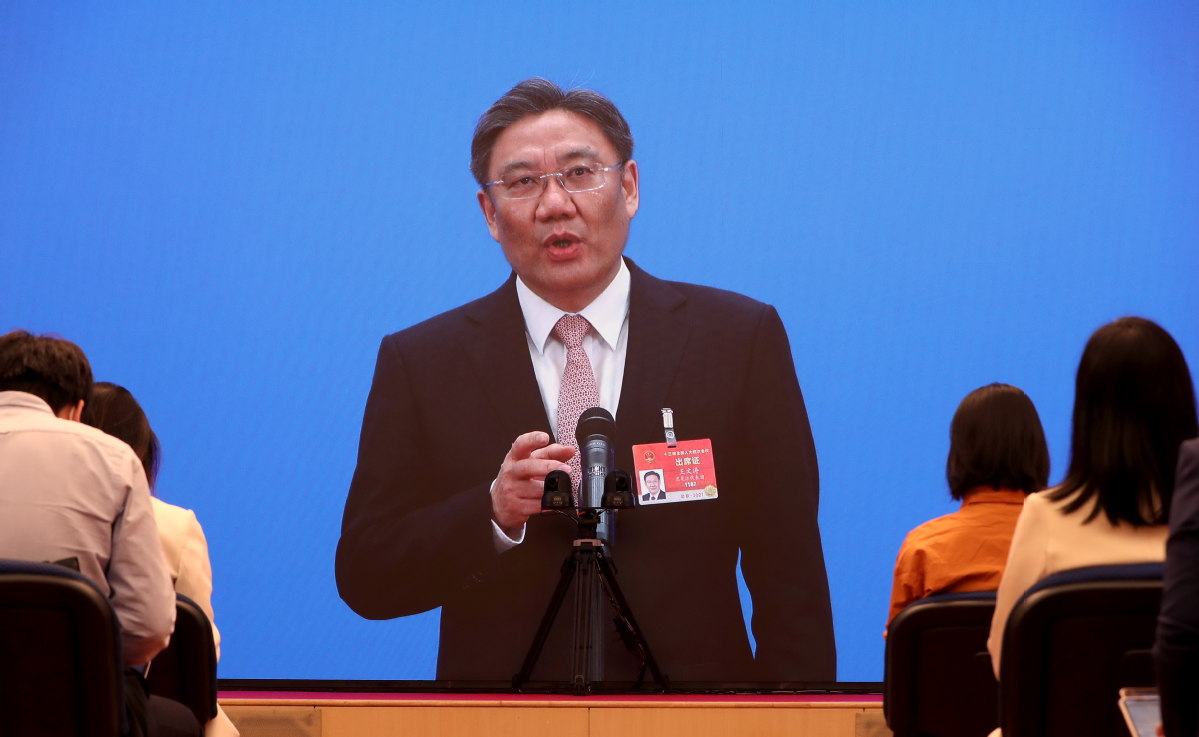
China will leverage high-level openness to promote the dual-circulation development pattern, which should not only help stimulate domestic consumption but attract foreign resources, the country's top commerce official said on Monday.
While expanding domestic demand and ensuring the smooth flow of the internal circulation-the domestic cycle of production, distribution and consumption-China will continue to boost both exports and imports, as well as attract foreign direct investment, thereby strengthening its efforts for global cooperation, said Commerce Minister Wang Wentao.
The official said the dual-circulation paradigm will be the centerpiece of the overall effort and propel China toward sustainable and high-quality growth.
The new pattern has the domestic market as the mainstay of the economy, while domestic and international markets support each other.
He said China has been pushing for the implementation of the Regional Comprehensive Economic Partnership agreement. It is also actively advancing negotiations for a tripartite free trade agreement involving Japan and South Korea. Besides, the country has been actively joining various free trade agreements and investment agreements.
All these efforts have helped form a network of free trade zones, facilitating a high level of global trade liberalization, Wang said.
While China is actively considering to join the Comprehensive and Progressive Agreement for Trans-Pacific Partnership, or the CPTPP, in order to move forward with reform and opening-up across the board, the Ministry of Commerce has conducted a large amount of preliminary work and also established informal contact with the parties concerned.
The CPTPP, which took effect on Dec 30, 2018, is a trade agreement among 11 countries: Australia, Brunei, Canada, Chile, Japan, Malaysia, Mexico, New Zealand, Peru, Singapore and Vietnam. Their aggregate GDP accounts for 13 percent of the global economy.
Since the Chinese economy has been deeply integrated into the world economy, with more intertwined interests than ever before, demand-side management is another practical solution to stabilize foreign trade and foreign investment, said Zhang Yongjun, a researcher at the Beijing-based China Center for International Economic Exchanges.
"The domestic market cannot be separated from the global market and external circulation could boost domestic circulation. This is a key factor of demand-side management," he said.
Sun Yibiao, a member of the 13th National Committee of the Chinese People's Political Consultative Conference, said China should actively participate in digital technology-based trade activities, the tax reform of digital products and services under the World Trade Organization rules, as well as take part in the formulation of related global rules.
In addition to enhancing the protection of digital intellectual property, China should start with the relatively easy-to-reach goals such as the exploration of digital certificates, and the protection of consumer rights and interests to promote the negotiation of new digital trade rules within regions, including economies involved in the Belt and Road Initiative, said Sun, who is also former vice-minister of the General Administration of Customs.
He said China should accelerate the digital transformation of foreign trade to cultivate new business formats and better position its manufacturers in global supply chains.
Digital trade includes products and services delivered in digital form, such as software and cloud computing, as well as forms of trade supported by digital technologies, such as cross-border e-commerce, he said.
The national political adviser said these moves can reinforce the global layout of China's e-commerce platforms and manufacturers, and build more overseas warehouses, exhibition and trade facilities, and service centers to enhance their market presence.
Thanks to its pillar role in supporting the global industrial chain, China's foreign trade soared by 32.2 percent on a yearly basis to 5.44 trillion yuan ($837.3 billion) in the first two months of the year, according to latest data from the General Administration of Customs.