



Plucking the trend









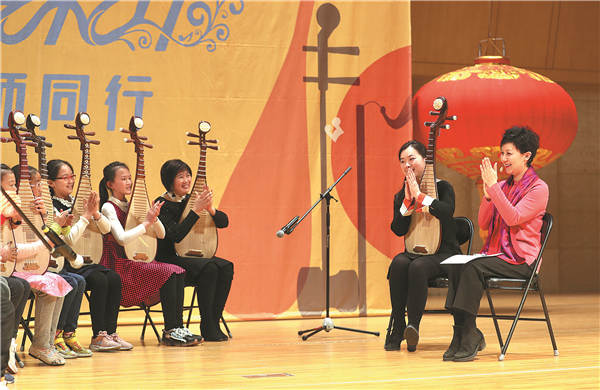
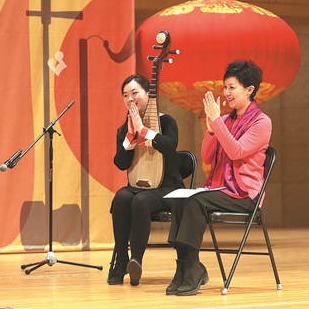
For the winter camp, Zhang arranged ten classes for students of various musical ability and, unlike the summer camp, which usually lasts for a week, she plans to expand the courses into a five-month-long teaching program, consisting of both online and in-person training.
"One of the best parts of offering online courses is that we can reach pipa learners from around the country who don't need to travel to Beijing to attend the classes. Since we have to adjust our plans due to the coronavirus pandemic, we hope to have the students come to play together in the capital in the early summer," says Zhang.
A harp training program, like the pipa, was also launched by the Gateway to Music festival in 2011.Conducted by harpist Wang Guan, who teaches at the Central Conservatory of Music in Beijing, the winter camp also offers online courses to students from different parts of the country.
"It was my first time learning the harp last summer and I am drawn to the musical instrument because it is very beautiful, like a fairy," says Shi Liu, a student from Beijing who attended the harp summer camp last year and has since joined the winter program. "It's more than playing a musical instrument. I have also learned about other art forms, such as ballet and classical music during the classes."
"When we first launched the harp training program during the Gateway to Music festival, there were about 30 students and none of them knew anything about the harp," recalls Wang. "The musical instrument was less well-known in China, compared to other musical instruments, such as the piano and violin. I'm happy to witness the changes and a growing number of harp students over the past few years."
Wang learned to play piano at the age of 3, and the guzheng, or Chinese Zither, at age 4. She was enrolled to study at the primary school affiliated to the Central Conservatory of Music when she was 10. That was when she was first introduced to the harp by her piano teacher.
"Like many harp students, I enjoy the sound of the musical instrument very much and it was a smooth transition for me to learn to play harp," recalls Wang.
As part of the online courses, Wang has selected classic music pieces for the musical instrument.
"We let students share classes together since it's a good way to learn from each other. Though they cannot meet one another in person, the students still make friends," says Wang.




















