Analysis: Decoupling could trim 1% off US GDP









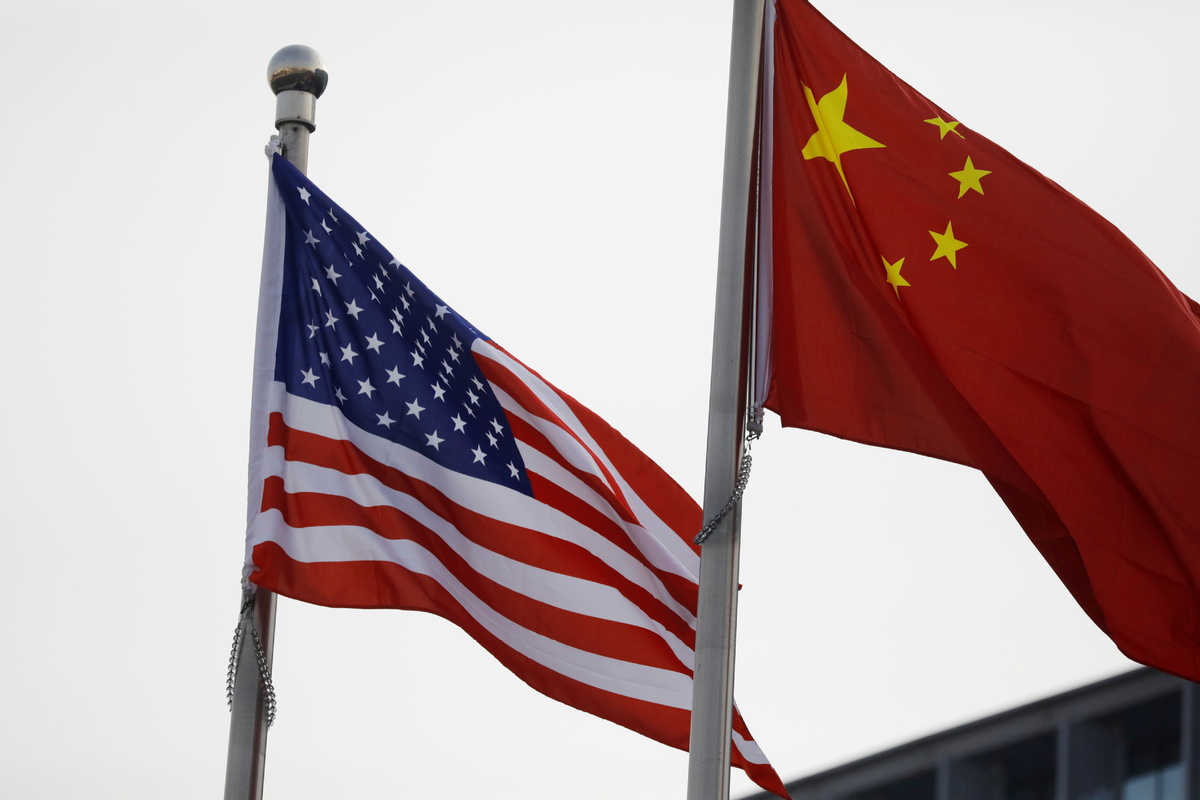
The United States would forgo $190 billion in its gross domestic product annually by 2025, or roughly 1 percent of its GDP at last year's level, if it were to fully decouple with China, a scenario that would force the US aviation industry alone to shed close to a quarter-million jobs, according to an analysis by the US Chamber of Commerce and Rhodium Group.
The projections highlight the potential costs to the American economy at a time when the Biden administration is grappling with a pandemic-battered economy and weighing its policy agenda with China.
"If the US and China were to fully decouple, American businesses and our economy would be significantly impacted, resulting in hundreds of billions in foregone GDP and capital gains losses while undermining US productivity and innovation," the US Chamber tweeted on Thursday about the report released Wednesday.
The first-of-its-kind study, "Understanding US-China Decoupling: Macro Trends and Industry Impacts", seeks to better understand the degree to which the US and Chinese economies are intertwined and dependent on each other for stability and growth, the chamber said in a statement.
The report uses a full decoupling scenario, defined as bilateral flows going to zero, because that provides the most complete look at the potential impact of the current trajectory of the US-China economic relationship, according to the authors of the analysis.
A complete disengagement also would significantly curtail investment, people and idea flows, as well as to key areas of national importance to the US, noted the report.
For example, US investors could lose $25 billion annually in capital gains, and one-time GDP losses could reach $500 billion if US companies reduce cumulative foreign direct investment (FDI) in China by 50 percent.
The COVID-19 pandemic has demonstrated the economic impact from lost Chinese tourism and education spending. If future flows are reduced by half from their pre-pandemic levels, the US would lose between $15 billion and $30 billion a year in services trade exports, according to the analysis.
For the US aviation industry, a loss of access to China, the largest export market for US aircraft, would cause $38 billion to $51 billion in annual output and lead to the US civil aviation manufacturing industry shedding 167,000 to 225,000 jobs, according to the report.
"If we were to try to cut off everything, or the preponderance of our economic engagement with China, (it) would be so expensive that it would make everyone, even the most hawkish Americans and national security professionals, very uncomfortable," Daniel Rosen, founding partner of Rhodium Group, said at a virtual release event for the report.
As US policymakers debate the next phase of US-China engagement, they should consider the major takeaways of the analysis: Data analysis is critical to policymaking, and China policy requires economic-impact assessment, cost-benefit analysis, and a process of public debate and discovery, the chamber and Rhodium Group said in a release.
US President Joe Biden has said his administration would not handle relations with Beijing "the way Trump did", and "we're ready to work with Beijing, when it's in America's interest to do so".
Biden has so far not answered the question of whether he will keep his predecessor's controversial tariffs of up to 25 percent on most Chinese imports, noted Edward Alden, a senior fellow at the Council on Foreign Relations.
Biden's press secretary, Jen Psaki, has said Biden is evaluating tariffs on Chinese goods and wants to coordinate future steps with allies.
Steeply high and sweeping tariffs are one of the hallmark decoupling policies of the Trump administration. US import tariffs, for example, cover more than 75 percent of aviation-related products imported from China.
"The Biden administration should know that a decoupling strategy is not popular with the EU or other US allies," said Gary Hufbauer, a senior fellow and trade expert at the Peterson Institute for International Economics.
"From the Rhodium analysis, it should learn that decoupling is not popular with US business and will ensure higher costs and spark inflation in the US," Hufbauer told China Daily.
In their first phone call last week, Chinese President Xi Jinping told Biden that the two sides should re-establish the various dialogue mechanisms and that the economic and other authorities of the two countries also should have more contacts.
Hufbauer suggested trusted interlocutors, possibly Kurt Campbell, the White House China's coordinator, on the US side, should do what former secretary of state Henry Kissinger did decades ago, and work out a de-escalation path, with the first step being reciprocal removal or reduction of tariffs.