China's manufacturing activity slows in Jan amid COVID-19 resurgence









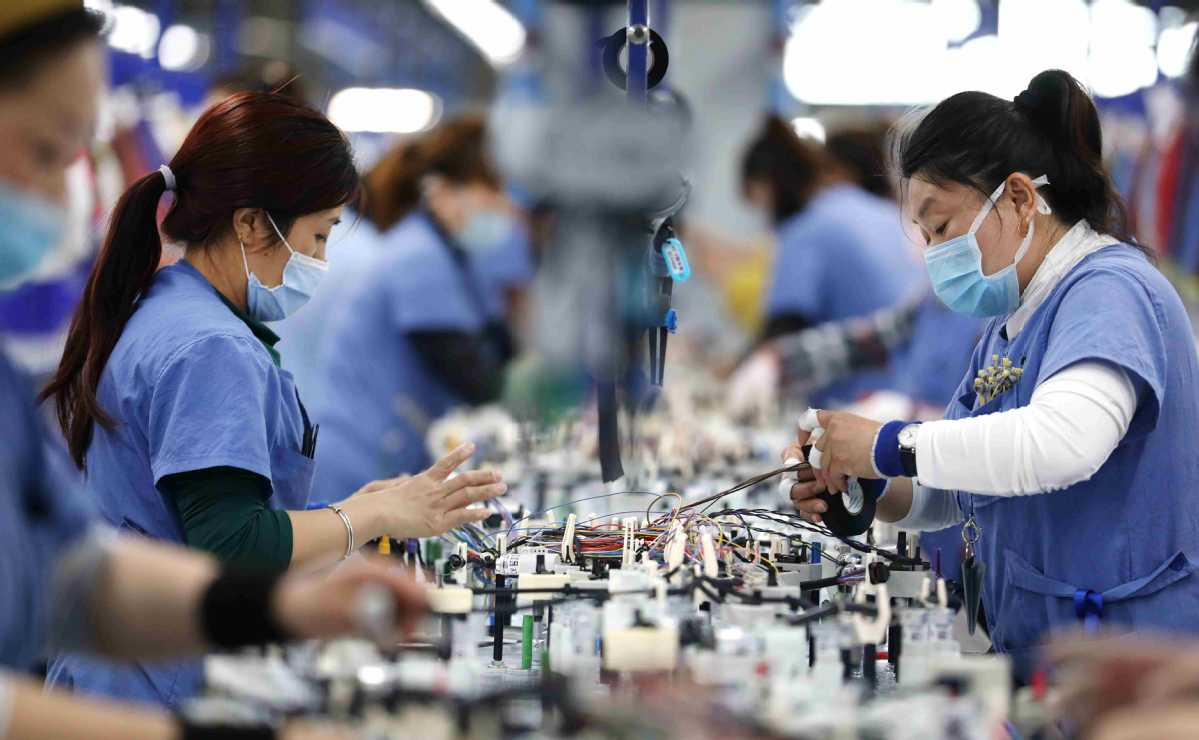
BEIJING - The purchasing managers' index for China's manufacturing sector came in at 51.3 in January, edging down 0.6 percentage points from December, data from the National Bureau of Statistics showed Sunday.
A reading above 50 indicates expansion, while a reading below reflects contraction. The PMI remained in the expansion zone for the 11th consecutive month.
The slowdown came as a series of locally transmitted COVID-19 cases temporarily affected the production and operation of enterprises, NBS senior statistician Zhao Qinghe said, adding that the period around the Spring Festival holiday is traditionally an off-season for factory activities.
The Spring Festival, or the Chinese Lunar New Year, falls on Feb. 12 this year. It is an important occasion for family reunions.
NBS data showed the sub-index for production stood at 53.5 in January, down 0.7 percentage points from December, while that for new orders dropped 1.3 percentage points to 52.3.
The new export order and import sub-indexes edged down to 50.2 and 49.8, respectively.
Sunday's data also showed that the PMI for China's non-manufacturing sector came in at 52.4 in January, down from 55.7 in December, which also remained above 50 for 11 consecutive months.
Some surveyed enterprises reported that the epidemic situation had affected the normal arrival of employees and some workers had returned home early for the Spring Festival, thus widening the shortage in staffing, according to the statistics bureau.
In the next stage, macro policies should maintain continuity, stability and sustainability, consolidate the foundation for an economic rebound, and further promote the accelerated recovery of manufacturing and small enterprises, said Wen Bin, chief analyst at China Minsheng Bank.
The country is expected to coordinate COVID-19 control with personnel mobility to meet the workforce needs of enterprises and improve the quality of employment, Wen said in a research note on the PMI data.
Lu Ting, chief China economist with securities firm Nomura, said that to fight the latest wave of sporadic and cluster COVID-19 cases, Chinese authorities have tightened social distancing measures, reimposed some locality-based lockdown measures and travel bans, and encouraged migrant workers to stay in the cities of their workplaces for the impending Lunar New Year holiday.
Lu said these measures will likely dent the recovery in the services sector, especially the hospitality industry, but may provide a small boost to industrial production and construction in south China in the holiday season, as workers would remain at workplaces.
"We expect some pent-up demand for services in the second quarter, boosting GDP growth by 0.2 percentage points," Lu said.
Last year, China unveiled a series of special measures in response to the epidemic-induced economic fallout. These measures played an important role in stabilizing the Chinese economy amid the ravaging COVID-19 and global economic recession. The country has vowed not to see a "policy cliff" in 2021 as it aims to keep its macro policies consistent, stable and sustainable to support steady economic recovery.
"China's macro policies will be in line with the needs of sustaining stable and sound economic development, and there will be no abrupt turnarounds," Yan Pengcheng, an official with the National Development and Reform Commission, said earlier this month.
Yan underscored the necessity of sustaining supportive measures this year, as some micro, small and medium-sized enterprises have just managed to navigate the COVID-19 slump and still need some time to recover.
But some of the temporary and emergency relief policies cannot be used as "long-term solutions," Yan noted.
With the economy gradually restoring strength, China will make more efforts to stimulate the vitality of market entities via reforms and innovation, which will also provide more space for policymakers to maneuver in the face of a more complicated situation in the future, Yan said.