



Can we revive the Tenants Purchase Scheme while boosting housing supply?









In the last article, we have explained why the Hong Kong government’s claim that the relaunch of the Tenants Purchase Scheme (TPS) will cause the supply of public rental housing (PRH) to shrink in a short period of time is nothing but an exaggeration. (Impact of relaunching tenants purchase plan would be negligible, Dec 17, 2020). Instead, we believe that relaunching the TPS and increasing the supply of public housing are not fish and bear’s paws and in the following, we will explain why.
Relaunching the TPS and tackling the public housing shortage are separate matters. Since the introduction of the TPS in 1998, its aim has been to improve the home ownership rate in Hong Kong, helping low- and middle-income families become homeowners and thereby narrowing the wealth gap. In other words, relaunching the TPS is not about increasing the supply of public housing; its objective is to redress economic inequality and help low-income families get on the property ladder. The scheme has successfully created wealth for more than 140,000 families who bought PRH units at the time. Between 2003 and 2019, the overall property prices in Hong Kong rose by more than five times, while the median household income grew by only 80 percent over the same period. The relaunch of the TPS will allow the remaining 800,000 low-income households living in PRH to benefit from asset appreciation as homeowners.
The government should aim to address both at the same time: by relaunching the TPS, it can build wealth for low-income families and narrow the wealth gap; by adopting a multi-pronged approach to increasing land and housing supply, it can strive to provide a home for all
The government has repeatedly stated that relaunching the TPS will only be considered after the shortage of public housing supply has been addressed. However, it is not realistic to expect that a policy designed for bridging the income gap can tackle public housing inadequacy, because reviving the TPS and boosting housing supply are entirely separate matters.
To limit the number of people on the PRH waiting list and shorten their waiting time, the most effective and reliable measure is to increase the supply of public housing. Unfortunately, in the past seven years, public housing construction has consistently failed to meet the target stated in The Long Term Housing Strategy, with a cumulative shortfall of nearly 82,600 units. Meanwhile, the housing authority still focuses on the 200 flats that will not be recovered each year as a result of the relaunch of the TPS — it really can’t see the forest for the trees.
Tackling a shortage requires a multi-pronged approach and a streamlined process. An adequate supply of available land is a prerequisite for the construction of more public housing units, just as flour is needed to make bread. Therefore, we are certainly pleased to hear the chief executive announce in her Policy Address that the government has identified all of the 330 hectares of land required for the construction of 316,000 public housing units, which will meet the demand for public housing in the next 10 years.
However, there are many hurdles to overcome between the identification of the land and the actual completion of housing. According to our analysis, we have found that the average development time for public housing projects is 10 years, with the longest one spanning over 15 years. Even after sites have been successfully rezoned for residential use, the projects can still suffer substantial delays due to complex bureaucratic procedures. For this reason, we are also glad to see that the Policy Address has proposed a review of the administrative procedures for public housing development, with a view to removing barriers and streamlining the process.
Meeting the demand for public housing in the next 10 years is only the first step. To provide a secure home for all Hong Kong people in the long run, a multi-pronged approach must be adopted to increase land supply, for example, by expediting the Lantau Tomorrow Vision, a massive reclamation scheme. Only by increasing the supply of land for housing substantially can we hope to accommodate all those on the PRH waiting list, or even follow the example of the Singaporean government and sell public housing units at an affordable price to the vast majority of Hong Kong people.
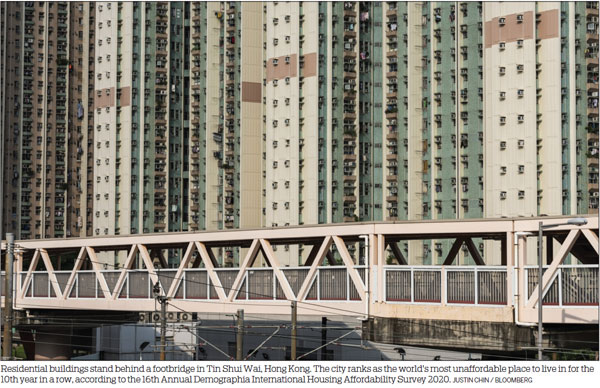
Whilst boosting housing supply, we also need to bridge the wealth gap. On the one hand, Hong Kong has the biggest gap between rich and poor among the developed economies. On the other hand, the chronic shortage of housing supply has not only made Hong Kong’s property prices the most unaffordable in the world, but also caused the waiting time for PRH to reach record highs, evidence of our acute housing crisis. A yawning wealth gap and a critical housing shortage are equally urgent social problems, so it makes little sense for the government to prioritize one over the other. The government should aim to address both at the same time: by relaunching the TPS, it can build wealth for low-income families and narrow the wealth gap; by adopting a multi-pronged approach to increasing land and housing supply, it can strive to provide a home for all.
Ryan Ip Man-ki is head of the Land and Housing Research, and Koby Wong Lok-yin is an assistant researcher at Our Hong Kong Foundation.
The views do not necessarily reflect those of China Daily.





