Green energy key to speeding up China's emissions reduction









Country aims to become carbon neutral before 2060
China's auto industry is expected to play a pivotal role in the country hitting peak carbon dioxide emissions by 2030 and achieving carbon neutrality by 2060, through the continued development of new energy vehicles, according to industry experts and officials at the recently held EV100 Forum in Beijing.
China's carbon peak and carbon neutrality targets directly feed into the development of renewable energy, Wan Gang, president of the China Association of Science and Technology said at the forum.
Electric and hydrogen power in particular are major players in the drive for zero emissions, and can be widely used across all sectors of the economy.
The automobile industry can play an important role in reducing carbon emissions and with increased financial support can have the capacity for an even greater influence on greater markets, according to Wan.
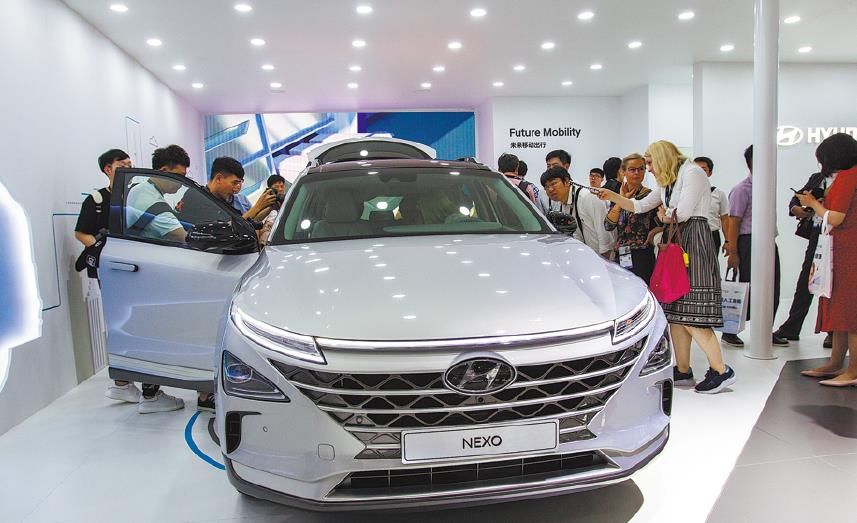
Fuel cells are already having an impact on many industries in China, with fuel cell driven light rail and submarine applications as well as in passenger and commercial vehicles. Hydrogen and photovoltaic power are being used in varied industrial applications and in construction.
According to official statistics, medium and heavy commercial vehicles account for 5 percent of the vehicle ownership in China, but their particulate and nitrogen oxide emissions account for 68 and 90 percent respectively in the country. Fifty percent of all carbon dioxide emissions are the result of the consumption of refined oil.
Therefore, it is very important to promote the use of hydrogen fuel cells in commercial vehicles to reach a carbon peak and achieve carbon neutralization sooner, Wan said.
Early this month, Hyundai Motor Group announced the building of its first overseas hydrogen fuel-cell system production plant in Guangzhou, capital of South China's Guangdong province.
Hyundai has inked deals with many Chinese companies in the Yangtze River Delta and the Beijing-Tianjin-Hebei region, with 4,000 hydrogen fuel-cell trucks to be delivered in total by 2025.
The company has focused on research and developing hydrogen fuel-cell systems since 1998.
China has released plans to promote the development of hydrogen energy and plans to have 1 million hydrogen fuel-cell vehicles on the road by 2030, with at least 1,000 hydrogen refueling stations.
Ouyang Minggao, vice-president of China EV100, said that over the next decade efforts need to be made to reduce the costs of hydrogen technology, hydrogen storage and transportation.
Electric technology also has an important part to play in reducing emissions.
According to Wang Hao, general manager of Tesla China, its vehicles had saved 5.64 billion liters of gas and reduced 16.96 million metric tons of carbon dioxide emissions globally by the end of 2020.
Tesla's super-charging pile factory in China will be put into operation this year, with a production capacity of 10,000 annually, he said.
According to the China Association of Automobile Manufacturers, the country sold 25.31 million vehicles last year, down 1.9 percent, however, the sales of new energy vehicle reached 1.37 million in 2020, up 10.9 percent year-on-year.
Miao Wei, former minister of industry and information technology, said at the forum that China's new energy vehicle market has good development momentum with production and sales both ranked top worldwide.
"Meanwhile, we should note that China's NEV sales accounted for 5.4 percent of total car sales last year. But it currently lags behind the European Union in terms of NEV take-up, with 9.9 percent of total EU car sales in the first three quarters of 2020 being NEVs," Miao added.