


Discovery gives archaeologists deeper insight into region's nomadic past









Archaeologists have uncovered a housing site dating back about 3,300 years in Northwest China's Xinjiang Uygur autonomous region.
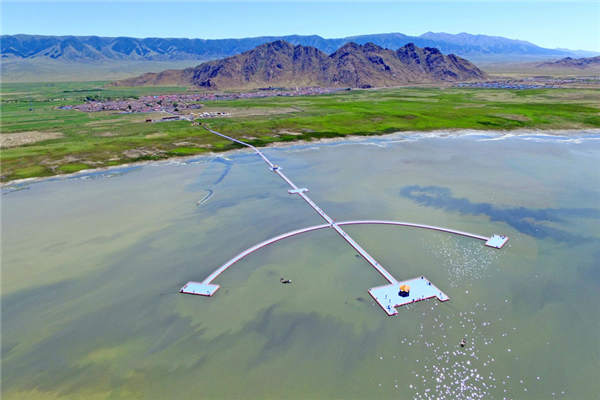
The site, spread over some 1,240 square meters and consisting of 12 rooms including an anteroom, a kitchen and a warehouse, was discovered in the Barkol Kazak autonomous county.
It appears to have been renovated, used and abandoned at least three times, according to Ren Meng from Northwest University in Xi'an, Shaanxi province, who is a leading member of the archaeological team.
The first use of the site was estimated at sometime between 1300 BC and 1100 BC, and the second from 1100 BC to 900 BC. During the first two occupancies, the structure of the site remained basically unchanged.
Archaeologists identified the location of the kitchen on the basis of excavated relics, such as stoves, ash pits as well as barley in pottery containers, and deduced the positions of the main room and warehouse by analyzing the layout, wall structure and unearthed relics.
"We have decided to call the site 'the luxury lake-view house' because it features a complicated structure and is located near the Barkol Lake," Ren says.
Excavations have revealed that by the time the site was rebuilt and used for the third time-from 900 BC to 800 BC-the walls of the house had been buried and turned into earthen mounds. Additionally, two artificial platforms were built atop the mounds.
Based on fragmented pottery, barley, as well as traces of fire use, archaeologists speculated that the site at that time was no longer a house with high walls, but had tent-like structures set up on the platforms.
"Both the tent-style structures built to replace the original house and the rough pottery discovered there indicate people seemingly had opted for a nomadic lifestyle during that period," Ren says.
To explore the impact of environmental changes on human activities, the archaeological team and the department of geology at Northwest University conducted a study on the changes in the surface of the Barkol Lake.
The study found that before 1000 BC, the water level of the lake was much higher than today, and the local climate was relatively warm and humid. After 1000 BC, the lake began to recede, the climate became dry and cool, and drought-resistant plants began to grow on the grassland.
"It is likely that, in the process of climate change, people at that time found their original lifestyle unsustainable, so they gradually embraced a nomadic life," says Ren, adding that the discovery is of great significance and key to ascertaining the origin of the nomadic economy in the region.